
A duplex investment is defined as a single residential property containing two separate living units, each with its own entrance, kitchen, and bathroom, sold together under one deed. This structure lets you collect dual rental income from one purchase while qualifying for residential mortgage financing instead of the costlier commercial loans that apply to five or more units. For real estate investors and potential landlords, that combination is rare. You get two income streams, one loan, and a manageable property size that does not require a property management company to run. This guide covers what a duplex investment is, how to finance one, and how to generate consistent rental income from it in 2026.
What is a duplex investment and why does it matter?
A duplex is a single residential structure with two fully separate living units sharing one foundation, one roof, and one deed. Each unit has its own front door, kitchen, bathroom, and utility connections. The property sells and finances as one transaction, not two. That single-deed structure is what keeps duplexes inside the residential financing world, where rates are lower and terms are longer than commercial loans.
The industry term for this asset class is "small multifamily," covering properties with two to four units. Duplexes sit at the entry point of that category. Investors who understand this distinction gain access to financing products, including 30-year fixed rate mortgages, that are not available to buyers of five or more unit buildings. That financing advantage is the core reason duplexes attract first-time investors and experienced landlords alike.

House hacking is the most common use case for duplex investment properties. You buy the duplex, live in one unit, and rent the other. The rental income offsets your mortgage payment, sometimes covering a substantial portion of your total housing cost. That setup lets you build equity while someone else helps pay your mortgage.
What are the main benefits of investing in duplex properties?
Duplex investments deliver several advantages that single-family homes cannot match.
- Dual rental income. Two units mean two rent checks. If one tenant moves out, the other unit still generates cash flow. Vacancy risk drops significantly compared to a single-family rental where one vacancy means zero income.
- Residential financing. Properties with one to four units qualify for conventional and government-backed mortgages. Those products carry lower interest rates and longer repayment terms than commercial loans, which typically have higher rates and balloon payment structures.
- Tax advantages. Duplex owners can deduct maintenance, repairs, utilities, and depreciation on the rented portion of the property. When one unit is owner-occupied, you also access homeowner tax benefits simultaneously. That double-dip tax position is not available with pure commercial or pure single-family properties.
- Shared structure savings. One roof and one foundation cover both units. Maintenance costs per unit are lower than owning two separate single-family homes.
- Equity growth. Rental income from the second unit accelerates mortgage paydown and builds equity faster than a standard owner-occupied home.
Pro Tip: Run your duplex numbers with a dedicated deal analyzer before you make an offer. Knowing your projected net operating income upfront prevents you from overpaying for a property that looks good on the surface.
The house hacking strategy deserves special attention. Investors who live in one unit and rent the other report that rental income can cover a large share of total housing costs. That reduction in personal living expenses frees up capital for future investments. It also puts you on-site to manage the property directly, which cuts management fees entirely.
How do financing options work for duplex investments?
Financing a duplex follows residential mortgage rules as long as the property has four or fewer units. That rule is the single most important fact in duplex investing. Cross that threshold to five units and you enter commercial lending, where rates rise, terms shorten, and qualification criteria tighten considerably.
- FHA loans. Owner-occupants can purchase a duplex with as little as 3.5% down using an FHA loan. The 2026 FHA duplex loan limit reaches approximately $693,050 in many markets. You must commit to living in one unit for at least 12 months. Violating that occupancy requirement creates loan qualification problems and potential penalties.
- Conventional investment loans. If you are not living in the property, conventional lenders typically require 15–25% down. Credit score requirements are stricter, and the interest rate will be slightly higher than an owner-occupied loan.
- Rental income credit. Lenders count only 75% of projected rents when calculating your qualifying income. That conservative credit means your actual buying power is lower than the gross rent numbers suggest. Many investors overestimate what they can borrow because they use 100% of projected rent in their own calculations.
- 30-year fixed rate mortgages. Duplexes qualify for 30-year fixed financing, a product unavailable to commercial multifamily buyers. That long amortization period keeps monthly payments manageable and protects cash flow.
Pro Tip: Before applying for a loan, calculate your qualifying income using the 75% rental income rule. Subtract that number from your expected mortgage payment to see your true monthly exposure. Surprises at closing are expensive.
The FHA 12-month occupancy rule is a firm commitment, not a suggestion. Plan your exit from owner-occupancy carefully. After 12 months, you can move out, rent both units, and refinance into a conventional investment loan if your equity position supports it.
What strategies generate the best duplex rental income?
The right strategy depends on your personal situation and financial goals. Two core approaches cover most investors.
Living in one unit. House hacking reduces your personal housing cost while you learn landlord skills in a low-risk environment. You handle tenant issues directly because you live next door. That proximity builds practical experience faster than any course or book. Investors who start with house hacking consistently report that the hands-on experience prepares them for larger multifamily properties later.
Renting both units. Pure investment mode maximizes cash flow. Both units generate income, and you live elsewhere. This approach requires a larger down payment because you lose access to FHA owner-occupant rates. The cash flow upside is higher, but so is your out-of-pocket cost at purchase.
Regardless of which approach you choose, these operational practices protect your returns:
- Screen tenants thoroughly. Credit checks, income verification, and rental history reviews reduce the chance of late payments and evictions.
- Budget for vacancies. Keep one to three months of mortgage payments in reserve at all times. Vacancies happen even in strong rental markets.
- Account for maintenance. Older duplexes especially need regular capital expenditure budgets for roofing, plumbing, and HVAC systems.
- Understand local zoning. Urban markets generally favor duplex availability, while many suburban areas restrict multifamily construction. Your location choice directly affects both purchase price and rental demand.
- Check insurance requirements. Duplex insurance differs from standard homeowner policies. Landlord policies cover rental income loss, liability, and structure. Confirm your coverage before closing.
Location drives rental income more than almost any other factor. A duplex in a high-demand rental market with low vacancy rates will outperform a cheaper duplex in a slow market every time.
How do duplexes compare with single-family homes and larger multifamily properties?
Duplexes occupy a specific position in the investment property spectrum. Understanding where they sit helps you decide whether they fit your goals.
| Property type | Income streams | Financing type | Typical down payment | Vacancy risk |
|---|---|---|---|---|
| Single-family home | 1 | Residential | 5–20% | High (all-or-nothing) |
| Duplex | 2 | Residential | 3.5–25% | Moderate |
| Triplex or fourplex | 3–4 | Residential | 3.5–25% | Lower |
| 5+ unit multifamily | 5 or more | Commercial | 20–35% | Lowest per unit |
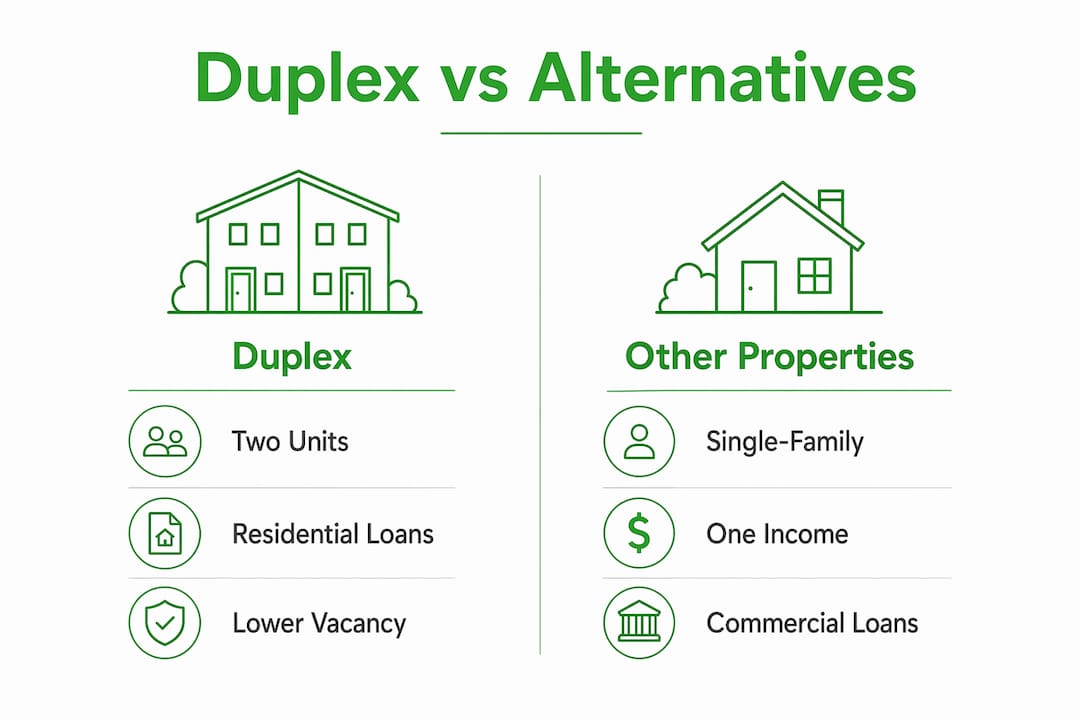
Single-family rentals generate one income stream. One vacancy means zero rental income. A duplex cuts that risk in half. Even if one unit sits empty for a month, the other unit continues to pay. That income diversification is the primary reason duplexes outperform single-family rentals on a risk-adjusted basis for most investors.
Larger multifamily properties with five or more units offer more income streams but require commercial financing. Commercial loans carry higher interest rates, shorter terms, and larger down payments. The jump from four units to five units is the most significant financing cliff in real estate investing. Duplexes stay safely on the residential side of that cliff.
Condos and townhouses sometimes offer comparable price points, but they come with HOA fees and restrictions that reduce your control over the property. Duplexes typically have no HOA, which means lower ongoing costs and full authority over rental decisions, renovations, and tenant selection.
Purchase price per square foot for duplexes runs higher than single-family homes in most markets. The trade-off is a better rental income yield and lower vacancy exposure. For investors focused on cash flow rather than pure appreciation, that trade-off is worth it.
Key Takeaways
A duplex investment is the most accessible entry point into multifamily real estate, combining residential financing with two income streams and manageable operational complexity.
| Point | Details |
|---|---|
| Core definition | A duplex is one property with two units, one deed, and residential financing eligibility. |
| Financing advantage | FHA loans allow 3.5% down for owner-occupants; the 2026 duplex limit reaches about $693,050. |
| Rental income credit | Lenders count only 75% of projected rents, so calculate your real buying power before applying. |
| House hacking benefit | Living in one unit and renting the other reduces personal housing costs and builds landlord skills. |
| Vacancy risk reduction | Two income streams cut vacancy risk compared to single-family rentals where one vacancy means zero income. |
Why I think duplexes are the most underrated first investment
Most new investors chase single-family homes because they feel familiar. That instinct costs them money. A duplex gives you the same residential financing, the same manageable size, and double the income potential. The learning curve is steeper because you are managing tenants, but that is exactly the point.
The investors I respect most started with a duplex and house hacked their way into their first rental portfolio. They learned to screen tenants, handle maintenance calls, and read a rent roll while their tenant covered most of their mortgage. That experience is worth more than any real estate course. When they moved on to triplexes and fourplexes, they were not guessing. They had already done the work.
The tax position alone makes duplexes worth serious consideration. Deducting expenses on the rental unit while claiming homeowner benefits on your own unit is a dual tax advantage that most investors overlook until their accountant points it out at year end. Build that into your analysis from day one.
My honest advice: if you are sitting on enough cash for a single-family down payment, run the duplex numbers first. The extra complexity is manageable. The extra income stream is real. And the financing terms are identical.
— ARX
Deal-zilla tools for duplex investors
Real estate investors who run their numbers before making an offer consistently outperform those who rely on gut feel. Deal-zilla gives you the tools to do exactly that.

The Deal-zilla platform includes a Deal Analyzer, Rent Analyzer, and BRRR calculator built specifically for investors evaluating income properties like duplexes. You can model projected rental income, estimate cash flow after expenses, and stress-test your numbers against vacancy and maintenance scenarios. The Section 8 Investment Analyzer and real HUD rate data let you evaluate government-assisted rental income potential on any duplex you are considering. Run your deal before you run to the closing table.
FAQ
What is a duplex investment in simple terms?
A duplex investment is a single property with two separate living units, each with its own entrance and kitchen, purchased under one residential mortgage. Investors collect rent from one or both units while building equity through a single loan.
Can I use an FHA loan to buy a duplex?
Yes. Owner-occupants can use an FHA loan to buy a duplex with as little as 3.5% down, subject to a 12-month occupancy requirement and the 2026 FHA duplex loan limit of approximately $693,050 in many markets.
How does rental income affect my mortgage qualification?
Lenders typically credit only 75% of projected rental income toward your qualifying income. That means your actual loan eligibility is lower than the gross rent figures suggest, so calculate carefully before applying.
Is a duplex better than a single-family rental?
A duplex reduces vacancy risk because two units generate income instead of one. If one unit is vacant, the other still pays. Single-family rentals produce zero income during a vacancy, making duplexes a stronger cash flow investment for most landlords.
What is house hacking with a duplex?
House hacking means living in one unit of your duplex and renting the other. The rental income offsets your mortgage payment, reducing your personal housing cost while you build equity and gain hands-on landlord experience.