
Fix and flip is defined as a real estate investment strategy where an investor purchases a distressed or undervalued property, renovates it, and sells it for a profit within a short time frame. The industry term is "house flipping," and it sits firmly in the short-term, active-investment category. Unlike buy-and-hold investing, this approach demands hands-on project management, tight financial controls, and a clear exit plan before you ever close on a property. The 70% rule governs deal selection, hard money loans fund most acquisitions, and your profit is determined long before the first nail goes in. Understanding the fix and flip strategy explained here will help you approach each deal as a business decision, not a renovation project.
What is the 70% rule and how does it guide fix and flip investments?
The 70% rule is the most widely used financial baseline in house flipping. It states that your total acquisition cost plus renovation budget must not exceed 70–75% of the After Repair Value (ARV). That buffer covers holding costs, selling expenses, and your profit margin.
Here is how the formula works in practice:
- Estimate the ARV using recent comparable sales within a quarter mile, closed within the last 90 days.
- Multiply the ARV by 0.70 to get your maximum all-in cost.
- Subtract your estimated renovation budget from that number.
- The result is your maximum allowable purchase price (MAP).
Example: A property has an ARV of $300,000. Multiply by 0.70 to get $210,000. If renovation costs run $50,000, your MAP is $160,000. Paying more than that compresses your margin to the point where exit costs erase the profit.
The rule accounts for holding and selling costs typically estimated at 8–10% of the final sale price. That includes agent commissions, closing costs, property taxes, insurance, and loan interest. Ignoring these line items is the most common beginner error.

The 70% rule is not a ceiling for ambition. It is a floor for discipline. In 2026, with gross flipping returns at their tightest levels in over a decade, some experienced investors tighten the formula to 65% in slower markets or when renovation scope is uncertain.
Pro Tip: Never use list price to estimate ARV. Use only closed sales. Active listings reflect seller hope, not market reality.
How to effectively analyze and budget a fix and flip deal
Deal analysis starts with ARV, and ARV starts with data. Pull closed comparable sales within 90 days, within a quarter mile, and with similar square footage and condition. Avoid using pending sales or active listings as comps. The ARV you calculate determines every other number in your budget.
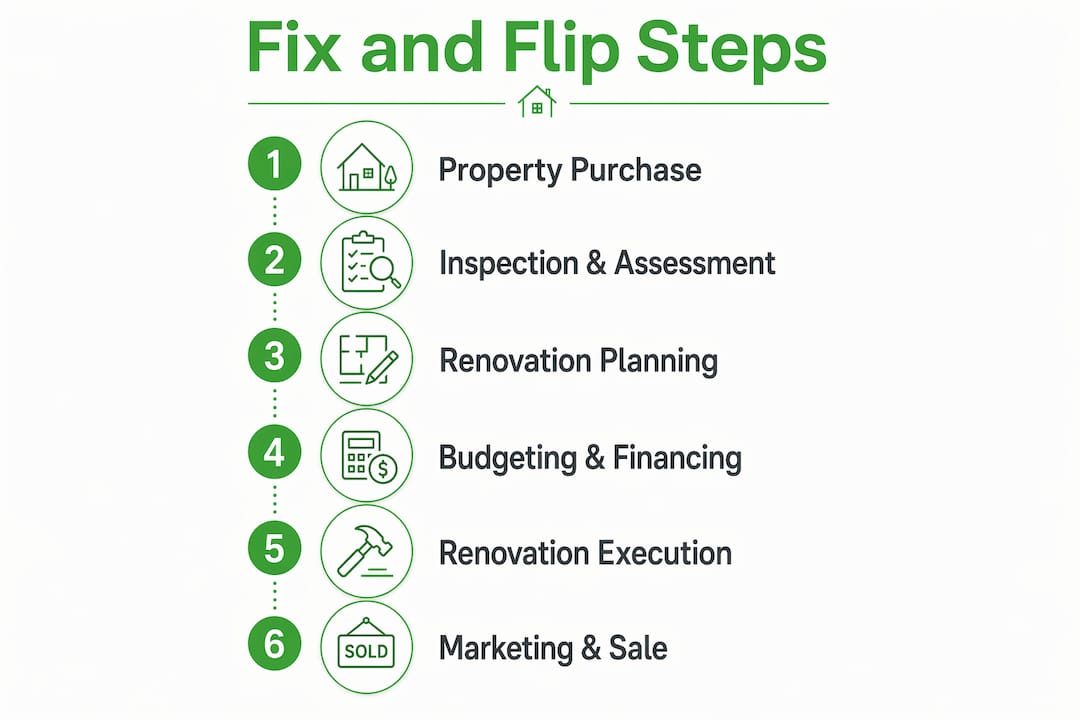
Renovation budgeting
Renovation budgeting is where most investors lose money. The biggest profit killers are not material costs. They are scope creep and labor delays. A cosmetic rehab can balloon into a full systems overhaul once demolition reveals outdated wiring or failed plumbing. Pad your renovation budget by 15–20% as a contingency. That buffer is not pessimism. It is math.
Key budget line items to include:
- Acquisition costs: Purchase price, closing costs, inspection fees
- Renovation costs: Labor, materials, permits, and a 15–20% contingency
- Holding costs: Loan interest, property taxes, insurance, and utilities for the full projected hold period
- Selling costs: Agent commissions (typically 5–6%), title fees, and closing costs
Deal break-even example
| Line Item | Estimated Cost |
|---|---|
| Purchase price | $160,000 |
| Renovation budget | $50,000 |
| Holding costs (5 months) | $12,000 |
| Selling costs (6% of ARV) | $18,000 |
| Total all-in cost | $240,000 |
| ARV | $300,000 |
| Projected gross profit | $60,000 |
This example shows a $60,000 gross profit on a $300,000 ARV deal. That margin shrinks fast if renovation runs over or the property sits on the market longer than planned.
Detailed pre-close rehab scopes reduce budget overruns more than any other single practice. Walk the property with your contractor before closing, not after. Get line-item bids, not ballpark estimates. The money in flipping is made in the spreadsheet, not the tool belt.
Pro Tip: Use a dedicated deal analyzer to model multiple scenarios before you make an offer. Adjust ARV down by 5% and renovation costs up by 20% to stress-test the deal.
What financing options are available for fix and flip investors?
Hard money loans are the primary financing tool for house flipping. These are asset-based loans that focus on deal viability rather than borrower income or credit score. They close in 7–15 days, which matters when competing for distressed properties.
Key characteristics of hard money financing:
- Interest rates: Typically around 8.50%, though rates vary by lender and market
- Loan-to-Cost (LTC): Up to 95% of total project cost in some programs
- Loan-to-Value (LTV): Capped at 70% of ARV
- Loan terms: Generally 6–18 months, aligned with typical flip timelines
- Draw schedules: Funds released in stages tied to renovation milestones
Draw schedules tied to milestone completions protect both the lender and the investor. They prevent overpaying contractors upfront and keep the project moving in defined phases. Releasing funds only after verified work completion reduces financial exposure significantly.
Conventional mortgages are not suited for fix and flip projects. Lenders require the property to be in livable condition, and the 30-year amortization structure does not fit a 5-month hold. Private bridge loans from individual investors offer a middle ground, often with more flexible terms than institutional hard money lenders.
Cash offers close fastest and eliminate financing costs entirely. Many experienced flippers start with hard money loans and transition to self-funding as capital builds. Every dollar saved on interest and origination fees goes directly to the bottom line.
Pro Tip: Always model your financing costs at the high end of the interest range. If the deal works at 12%, it definitely works at 8.5%.
What does a fix and flip project timeline look like?
Fix and flip projects typically run 4–6 months from purchase to closing on the sale. Experienced operators complete cosmetic rehabs in 90–120 days, but modeling for 120–150 days protects your budget against the delays that almost always occur.
A realistic project sequence looks like this:
- Weeks 1–2: Close on the property, pull permits, and finalize contractor agreements.
- Weeks 3–6: Demolition and rough work, including structural, electrical, and plumbing.
- Weeks 7–12: Finish work, including drywall, flooring, fixtures, and paint.
- Weeks 13–16: Final inspections, punch list, staging, and professional photography.
- Weeks 17–20: Active listing, showings, offer negotiation, and buyer due diligence.
- Weeks 21–24: Buyer financing, appraisal, and closing.
Every week of delay adds holding costs. On a $200,000 hard money loan at 10% annual interest, each additional month costs roughly $1,667 in interest alone. Add taxes, insurance, and utilities, and a two-month delay can erase $5,000–$8,000 in profit.
Staging and professional photography reduce days on market. A well-staged property photographs better, attracts more showings, and generates stronger offers faster. The cost of staging is almost always recovered in a faster, higher-priced sale.
Pro Tip: Order your permits the day you close. Permit delays are the single most common cause of project overruns, and they are entirely within your control to start early.
What are common fix and flip mistakes and how can they be avoided?
Flipping is speculative and high-risk, comparable in volatility to day trading. The investors who succeed treat it as a business with defined processes, not a series of one-off gambles. The most common mistakes follow predictable patterns.
Common pitfalls to avoid:
- Overimproving the property: Installing $80,000 kitchens in a $250,000 ARV neighborhood destroys margins. Renovate to the neighborhood standard, not above it.
- Ignoring carrying costs: Exit friction including commissions, closing costs, and carrying time can reduce profits drastically. Model every cost before you make an offer.
- Optimistic timelines: Modeling a 90-day flip when the realistic timeline is 150 days understates holding costs by thousands of dollars.
- Competing on the MLS: Off-market sourcing produces better margins. MLS deals are priced for retail buyers, not investors.
- No exit strategy: If the property does not sell at your target price, you need a backup plan. Renting or refinancing into a long-term hold preserves capital when the market softens.
Scope creep is the silent profit killer. A project that starts as a cosmetic rehab can become a full gut renovation the moment demolition reveals hidden problems. The investor who budgets for surprises survives. The one who assumes a clean project does not.
Conservative budgeting and realistic timelines are not signs of inexperience. They are the habits that separate investors who build wealth from those who break even.
Key Takeaways
A successful fix and flip requires conservative cost modeling, disciplined deal selection using the 70% rule, and a detailed renovation scope completed before closing.
| Point | Details |
|---|---|
| Apply the 70% rule | Keep total costs at or below 70% of ARV to protect profit after selling expenses. |
| Budget for overruns | Pad renovation estimates by 15–20% to absorb scope creep and labor delays. |
| Model realistic timelines | Plan for 120–150 days of renovation plus 60 days to close the sale. |
| Source off-market deals | MLS properties are priced for retail buyers; off-market deals produce better investor margins. |
| Know your exit options | If the property does not sell, have a rent or refinance plan ready to protect capital. |
What I have learned from years of watching flips succeed and fail
The investors I have seen succeed consistently share one habit: they finish their spreadsheet before they start their renovation. The ones who lose money almost always made the same mistake in reverse. They fell in love with a property, estimated costs loosely, and started swinging hammers before the numbers were solid.
The 70% rule is not a formula you apply once and forget. It is a discipline you apply to every single deal, even when the property looks like a sure thing. Especially then. The deals that feel obvious are often the ones where everyone else has already priced in the upside.
Off-market sourcing changes the math entirely. When you buy a property before it hits the MLS, you are not competing with retail buyers who will pay full price. You are buying at a discount that gives your renovation budget room to breathe. That margin is where real profit lives.
Managing contractors is a skill that takes time to develop. Pay on completion, not upfront. Hold back the final draw until the punch list is signed off. Set clear timelines in writing before work begins. These are not adversarial tactics. They are the professional standards that keep projects on schedule.
Treat every flip as a business with a defined budget, a defined timeline, and a defined exit. The investors who approach it that way build repeatable systems. The ones who treat it as speculation get one good flip and one expensive lesson.
— ARX
Deal-zilla gives fix and flip investors a real edge
Running the numbers on a fix and flip deal by hand takes time and leaves room for error. Deal-zilla gives real estate investors a purpose-built platform to analyze deals, model renovation budgets, and track project performance from offer to closing.

The Deal-zilla deal analyzer lets you input ARV, renovation costs, financing terms, and holding costs to see your projected profit in real time. Adjust any variable and the model updates instantly. That kind of scenario modeling is what separates investors who close confidently from those who guess and hope. Whether you are evaluating your first flip or your fiftieth, Deal-zilla gives you the financial clarity to make better decisions faster.
FAQ
What is a fix and flip in real estate?
A fix and flip is a short-term investment strategy where an investor buys a distressed property, renovates it, and sells it for a profit. The typical hold period runs 4–6 months from purchase to sale closing.
How does the 70% rule work for house flipping?
The 70% rule states that your purchase price plus renovation costs must not exceed 70% of the property's After Repair Value. That buffer covers holding costs, selling expenses, and your target profit margin.
What financing do most fix and flip investors use?
Hard money loans are the most common financing tool, with interest rates around 8.50% and loan terms of 6–18 months. These asset-based loans close in 7–15 days, making them practical for competitive acquisitions.
What are the biggest mistakes in fix and flip investing?
The most costly mistakes are underestimating renovation costs, ignoring carrying costs, and modeling timelines that are too short. Padding your renovation budget by 15–20% and planning for 120–150 days of hold time prevents most of these losses.
How do I find good fix and flip deals?
Off-market sourcing consistently produces better margins than MLS deals. Target properties through direct mail, wholesalers, or distressed owner outreach to avoid competing with retail buyers who drive up prices.