
Forced appreciation is the process of actively increasing your rental property's value through targeted improvements and management strategies, rather than waiting for market conditions to do the work. Unlike natural appreciation, which depends on local economic trends, forced appreciation puts you in control. Real estate investors who master this approach use it to raise net operating income (NOI), push cap rate valuations higher, and build equity on their own timeline. This guide covers the upgrades, operational tactics, and financial metrics that make force appreciation rental property strategies work in practice.
What is forced appreciation and why does it matter for rental investors?
Forced appreciation is the investor-driven increase in a property's value created by deliberate actions, not market drift. Natural appreciation happens when the surrounding market rises. Forced appreciation happens when you raise rents, cut expenses, or improve the property in ways that directly increase NOI.
Income properties are valued differently than owner-occupied homes. Lenders and appraisers use the income approach: property value equals NOI divided by the local cap rate. That math is the engine behind forced appreciation. Raising NOI by $200,000 in a 5% cap rate market adds $4,000,000 in property value. That is not a market trend. That is a decision you make.

For rental investors, this distinction matters enormously. You cannot control interest rates or neighborhood demand. You can control whether your units have in-unit laundry, whether your utility costs are billed back to tenants, and whether your rents are priced at market. Each of those decisions moves NOI, and NOI moves value.
The core levers of forced appreciation include:
- Physical upgrades that justify higher rents or attract better tenants
- Operational improvements that reduce expenses and vacancy
- Rent optimization that closes the gap between current and market rents
- Repositioning that changes the property's tenant profile or market class
Investors who treat forced appreciation as a system, not a one-time renovation, build equity faster and with more predictability than those who wait for the market to reward them.
Which upgrades deliver the best return for forced appreciation?
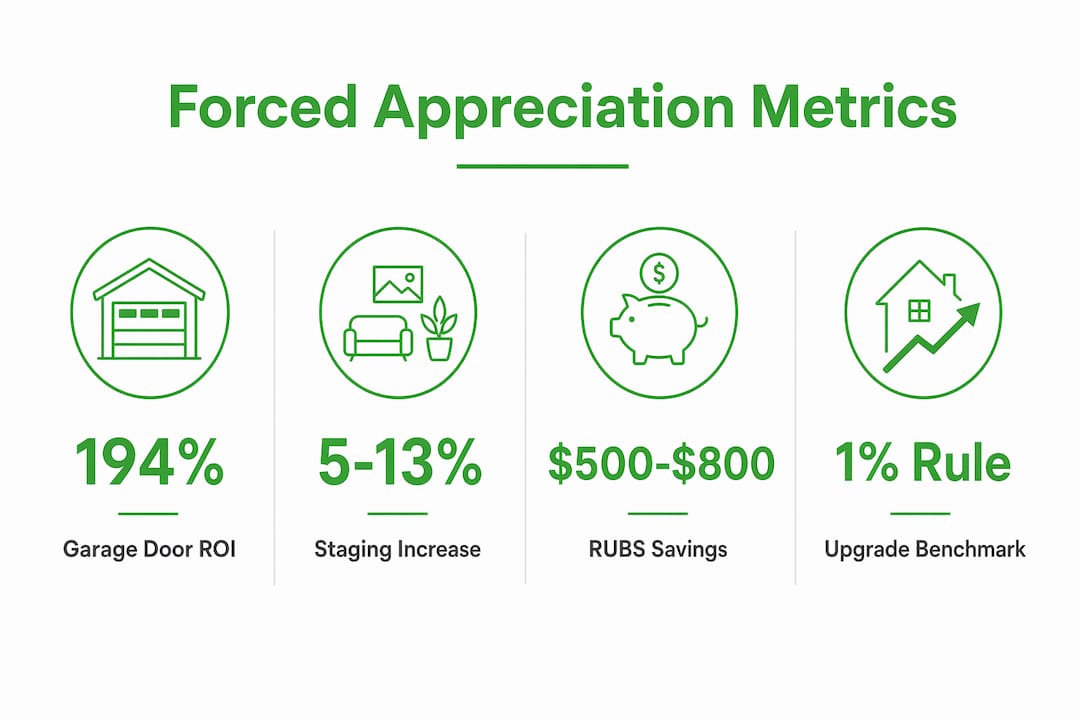
The 1% rule is the clearest filter for evaluating physical improvements. Any capital improvement should generate at least 1% of the total project cost in additional monthly rent. A $10,000 kitchen refresh needs to produce at least $100 per month in higher rent to clear the bar. Payback periods under 24 months are strong. Under 12 months is excellent.
Not all upgrades pass that test. The ones that consistently do share a common trait: tenants actively seek them out when choosing where to live.
High-ROI physical improvements
In-unit laundry and central AC reduce vacancy periods and turnover costs beyond just supporting higher rents. Tenants who find what they need stay longer. Lower turnover means fewer vacancy days, fewer make-ready costs, and steadier cash flow. That is forced appreciation working on two fronts at once.
Garage door replacements are a standout example of exterior ROI. Garage door replacements deliver roughly 194% ROI, making them one of the most cost-effective curb appeal investments available. Fresh exterior paint, updated lighting, and landscaping improvements follow a similar logic: they lift perceived value at low cost.
Professional staging matters more than most investors expect. Staging increases sale price by 5–13% and helps buyers and tenants visualize the space. For rental investors preparing to refinance or sell, staging is a low-cost value-add that pays well above its price.
Budget discipline is critical. A focused $5,000–$15,000 investment on high-ROI renovations increases sale price by 5–12%. Spending beyond $25,000 produces diminishing returns in most markets. That ceiling exists because local rent levels cap what tenants will pay regardless of finish quality.
| Upgrade | Estimated ROI | Payback Period | Rent Impact |
|---|---|---|---|
| Garage door replacement | ~194% | Under 12 months | Moderate |
| In-unit laundry | High | 12–24 months | Strong |
| Fresh interior paint | High | Under 12 months | Moderate |
| Central AC | Moderate to high | 12–24 months | Strong |
| Kitchen refresh ($5K–$10K) | Moderate | 18–24 months | Moderate |
| Professional staging | 5–13% price lift | Immediate | Indirect |
Pro Tip: Before committing to any renovation, survey your current and prospective tenants about which features they would pay more for. Their answers tell you exactly where to spend.
Over-improving properties beyond local market rent ceilings leads to poor ROI. Installing premium granite countertops in a Class C neighborhood does not raise rents enough to recover the cost. Match your renovation quality to your property class and your market's rent ceiling.
How can operational improvements contribute to forced appreciation?
Operational forced appreciation does not require a single nail or paintbrush. It works by reducing expenses, recovering costs from tenants, and tightening management practices. The result is higher NOI from the same physical asset.
Utility billback programs, known as RUBS (Ratio Utility Billing System), are one of the most direct operational tools available. Utility billback programs recover water and sewer costs from tenants, boosting NOI and property valuation without a single physical improvement. In a 5% cap rate market, recovering $500 per month in utility costs adds $120,000 in property value. That is a spreadsheet change, not a construction project.
Other high-impact operational moves include:
- Tenant screening upgrades: Better screening reduces evictions, property damage, and turnover. Each avoided turnover saves thousands in make-ready and vacancy costs.
- Rent benchmarking: Comparing your rents to current market comps monthly identifies gaps. Closing a $150 per month gap on a 10-unit property adds $18,000 per year in NOI.
- Expense audits: Insurance, landscaping, and maintenance contracts often run above market. Renegotiating one contract per quarter compounds over time.
- Lease structure changes: Moving from gross leases to net leases shifts expense responsibility to tenants, directly improving NOI.
Repositioning is the most aggressive operational strategy. It means changing the property's tenant profile, rebranding the building, or upgrading amenities to attract higher-income renters. Done correctly, repositioning can move a property from Class C to Class B, unlocking a higher rent ceiling and a lower cap rate at sale.
Pro Tip: Audit your operating expenses before planning any physical renovation. Operational changes often produce faster NOI gains at a fraction of the cost.
What tools and metrics do investors need to track forced appreciation?
Forced appreciation without measurement is guesswork. Four metrics define whether your strategy is working.
Net Operating Income (NOI) is the foundation. NOI equals gross rental income minus operating expenses, excluding debt service. Every forced appreciation decision should be evaluated by its projected NOI impact before you commit capital.
Cap Rate is the market's pricing mechanism for income properties. Cap rate equals NOI divided by property value. When you raise NOI, value rises at the same cap rate. Knowing your local cap rate tells you exactly how much each dollar of NOI improvement is worth in property value.
Payback Period measures how long it takes for a project's rent increase to recover its cost. A $6,000 in-unit laundry installation that adds $100 per month in rent has a 60-month payback. That fails the 24-month standard. A $1,200 exterior paint job that supports a $75 rent increase pays back in 16 months. That passes.
Internal Rate of Return (IRR) matters for larger projects. IRR accounts for the time value of money and lets you compare a renovation against other uses of capital, including paying down debt or buying another property.
| Metric | What it measures | How to use it |
|---|---|---|
| NOI | Annual income minus expenses | Baseline for all value calculations |
| Cap Rate | Market pricing of income | Converts NOI to property value |
| Payback Period | Months to recover project cost | Filter for renovation decisions |
| IRR | Time-adjusted return | Compare projects and alternatives |
| Rent-to-Cost Ratio | Monthly rent gain vs. project cost | Apply the 1% rule here |
Pro Tip: Track rent increases and project costs monthly in a simple spreadsheet. Comparing actual NOI growth to your projections tells you whether a project is performing or needs adjustment.
Deal-zilla's Deal Analyzer and Rent Analyzer tools give investors a structured way to model these metrics before committing to any project. Running the numbers in advance prevents expensive surprises.
What are common pitfalls when forcing appreciation on rental properties?
Most forced appreciation mistakes fall into a small number of repeatable patterns. Recognizing them early saves capital and time.
- Over-improving for the neighborhood: Premium finishes in a low-rent market do not raise rents enough to recover costs. The local rent ceiling is a hard constraint. Renovate to the market, not above it.
- Focusing only on aesthetics: Fresh paint and new fixtures improve curb appeal but do not always move rents. Every upgrade needs a clear rent impact or expense reduction to justify the spend.
- Ignoring operational improvements: Investors who skip RUBS programs, expense audits, and rent benchmarking leave NOI gains on the table. Operational changes are often faster and cheaper than physical ones.
- Underestimating renovation costs: Material and labor costs frequently run 15–20% above initial estimates. Build a contingency into every project budget.
- Poor tenant communication: Renovating occupied units without clear timelines and communication increases turnover. A tenant who leaves during a renovation creates a vacancy that erases months of rent gains.
- Raising rents too fast: Large, sudden rent increases spike vacancy. Incremental increases tied to lease renewals and documented improvements are easier for tenants to accept and less likely to trigger turnover.
The most overlooked pitfall is treating forced appreciation as a one-time event. The investors who build the most equity treat it as an ongoing system: quarterly expense reviews, annual rent benchmarking, and a rolling list of improvement projects ranked by payback period.
Key takeaways
Forced appreciation is the most reliable way to build rental property equity because it depends on your decisions, not market timing.
| Point | Details |
|---|---|
| NOI drives value | Every dollar of NOI increase multiplies into property value at your local cap rate. |
| Use the 1% rule | Upgrades should generate at least 1% of project cost in monthly rent to clear the payback threshold. |
| Operational gains come first | Utility billback programs and expense audits often produce faster NOI gains than physical renovations. |
| Match renovations to market class | Over-improving beyond local rent ceilings produces poor ROI regardless of finish quality. |
| Track metrics monthly | Comparing actual NOI growth to projections tells you whether each project is performing as planned. |
Why I think most investors underestimate the operational side
Most rental investors I have seen focus almost entirely on physical renovations when they think about increasing property value. They plan kitchen refreshes and bathroom upgrades, price out flooring, and argue over appliance brands. That is not wrong. Physical improvements matter. But the investors who consistently build the most equity are the ones who treat the income statement as seriously as the floor plan.
A RUBS program on a 20-unit building can add $500 to $800 per month in recovered utility costs with almost no capital outlay. At a 6% cap rate, that is $100,000 to $160,000 in added property value from a policy change. No contractor required. That kind of leverage is hiding in plain sight on most rental properties, and most investors walk right past it.
The other thing I have learned is that tenant relations are not soft skills. They are financial skills. A tenant who trusts you, understands why rents are increasing, and sees genuine improvements in the property stays longer. Lower turnover is one of the most powerful NOI drivers available, and it costs almost nothing if you manage it well. The investors who treat tenants as partners in the property's improvement almost always outperform those who treat them as a revenue source to be managed.
My honest advice: before you spend a dollar on renovations, spend an afternoon with your operating expenses and your current rents versus market rents. The gap you find there is often larger, and faster to close, than anything a contractor can build.
— ARX
How Deal-zilla helps you plan and track forced appreciation
Forced appreciation requires real numbers, not estimates. Deal-zilla gives rental investors the tools to run those numbers before committing capital.
The Deal-zilla platform includes a Deal Analyzer, Rent Analyzer, BRRRR calculator, and access to real Section 8 and HUD rate data. Investors use these tools to model NOI improvements, benchmark rents against local market comps, and evaluate renovation payback periods before a single dollar is spent. Whether you are analyzing a value-add acquisition or planning upgrades on an existing portfolio, Deal-zilla puts the metrics you need in one place. Running your forced appreciation strategy through a structured analyzer removes the guesswork and keeps your capital focused on the projects that actually move the needle.
FAQ
What is forced appreciation in real estate?
Forced appreciation is the increase in a rental property's value created by investor actions like renovations, expense reduction, and rent optimization. It differs from natural appreciation, which depends on market conditions outside the investor's control.
How does NOI affect forced appreciation?
NOI directly determines income property value. Raising NOI by $200,000 in a 5% cap rate market adds $4,000,000 in property value, making every NOI improvement a direct equity gain.
What is the 1% rule for rental property upgrades?
The 1% rule states that any capital improvement should generate at least 1% of the total project cost in additional monthly rent. Projects with payback periods under 24 months are strong; under 12 months is excellent.
What are RUBS programs and how do they force appreciation?
RUBS (Ratio Utility Billing System) programs bill tenants for a proportional share of water and sewer costs. Recovering these costs raises NOI directly without physical improvements, increasing property value at the prevailing cap rate.
How do I avoid over-improving a rental property?
Match renovation quality to your property's neighborhood class and local rent ceiling. Installing premium finishes in a lower-rent market rarely recovers its cost because the market will not support the higher rents needed to justify the spend.