
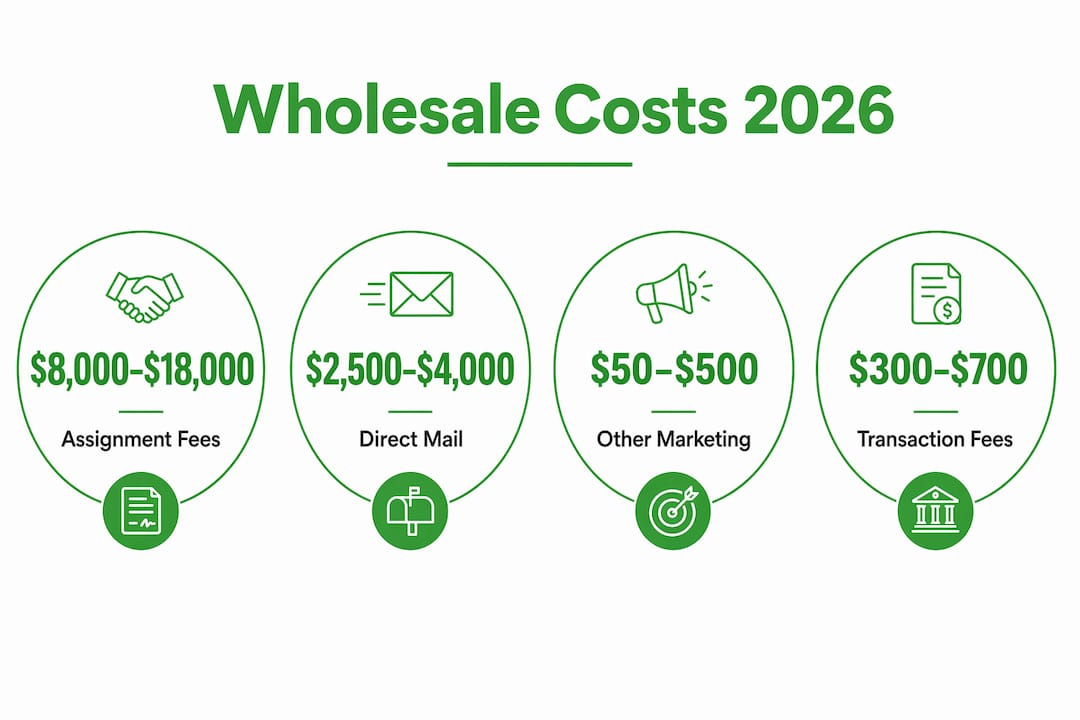
Wholesale real estate investing is the practice of putting a distressed property under contract at a below-market price, then assigning that contract to a cash buyer for a fee, without ever taking ownership of the property. The profit comes from the spread between your contract price and what the buyer pays. Assignment fees now range from $8,000 to $18,000 per deal in 2026, up from $8,000 to $12,000 in 2024. That increase reflects wider price spreads between distressed and retail values, which makes this one of the most accessible entry points in real estate today. You need no mortgage, no renovation budget, and no landlord experience to get started.
How does wholesale real estate investing work step by step?
Real estate wholesaling follows a clear sequence. Skipping any step is the fastest way to lose credibility and money.
- Find motivated sellers. Target distressed properties: pre-foreclosures, probate estates, tax-delinquent homes, and absentee owners. These sellers prioritize speed over price, which creates the spread you need.
- Run your numbers. Calculate the After Repair Value (ARV) of the property, then subtract repair costs and your target fee. The standard formula is: Maximum Allowable Offer = (ARV × 70%) minus repair costs minus your fee.
- Sign an assignable purchase contract. Your contract must include an assignability clause. Without it, you cannot legally transfer your position to a buyer.
- Match the deal to your buyers list. Send the deal details to qualified cash buyers immediately. Speed matters. The longer a deal sits, the more risk you carry.
- Execute the assignment agreement. You sign an assignment of contract with your buyer. They pay your fee at closing, either directly or through escrow.
- Close and collect. The title company handles the closing. Your fee gets paid without you ever appearing on the deed.
Wholesaling requires low upfront cash but demands real investment in marketing, data tools, and consistent outreach. Most beginners underestimate the time cost and overestimate how fast deals close.
Pro Tip: Build your buyers list before you sign your first contract. Knowing exactly who will buy the deal before you lock it up removes the biggest risk in the entire process.

What are the critical financial factors in wholesaling?
Assignment fees are the core revenue driver in wholesale property investing. Active wholesalers earn between $50,000 and $300,000 annually, depending on deal volume and market. That range is wide because the business model scales directly with how many deals you close per year.
Marketing cost per deal is the metric that separates profitable operators from those who grind without results. Direct mail costs $2,500 to $4,000 per deal, multi-channel marketing runs $1,500 to $3,000, and precision-targeted digital campaigns drop that figure to $1,000 to $2,000. Precision targeting wins on margin, but it requires better data and more technical skill to execute.
| Marketing method | Cost per deal | Skill level required |
|---|---|---|
| Direct mail | $2,500–$4,000 | Low |
| Multi-channel | $1,500–$3,000 | Medium |
| Precision-targeted | $1,000–$2,000 | High |
Beyond marketing, you carry transaction costs on every deal: title search fees, earnest money deposits, and occasionally assignment recording fees. These rarely exceed a few hundred dollars per deal, but they add up at volume. Once you close more than 50 deals per year, CRM systems and automated follow-up become necessary to maintain margins. At that scale, manual tracking kills efficiency faster than any single bad deal.
Which marketing strategies boost wholesale deal flow?
Lead generation is the engine of wholesale house deals. Without a consistent pipeline of motivated sellers, no amount of contract skill matters.
The most effective channels for finding distressed sellers include:
- Direct mail campaigns targeting pre-foreclosures, probate, and tax-delinquent lists. Response rates are low, but the leads are highly motivated.
- Cold calling using skip-traced phone numbers attached to absentee owner lists. This is the highest-effort channel and the lowest cost per contact.
- Driving for dollars combined with digital tools that let you tag properties and pull owner data instantly from your phone.
- Online advertising through Google Local Services and Facebook targeting homeowners in financial distress signals.
- Networking with title companies and real estate attorneys who regularly encounter sellers in difficult situations before those properties hit any public list.
Data quality determines results more than channel selection. Targeting equity-rich properties where the owner shows distress signals (delinquent taxes, code violations, recent divorce filings) produces far better conversion than blasting generic lists.
Pro Tip: Skip tracing is the process of finding contact information for property owners who are hard to reach. Paid skip-tracing services pull cell numbers, email addresses, and relatives' contacts from public records. This single tool multiplies your cold-calling output.
Relationships with local investor networks also generate deal flow that no marketing budget can replicate. Attend local Real Estate Investor Association (REIA) meetings and build genuine connections with cash buyers, hard money lenders, and other wholesalers. Those relationships surface off-market opportunities before they reach anyone else.
What legal and compliance issues should wholesalers know in 2026?
Wholesaling sits in a legal gray area in several states. Ignoring local rules is not a calculated risk. It is a business-ending mistake.
Key legal points every wholesaler must understand:
- State licensing thresholds. Illinois requires wholesalers to register after 2 deals per year. Oklahoma requires a real estate license after 5 deals per year. Other states are tightening rules as wholesaling volume grows. Check your state's real estate commission website before closing your first deal.
- Assignability clauses. Every purchase contract must explicitly allow assignment. Some sellers or their agents will push back on this language. Know how to explain it and when to walk away.
- Assignment vs. novation. A standard assignment keeps you on the contract as the original buyer. A novation agreement replaces you entirely, allowing title to transfer directly from seller to buyer. Novation is required when the end buyer uses FHA or VA financing, since those loan programs prohibit assignment.
- Disclosure requirements. Many states require you to disclose that you are assigning the contract and that you are not a licensed agent. Failing to disclose creates liability.
- Penalties for non-compliance. Fines, deal rescissions, and license revocation are all real consequences. The legal landscape is evolving quickly as regulators catch up to wholesaling's growth.
Consult a local real estate attorney before you close your first deal in any new state. A one-hour consultation costs far less than a compliance violation.
What best practices maximize success in wholesale real estate investing?
The wholesalers who build lasting businesses share a specific set of habits. The ones who burn out after six months share a different set.
- Build your buyers list first. Start with 15 to 25 qualified cash buyers before you sign any contract. Qualified means they have closed deals recently, have proof of funds, and buy in your target market. A list of 100 unverified names is worth less than 20 verified buyers.
- Use a buyer-first sourcing strategy. Experienced wholesalers source deals for known buyers, not the other way around. When you know exactly what your buyers want, you stop wasting time on deals that will never close.
- Track your cost per deal obsessively. Marketing spend without deal tracking is just spending. Know which channel produced each deal and cut what does not convert.
- Transition to systems before you need them. Most beginners wait until they are overwhelmed to build processes. Set up your CRM, follow-up sequences, and contract templates before volume forces you to.
- Use data analytics to find better leads. Larger spreads in 2026 reward wholesalers with sharper data who can identify the highest-equity, highest-motivation targets before competitors do.
The biggest mistake beginners make is signing a contract without a buyer lined up. That scramble destroys your negotiating position, your timeline, and your reputation with sellers.
Key Takeaways
Wholesale real estate investing generates profit through assignment fees, not property ownership, and success depends on building a qualified buyers list, controlling marketing costs, and staying compliant with state-specific rules.
| Point | Details |
|---|---|
| Assignment fees in 2026 | Fees now range from $8,000 to $18,000 per deal, up from prior years. |
| Marketing cost per deal | Precision-targeted campaigns cost $1,000 to $2,000 per deal, the lowest of any channel. |
| Buyers list first | Build 15 to 25 verified cash buyers before signing any purchase contract. |
| Legal compliance | Illinois and Oklahoma both require registration or licensing above specific deal thresholds. |
| Systems at scale | CRM and automation become necessary to stay profitable above roughly 50 deals per year. |
The real edge in wholesaling is not what most beginners think
Most people who research how to wholesale real estate fixate on finding deals. The actual constraint is almost always the buyers list. I have watched beginners lock up solid contracts at great prices and then spend two weeks scrambling to find a buyer, watching the deal fall apart and their earnest money disappear with it.
The 2026 market is genuinely interesting for wholesalers. Stalled home price growth is increasing distressed inventory and widening the spread between what a motivated seller will accept and what a cash buyer will pay. That is the exact condition wholesalers need. The challenge is that funded wholesaling operations with large marketing budgets are competing for the same leads. You cannot out-spend them. You can out-target them.
The wholesalers I respect most treat this like a data business with a real estate license problem attached. They know their cost per lead, their conversion rate at each stage, and their average fee per deal. They are not grinding on hustle alone. They have built systems that generate consistent deal flow without requiring them to personally cold-call eight hours a day forever.
If you are just starting out, do not let the competition intimidate you. Funded operations are often less nimble and less relationship-driven than a focused individual working a specific zip code. Pick a tight market, build real relationships with title companies and local investors, and close your first five deals before you think about scaling. The systems will make more sense once you have real data from real deals.
— ARX
How Deal-zilla fits into your wholesale investing strategy
Wholesale investors need fast access to off-market properties and a reliable way to manage deal flow without losing track of contracts or buyers.

Deal-zilla gives you the tools to analyze wholesale house deals before you commit, with a Deal Analyzer built for investors who need accurate numbers fast. The platform also supports fix-and-flip analysis, BRRRR calculations, and rent comparisons, so your wholesale leads can be evaluated against multiple exit strategies in one place. Whether you are assigning contracts or considering a hold, Deal-zilla's deal analysis tools give you the data to make confident decisions without guessing at the numbers.
FAQ
What is wholesale real estate investing?
Wholesale real estate investing is the practice of contracting a property at a below-market price and assigning that contract to a cash buyer for a fee, without purchasing the property yourself. The wholesaler profits from the difference between the contract price and the buyer's price.
How much can you make wholesaling real estate?
Active wholesalers earn between $50,000 and $300,000 per year, with individual assignment fees typically ranging from $5,000 to $20,000 per deal. Income depends on deal volume, market conditions, and marketing efficiency.
Do you need a real estate license to wholesale?
Licensing requirements vary by state. Illinois requires registration after 2 deals per year, and Oklahoma requires a license after 5 deals per year. Always check your state's real estate commission rules before closing deals.
What is the difference between assignment and novation in wholesaling?
An assignment keeps the wholesaler on the original contract and transfers the buyer's position to a new investor. A novation replaces the wholesaler entirely, allowing title to pass directly from seller to buyer, which is required when the end buyer uses FHA or VA financing.
How much money do you need to start wholesaling real estate?
Wholesaling requires minimal upfront capital compared to fix-and-flip or rental investing. The primary costs are marketing, data tools, and skip-tracing services, not property purchases. Most beginners can start with a few hundred to a few thousand dollars in marketing budget.