
Finding a real estate investment analysis tool that handles reliable deal data, rental comps, and rapid underwriting for investors and syndicators is tougher than expected. Many platforms restrict property searches to a narrow asset class or impose subscriptions before you can try full analysis features. The comparisons below outline pricing, scope, and analysis methods across five ExactEstate.com alternatives so investors and syndicators can match a tool to their portfolio needs.
Table of Contents
DealZilla
At a Glance
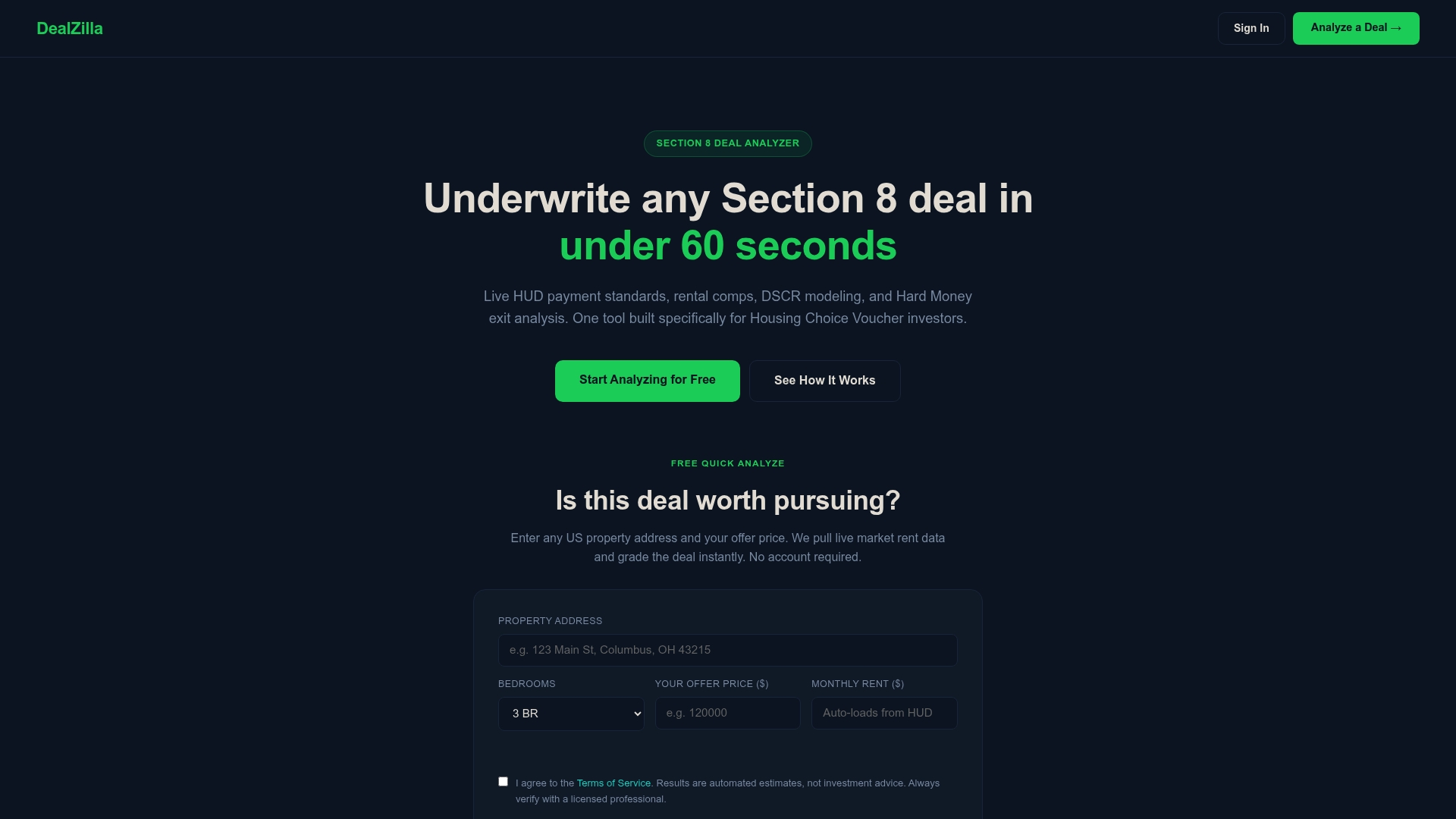
Live HUD payment standards by ZIP code power every analysis in DealZilla. The engine matches those standards to automated rental comps and produces an instant underwriting snapshot with no account required. That direct link to HUD rates focuses evaluations on voucher-backed income rather than market-rate rent.
Core Features
DealZilla runs instant property analysis without forcing you to sign up and pulls live HUD payment standards for the ZIP code you specify. The tool models multiple loan scenarios including Hard Money, DSCR, and Conventional lending, and it pulls rental comps alongside automated valuation estimates. It also includes Section 8 heat maps, BRRR calculations, stress testing for rent and vacancy downside, buy box grading, and exportable deal reports for lenders and partners.
Key Differentiator
Built specifically for Section 8 investing, DealZilla links live HUD payment standards to automated market comps across every U.S. ZIP code. That pairing shifts the focus from general market rent to voucher-eligible income and makes feasibility checks reflect program limits and allowances.
Pros
DealZilla gives you HUD-driven rent ceilings that simplify underwriting for voucher-backed properties and remove guesswork about allowable rents. Its instant analysis and side by side loan modeling cut the time needed to compare financing options for a single deal. The platform produces professional reports you can hand to lenders, and the buy box auto-grading helps you filter neighborhoods by your target return and underwriting rules.
Cons
- Only tailored for Section 8 housing investors; it does not serve market-rate rental underwriting.
Who It's For
Real estate investors and syndicators who focus on affordable housing and voucher-backed rental properties will get the most from DealZilla. The product fits investors who underwrite across multiple markets and need HUD-aware comparables and quick lender-ready reports. It is not aimed at standard market-rate buy and hold strategies.
Unique Value Proposition
Buy box auto-grading tied to HUD payment standards lets you scan ZIP codes and flag properties that meet your target metrics. That feature speeds portfolio-level deal screening so you spend less time on nonviable leads and more time running deeper underwriting on prospects. The combination of grading and exportable reports makes lender conversations faster.
Real World Use Case
An investor finds a three-unit in Chicago and runs an instant analysis with live HUD standards. They compare Hard Money and Conventional financing side by side, stress test rent declines, and export a report for a mortgage broker. The whole sequence finishes in minutes and produces numbers aligned with voucher program limits.
Pricing
DealZilla offers a free tier with limited monthly analyses and paid plans start at $29/month for unlimited analyses and advanced features. That pricing model lets you trial the workflow before committing to full access.
Website: https://deal-zilla.com
DealCheck
At a Glance
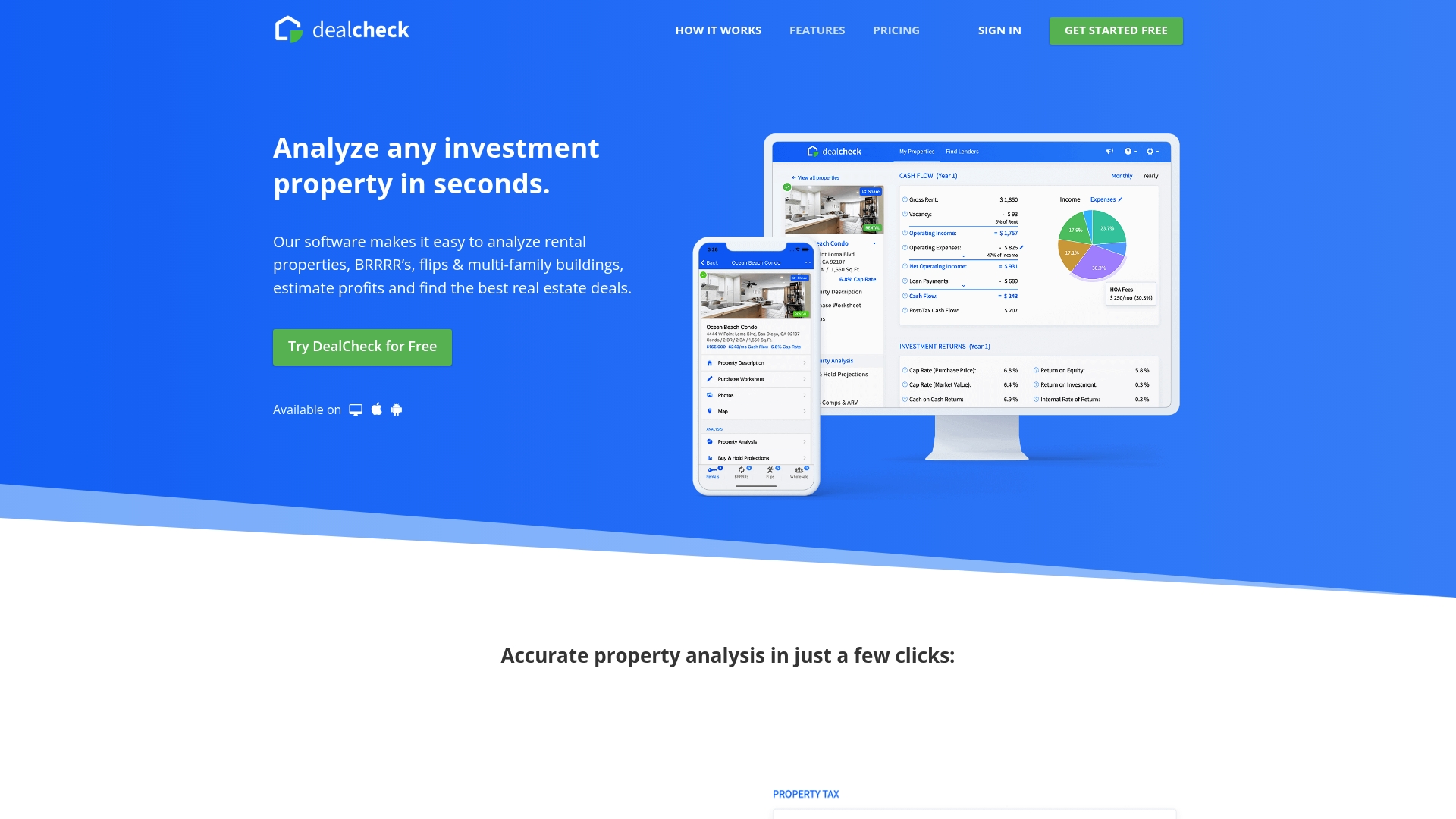
DealCheck reports it is trusted by over 350,000 professionals worldwide. The tool imports public records and listing data to populate deal inputs quickly, which saves time when screening many properties. It also creates professional, branded reports you can share with partners or lenders.
Core Features
DealCheck provides property data import, customizable financing and rehab fields, and detailed cash flow and return projections for rentals, flips, BRRRR, and multifamily buildings. The platform includes a comps lookup for recent sales and rental comparables in the US market and templates for client ready reports. You can run multiple scenarios and compare outcomes without rebuilding a worksheet each time.
Key Differentiator
DealCheck stands out for its combination of fast analysis and report quality across devices. The product emphasizes quick deal entry from public records and listings so you spend less time on data entry and more time on underwriting. That workflow suits investors who evaluate many deals per week and need polished deliverables for sellers and lenders.
Pros
DealCheck is straightforward to learn while letting you adjust detailed financing and rehab assumptions for precise scenarios. It reduces repetitive lookups with instant reports and property data import from public records and listings. Support for rentals, flips, BRRRR, and multifamily analysis covers the common strategies most investors use and the output is presentable to clients, partners, and lenders.
Cons
- Data availability varies by region, which may leave gaps for certain property types or remote locations.
- Advanced features have a learning curve for complete beginners and require some setup to use effectively.
- Premium plans require a subscription, which may limit power users who expect unlimited free analysis.
When It May Not Fit
DealCheck may not fit investors who operate outside US markets where its comps data is strongest. Teams that need collaborative multi seat account controls may find the solo investor workflow limiting. Users who require automated bank or accounting integrations should verify compatibility because those connections are not emphasized.
Notable Integrations
DealCheck integrates with public records data sources for comps and property information. That connection powers automated population of address level details and recent sale and rent comparables in supported markets.
Who It's For
The product fits individual and small portfolio investors, agents, and brokers who analyze buy and hold, fix and flip, and BRRRR deals quickly. It also suits investors who must produce clean, branded reports for lenders or partners. Larger enterprises with specialized integration needs may need a different setup.
Real World Use Case
An investor screening ten listings per week uses DealCheck to import addresses, populate comparable sales, and run three financing scenarios per property. They export a branded report to attach to an offer and send a single PDF to their lender. That process reduces back and forth and speeds decision making.
Pricing
DealCheck offers a free tier with basic features and paid upgrades. Plans start at $10/mo for Plus and $20/mo for Pro, with a 14 day free trial and tiered limits on saved properties, photos, comps, and templates. Choose Pro if you need higher storage and frequent scenario runs.
Website: https://dealcheck.io
Connected Investors
At a Glance
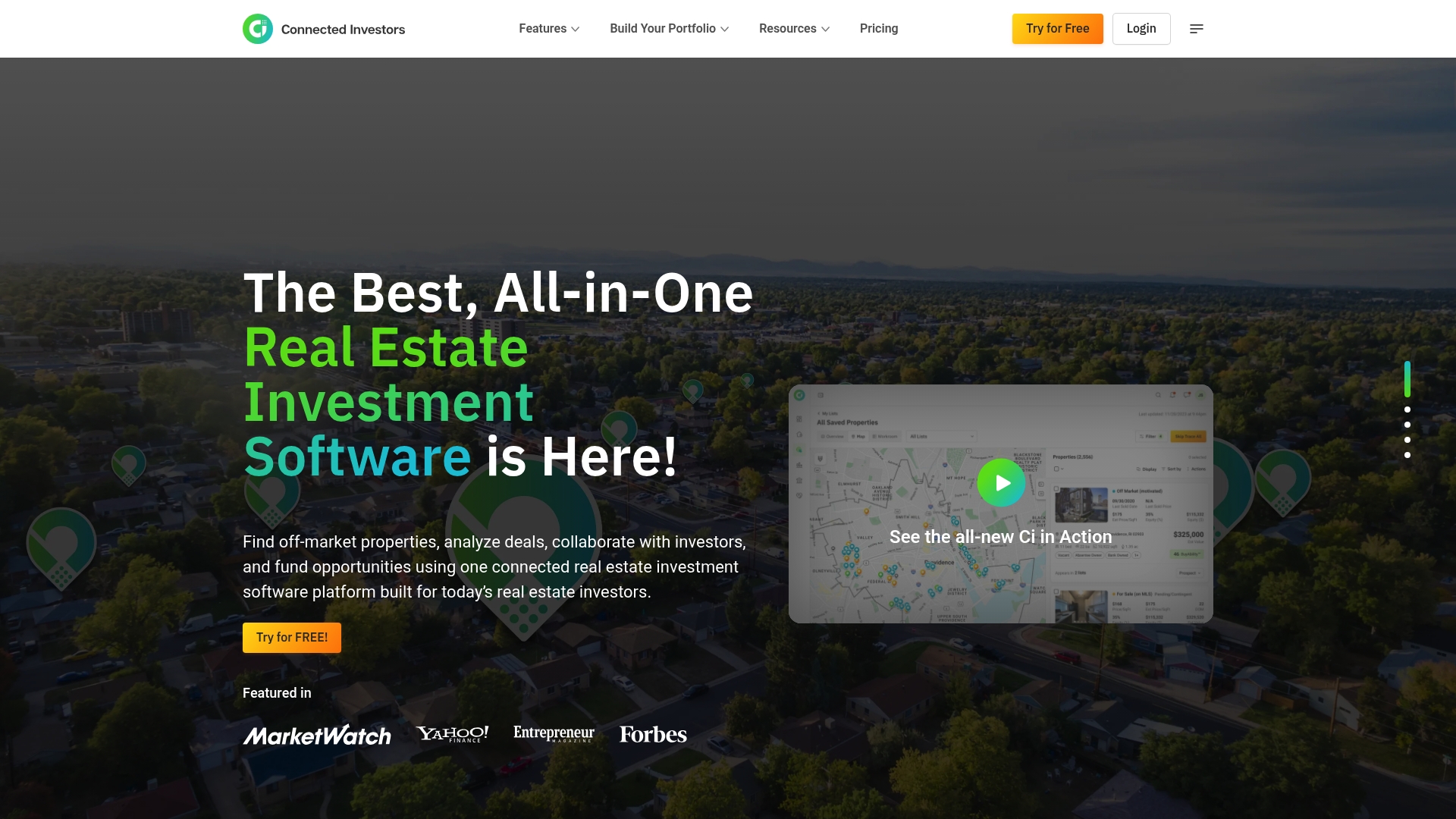
Connected Investors offers lead list building with over 150 filters for motivated sellers and cash buyers. It combines nationwide property and ownership data with AI enhanced buyability scores and sales comparables. The platform pairs integrated skip tracing with a mobile app so you can pursue leads and manage deals from your phone.
Core Features
Property analytics include buyability scores and sales comparables alongside nationwide ownership records. Lead list building provides deep filtering and integrated skip tracing to surface contactable owners. Collaboration tools and a funding marketplace let teams share deals, raise private capital, and control partner access.
Key Differentiator
The vendor advertises industry first collaboration features tailored to real estate investment teams. Those features emphasize secure deal sharing and team workflows rather than solo analysis tools. That emphasis positions the product more for coordinated teams than single investor toolsets.
Pros
The platform bundles sourcing, valuation, collaboration, and funding in one place so you avoid swapping multiple systems. Property data is reported as accurate and up to date, with AI enhanced scores that help prioritize leads. Lead filters are granular and skip tracing provides ownership level insights that shorten outreach cycles.
Cons
- Pricing details are not specified. The product likely uses subscription billing and may charge extra for some features.
- The platform scope and number of tools may overwhelm beginners who lack deal analysis experience.
- Dependence on third party data remains a risk. Even the best sources can have coverage gaps or outdated records.
When It May Not Fit
If you only need a single calculator or a simple rent roll, this platform may be more than you require. Budget conscious investors may find the opaque pricing problematic. Small teams that do not plan to raise private capital will not use the funding marketplace fully.
Who It's For
Investors who source off market deals and work with partners will get the most value. Wholesalers, flippers, rental property investors, and small investment teams fit the profile. REIT analysts and private lenders can also use the platform for deal flow and contact lists.
Real World Use Case
An investor locates off market properties using filtered lead lists and then runs buyability scores to rank opportunities. The investor shares selected deals with a partner group, collects offers through the funding marketplace, and closes using contacts found with skip tracing. All steps stay inside the same platform to reduce manual handoffs.
Pricing
Pricing is not publicly listed. The offering appears to rely on subscription billing and a free trial may be available. Expect possible additional fees for premium features or bulk skip tracing credits.
Website: https://connectedinvestors.com
DealWorthIt
At a Glance
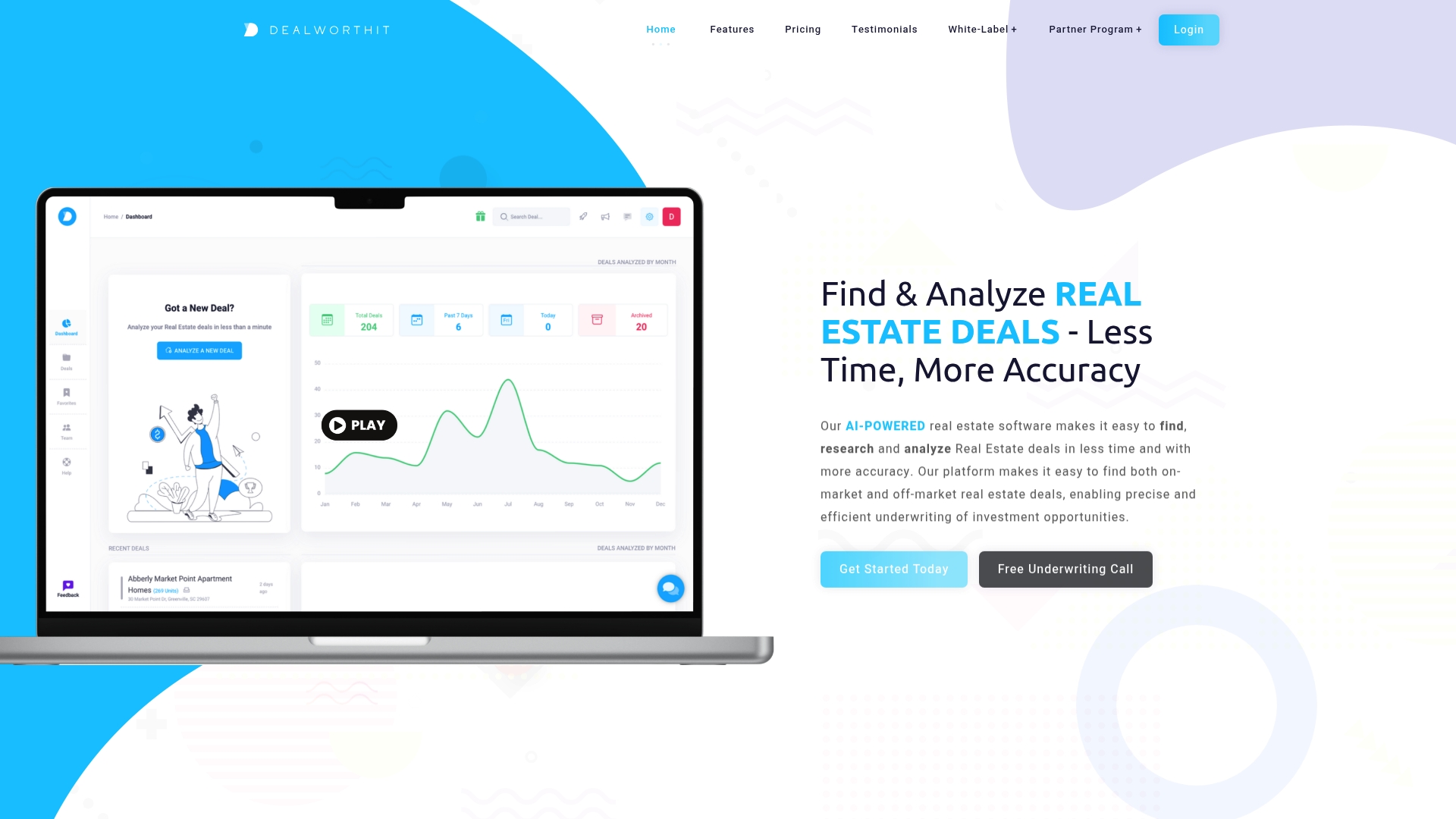
DealWorthIt reports it can find over 150 million properties nationwide. The platform couples AI powered automatic underwriting with live market data to speed deal evaluation. That mix targets investors who need both on market and off market sourcing plus rapid financial analysis.
Core Features
DealWorthIt combines wide property search with automated underwriting and deep property records. It delivers ownership details, mortgage data, sales history, and market rents alongside demographic and trend reports. Team collaboration, forecasting for appreciation and rental income, and a deal pipeline complete the workflow.
Key Differentiator
The single difference is the pairing of advanced AI driven underwriting with comprehensive, real time market data in one workspace. That pairing reduces manual modeling and centralizes inputs used for financing conversations. For teams, it keeps assumptions and documents tied to the same deal record.
Pros
DealWorthIt speeds sourcing and analysis by automating repetitive calculations and pulling broad property records into one view. It saves modeling time while giving teams a shared underwriting record and document space. The platform also helps surface undervalued and off market opportunities that individual spreadsheets often miss.
Cons
- Buyer scenarios requiring custom or highly localized analysis might need additional tools or data sources.
- Specific third party integrations beyond market data or property information are not listed, which may limit workflow connections today.
- Heavy reliance on AI and automation can miss subtle, property specific factors that local experts spot.
When It May Not Fit
If your portfolio focuses on ultra local quirks or rare asset classes, DealWorthIt may need supplemental data or custom modeling. Buyers who require bespoke underwriting templates for unique property types should plan for extra tooling. Firms needing wide third party integration options will find the current choices limited.
Who It's For
DealWorthIt fits individual investors, syndicators, and small to mid sized real estate firms that want faster deal screening and shared underwriting. Teams that collaborate on acquisitions will get value from the pipeline and document sharing. Investors who prioritize speed and broad market coverage will see the most immediate benefit.
Real World Use Case
An investment group used DealWorthIt to find undervalued multifamily listings off market, run multiple underwriting scenarios, and share a single report with a lender. The automatic modeling cut spreadsheet time and kept rate assumptions consistent during negotiation. That workflow helped move underwritten deals to financing more quickly.
Pricing
Pricing starts at $49/month for the Silver plan and scales to $249/month for the Diamond plan. Plans are available with monthly or yearly billing, and the vendor offers discounts for annual payments. The tiered model lets teams add features as their deal volume grows.
Website: https://dealworthit.com
GemHaus
At a Glance
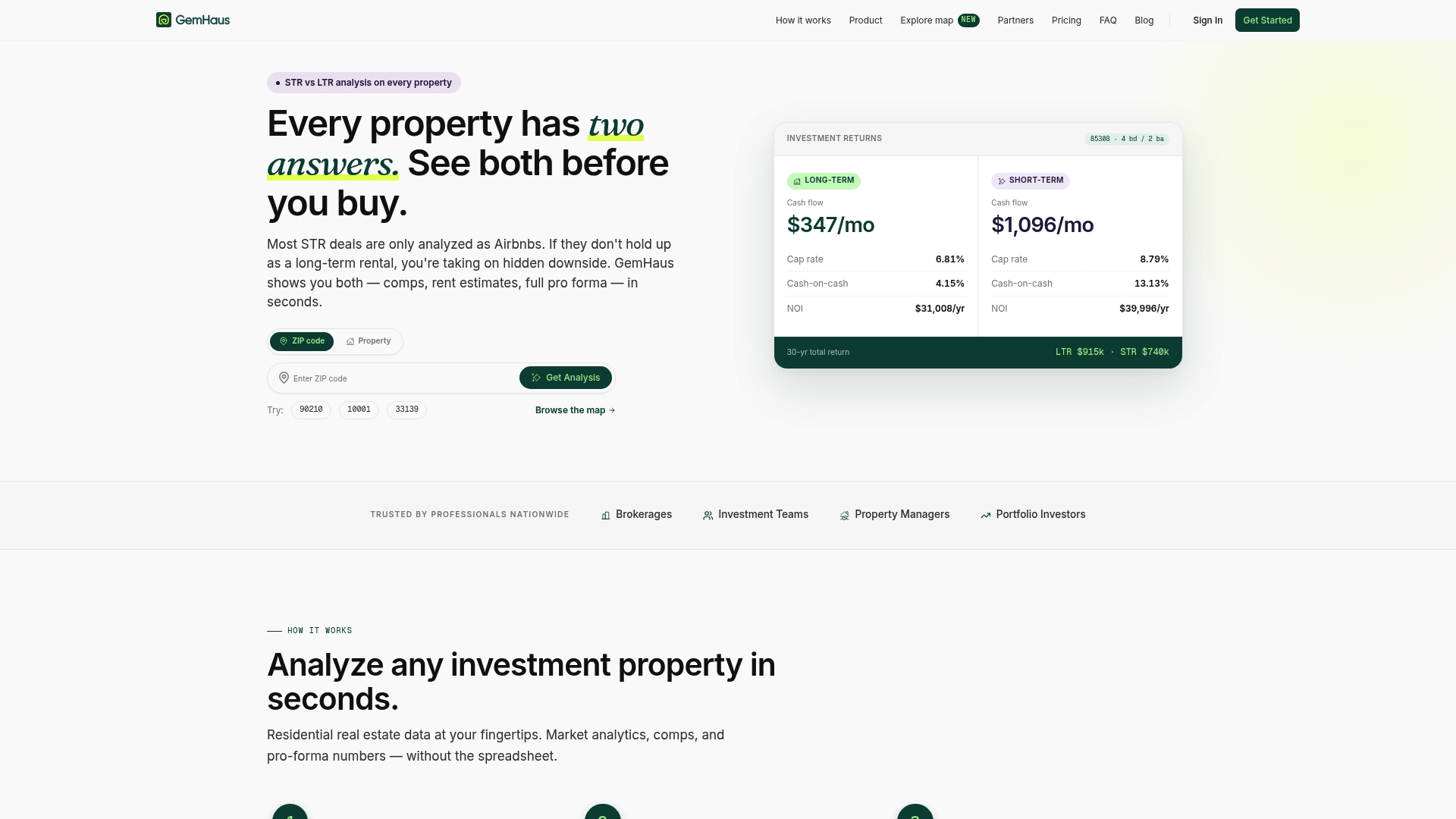
GemHaus claims it is the only tool that compares both short-term and long-term rental strategies side-by-side using real MLS data. The tool pulls MLS-grade comps and lets you run quick adjustments in a live deal calculator. It also provides market intelligence for ZIP codes and a map exploration tool for neighborhood discovery.
Core Features
GemHaus presents a side-by-side comparison view that places short-term and long-term rental cash flows next to each other for direct evaluation. The platform pulls MLS-grade data and runs automatic comps, then generates a 30-year projection of equity, appreciation, and cash flow. A live deal calculator updates instantly when you change assumptions, and market intelligence reports summarize neighborhood-level trends.
Key Differentiator
That claim centers on the side-by-side rental strategy comparison backed by MLS pulls. The layout reduces manual spreadsheet work by showing how the same property performs under two different operational models. That focus appeals if you regularly choose between nightly and long-term leasing for the same asset.
Pros
GemHaus speeds underwriting by replacing repetitive spreadsheet tasks with a visual deal workflow tied to MLS data. The MLS-backed data and automated comps cut the time spent checking listings and building comparable sets. The map exploration and neighborhood reports let you screen deals quickly and hand investors a single, presentable report.
Cons
- Limited to residential properties. Commercial investors will find the tool unsuitable for their asset classes.
- Accuracy depends on available MLS and public records. Less-documented markets may produce weaker projections.
- Pricing model may feel costly for very high-volume analysts who run frequent, small comparisons.
When It May Not Fit
If your portfolio includes retail, office, or industrial properties, this tool will not cover those asset types. If you invest in markets with sparse MLS coverage, results will depend heavily on public-record completeness. If you need offline, spreadsheet-first workflows, the web-first analysis approach may clash with established processes.
Who It's For
Residential real estate investors who compare rental models for the same property will get the most from GemHaus. Agents who prepare investor-grade reports and buyers evaluating rental viability will also benefit. The tool fits professionals who prefer fast, MLS-tied analysis over manual comp building.
Real World Use Case
An investor evaluating three single-family homes runs each through GemHaus to compare nightly versus monthly rental returns. They adjust occupancy, nightly rate, and financing terms in the live calculator and export side-by-side summaries for partners. That process replaces hours of spreadsheet assembly with a concise, comparable report for offers.
Pricing
GemHaus offers a pay-per-credit option and two subscription choices. There is a one-time $19.99 package for 30 credits, an unlimited $59/month subscription, and an annual plan at $499/year. The subscription gives unlimited analyses, while credits suit occasional users.
Website: https://gemhaus.com
Comparison of alternatives
In the landscape of real estate investment analysis tools, selecting the right platform depends significantly on the specific needs of an investor. While DealZilla excels with its HUD-oriented functionality tailored for investors in voucher-supported housing, other platforms provide unique advantages designed for different investment strategies.
Focused feature strengths
Each alternative tool exhibits capabilities that cater to varied investor requirements. DealCheck offers exceptional ease of use combined with rapid data imports from MLS and public records, making it ideal for investors aiming to evaluate multiple properties simultaneously without extensive setup. On the other hand, GemHaus distinguishes itself by its ability to show side-by-side comparisons of short-term vs. long-term rental strategies, providing insights for rental strategy planning directly informed by MLS-grade data.
Versatile collaboration and team integration
Connected Investors stands out for teams that necessitate collaborative features. The platform facilitates property sourcing with filtering and includes tools such as skip tracing and funding marketplaces, making it a valuable resource for investment groups engaged in multi-partner transactions. Similarly, DealWorthIt suits investors who require broad property datasets combined with AI-driven automated underwriting to streamline decision-making across diverse real estate ventures.
Best fit
- For investors specializing in Section 8 properties: DealZilla is in offering immediate market analysis using HUD payment standards, making it the go-to tool for affordable housing stakeholders.
- For individual investors valuing ease of public data integration with multi-scenario workflows: DealCheck provides a streamlined approach for detailed financial modeling and properties evaluation.
- For investment groups focusing on team collaboration and deal sourcing: Connected Investors delivers exceptional tools for secure deal sharing, nationwide lead generation, and partnering workflows.
- For residential investors comparing rental strategies: GemHaus effectively contrasts short-term and long-term rental projections for informed decision-making supported by granular data analytics.
Our pick
For investors targeting Section 8 voucher-backed rental properties, DealZilla is recommended for its specialized and efficient real estate investment underwriting process. However, for those requiring extensive team collaboration or multifaceted investment functionalities, platforms such as Connected Investors or DealCheck may provide a better fit. Thus, considering the unique requirements of your investment strategy is essential to choosing the right tool for your portfolio.
Discover which real estate investment tool best aligns with your Section 8 housing strategy.
| Product | Target Audience | Key Feature | Pricing | Limitation |
|---|---|---|---|---|
| Deal-zilla | Section 8 housing investors | HUD payment standards integration | Free tier, $29/month and up | Only supports Section 8 properties |
| DealCheck | Individual and small portfolio investors | Import public records for deal data | Free tier, $10–$20/month | Limited to U.S. market reliability in certain regions |
| Connected Investors | Investment teams and real estate partnerships | Collaboration features and funding marketplace | Price not published | Unsuitable for solos needing basic calculators |
| DealWorthIt | Real estate syndicators and firms | AI-backed automated underwriting | $49–$249/month | Heavy reliance on AI, lacks bespoke analysis for niche needs |
| GemHaus | Residential investors exploring rental strategies | Side-by-side short- and long-term analysis | $19.99/credit, $59/month, $499/year | Suitable for residential properties only |
How Section 8 Investment Analysts Can Solve Common Deal Evaluation Challenges
Real estate investors focused on affordable housing often face the challenge of matching rental income projections precisely to HUD voucher payment limits. Deal-zilla addresses this by pulling live HUD payment standards by ZIP code, creating instant underwriting snapshots without requiring an account. This focus on voucher-backed income instead of market-rate rent helps investors reduce uncertainty and underwrite deals realistically.

Explore how Deal-zilla’s Section 8 Investment Analyzer and BRRR calculator can simplify your deal screening and reporting tasks. Visit Deal-zilla to run instant property analyses that align with HUD standards and generate lender-ready reports within minutes. Take your Section 8 investing strategy beyond typical ExactEstate.com alternatives and get clearer results today.
FAQ
What specific features make Deal-zilla an ideal choice for real estate investment analysis?
Deal-zilla excels in providing HUD-driven rent ceilings that simplify underwriting for voucher-backed properties. Its instant analysis and comprehensive loan modeling reduce the time needed to compare financing options. Investors can expect a user-friendly platform that streamlines the deal evaluation process.
How does the analysis speed of Deal-zilla compare to DealCheck?
DealCheck is trusted for its fast property data import and customizable financing fields. This allows for quick evaluations of many properties in a short amount of time. Deal-zilla, however, focuses exclusively on Section 8 investing and provides instant underwriting snapshots linked to HUD standards, making it more tailored for that specific use case.
What type of reporting does Deal-zilla offer for users?
Deal-zilla produces professional reports that can be easily exported and shared with lenders and partners. This feature allows for seamless communication of underwriting details, which is beneficial for real estate investors and syndicators looking to present detailed analyses.
Can Deal-zilla be used effectively for markets outside Section 8 housing?
Deal-zilla is highly specialized for Section 8 housing investors and may not be suitable for those focused on market-rate rental underwriting. Investors whose strategies don't align with voucher-backed properties may find the platform limiting.
What pricing tiers are available for Deal-zilla?
Deal-zilla offers a free tier with limited monthly analyses, while paid plans start at $29 per month for unlimited analyses and advanced features. This pricing structure allows users to trial the platform and assess its value before committing to a subscription.