
Real estate investing strategies are deliberate, methodical approaches investors use to acquire, manage, and profit from properties, each calibrated to specific capital levels, risk tolerance, and time availability. The right strategy for a $30,000 budget looks nothing like the right strategy for a $300,000 portfolio. Metrics like cash flow, cap rate, and debt service coverage ratio (DSCR) determine whether a deal works before you ever sign a contract. This guide breaks down the core types of real estate investment strategies, the financial analysis behind them, and how to choose the approach that fits your actual situation in 2026.
What are the core real estate investing strategies and how do they differ?
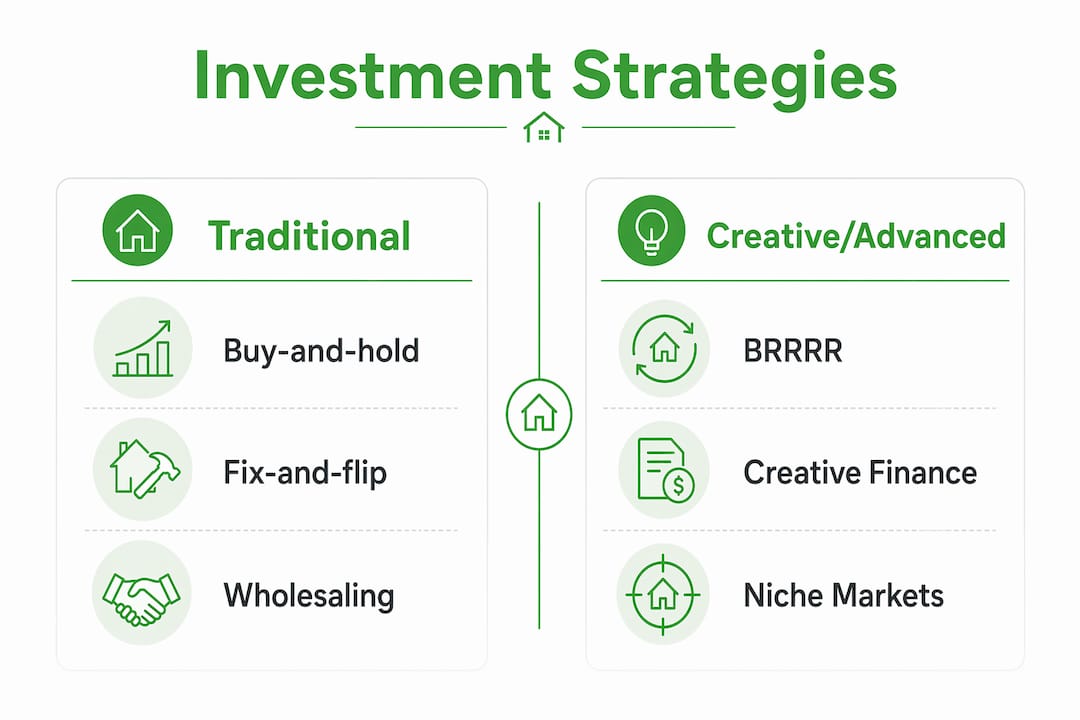
Three primary residential strategies dominate the market: traditional long-term rentals, BRRRR, and specialized niches like mid-term or build-to-rent properties. Each carries a distinct capital requirement, management burden, and growth trajectory. Knowing the difference before you commit capital is the single most important decision you will make as an investor.
Buy-and-hold is the most accessible entry point. You purchase a property, rent it out, and collect monthly cash flow while the asset appreciates over time. Traditional long-term rentals offer predictable income with lower operational complexity, making them well-suited for newer investors who want steady returns without constant deal-hunting.
Fix-and-flip targets distressed properties, renovates them, and sells for a profit. The fix-and-flip approach requires $30,000–$80,000 or more in starting capital, active project management, and a reliable contractor network. The upside is faster returns. The downside is higher risk if renovation costs overrun or the market shifts during the hold period.

Wholesaling requires the least capital of any strategy. You contract a property below market value and assign that contract to another buyer for a fee, typically without ever taking ownership. This approach suits investors with strong deal-finding skills but limited funds. A detailed breakdown of this model is available in Deal-zilla's wholesale investing guide.
BRRRR (Buy, Rehab, Rent, Refinance, Repeat) combines renovation with long-term holding. BRRRR attracts experienced investors seeking faster portfolio growth through renovation and refinancing cycles. The strategy recycles capital, so one well-executed deal can fund the next.
Creative finance covers seller financing, subject-to deals, and lease options. These techniques reduce or eliminate the need for traditional bank financing, which makes them valuable when interest rates are high or when a buyer's credit profile limits conventional loan access.
| Strategy | Starting Capital | Time Commitment | Best For |
|---|---|---|---|
| Buy-and-hold | Moderate | Low to medium | Steady income, beginners |
| Fix-and-flip | $30,000–$80,000+ | High | Active investors, fast returns |
| Wholesaling | Minimal | Medium | Deal finders, low capital |
| BRRRR | Moderate to high | High | Portfolio scaling, experienced investors |
| Creative finance | Low to moderate | Medium | High-rate environments, flexible buyers |
How do financial metrics determine whether a deal actually works?
Financial literacy matters more than strategy selection. A bad deal with a good strategy is still a bad deal. Investors who skip rigorous financial analysis and rely on gut feel consistently underperform those who run the numbers on every property.
Four metrics form the foundation of sound deal evaluation:
- Cash flow is the net income remaining after all expenses, including mortgage, taxes, insurance, and maintenance, are subtracted from gross rent. Positive cash flow is the baseline requirement for any rental strategy.
- Cap rate (capitalization rate) measures a property's income potential independent of financing. It equals net operating income divided by purchase price. Cap rate lets you compare properties across markets without financing variables distorting the picture.
- DSCR (debt service coverage ratio) measures whether rental income covers the mortgage payment. Experienced investors target a DSCR of at least 1.2x to build a buffer against vacancies and unexpected costs. DSCR-based loans also allow investors to qualify without W-2 income verification, which is critical for scaling a portfolio.
- Cash-on-cash return measures annual pre-tax cash flow against the actual cash invested. It answers the question every investor cares about most: what is my money actually earning? Deal-zilla's cash-on-cash return guide walks through the calculation in detail.
One metric that many investors skip is the maximum allowable offer (MAO). The MAO sets the ceiling price you can pay and still hit your return targets. Deal-zilla's MAO calculator guide shows how to apply this to rental acquisitions specifically.
Pro Tip: Deferred maintenance exceeding 10–15% of purchase price can erode returns for years. Experienced investors budget a 10% repair reserve for the first year on any acquisition, regardless of how clean the inspection looks.
What factors should drive your choice of investment strategy?
No universal best strategy exists. Successful investors match strategy to capital, experience, time, and goals. Choosing the wrong strategy creates liquidity problems and operational headaches that compound over time.
The key factors to assess honestly before committing to any approach:
- Available capital. New investors can enter the market with as little as $15,000 by aligning strategy with time and risk tolerance. Turnkey rentals require less active involvement but demand higher down payments. Fix-and-flip requires more upfront cash but can generate faster returns.
- Time availability. Active strategies like fix-and-flip and BRRRR demand significant weekly hours. Buy-and-hold with a property manager is far closer to passive income. Be honest about how many hours per week you can realistically commit.
- Risk tolerance. Fix-and-flip concentrates risk in a single project over a short window. Long-term rentals spread risk over years of steady income. Wholesaling carries almost no capital risk but requires consistent deal flow to generate income.
- Market conditions. Rising interest rates compress margins on leveraged deals. In high-rate environments, creative finance and DSCR loans become more attractive. A strategy that worked in 2021 may need adjustment for 2026 market realities.
- Experience level. BRRRR and creative finance require deeper knowledge of renovation management, refinancing timelines, and contract structures. Starting with a simpler strategy and scaling into complexity is the lower-risk path.
Pro Tip: Successful investors adapt strategies based on market conditions, personal goals, and financial realities rather than locking into one approach permanently. Build flexibility into your investment plan from day one.
The same buy-and-hold strategy performs very differently in a low-vacancy urban market versus a rural area with high tenant turnover. Market analysis is not optional. It is the work that separates profitable investors from those who break even.
What emerging real estate niches are worth considering in 2026?
Beyond the core strategies, several specialized property investment techniques have gained traction as market conditions shift. Each offers a different trade-off between income potential, management complexity, and capital requirements.
Short-term rentals (platforms like Airbnb and Vrbo) generate 20–30% higher gross income than long-term rentals but carry 30–40% higher operating expenses and three to four times the management workload. Net cash flow often ends up similar to a long-term rental, but with significantly more active involvement. Short-term rentals work best in high-demand tourist or business travel markets where occupancy rates stay consistently high.
Mid-term rentals target traveling nurses, corporate relocations, and remote workers on 30 to 90-day stays. They sit between short-term and long-term rentals in both income and complexity. Tenant quality tends to be higher, and turnover costs are lower than short-term platforms. This niche suits investors who want above-market rents without the daily management demands of vacation rentals.
Build-to-rent involves constructing residential properties specifically for the rental market rather than for sale. This approach requires more capital and longer timelines but produces newer assets with lower near-term maintenance costs and strong tenant demand in undersupplied markets.
Real estate crowdfunding and REITs provide investment opportunities with less active management and lower capital barriers. These options suit investors seeking passive income without direct property management responsibilities. The trade-off is reduced control over individual asset decisions and lower upside compared to direct ownership.
| Niche | Income Potential | Management Burden | Capital Barrier |
|---|---|---|---|
| Short-term rental | High gross, moderate net | Very high | Moderate |
| Mid-term rental | Above market | Medium | Moderate |
| Build-to-rent | Steady, long-term | Low post-build | High |
| Crowdfunding / REITs | Moderate, passive | Very low | Low |
For investors looking to improve returns on existing rental properties, Deal-zilla's cash flow improvement guide covers practical techniques across multiple rental types.
Key Takeaways
The most effective real estate investing strategy is the one that matches your available capital, time commitment, and risk tolerance to current market conditions, not the one that sounds most profitable in theory.
| Point | Details |
|---|---|
| Strategy selection is personal | Match your approach to capital, time, experience, and market conditions before committing. |
| Financial metrics are non-negotiable | Cash flow, cap rate, DSCR, and cash-on-cash return determine deal viability for every strategy. |
| DSCR unlocks portfolio scaling | A DSCR of at least 1.2x reduces risk and enables loan qualification without W-2 income. |
| Short-term rentals carry hidden costs | Higher gross income is offset by 30–40% higher operating expenses and far greater management demands. |
| Flexibility beats formula | Successful investors adapt their strategy as market conditions, interest rates, and personal goals evolve. |
Why I think most investors choose the wrong strategy first
The most common mistake I see is investors picking a strategy based on what worked for someone else, not what fits their own situation. A fix-and-flip success story from a full-time contractor with $100,000 in cash reserves tells you nothing about whether that strategy works for a salaried professional with $40,000 saved and 10 hours a week to spare.
Financial literacy is the real differentiator, not the strategy label. Investors who understand debt, taxes, and cash flow analysis make money across multiple strategies. Investors who chase the trending approach without mastering the numbers get burned regardless of which strategy they pick.
Start smaller than you think you need to. One well-analyzed duplex teaches you more about real estate operations than six months of reading. Deal-zilla's duplex investor guide is a good starting point for investors considering their first multi-unit acquisition.
The investors I respect most are not the ones with the most properties. They are the ones who know their numbers cold, adapt when conditions change, and never confuse activity with progress. A data-driven mindset is not a nice-to-have. It is the actual job.
— ARX
How Deal-zilla supports your investment decisions
Choosing the right property investment technique is only half the work. Running the numbers accurately on every deal is where most investors lose money or leave it on the table.

Deal-zilla gives investors the tools to analyze deals before committing capital. The platform includes a Deal Analyzer, BRRRR Calculator, Rent Analyzer, and Section 8 Investment Analyzer backed by real HUD rate data. Whether you are evaluating a long-term rental, a fix-and-flip, or a Section 8 opportunity, Deal-zilla puts the financial analysis in one place. Visit Deal-zilla to run your next deal with confidence and stop relying on guesswork from spreadsheets.
FAQ
What is the best real estate investing strategy for beginners?
Traditional long-term rentals are the best starting point for most beginners. They offer predictable income, lower operational complexity, and a manageable learning curve compared to fix-and-flip or BRRRR.
How much capital do I need to start investing in real estate?
New investors can enter the market with as little as $15,000 by choosing a strategy aligned with their available time and risk tolerance. Fix-and-flip typically requires $30,000–$80,000 or more, while wholesaling requires minimal upfront capital.
What is DSCR and why does it matter?
DSCR (debt service coverage ratio) measures whether a property's rental income covers its mortgage and expenses. Experienced investors target a DSCR of at least 1.2x, and DSCR loans allow portfolio scaling without traditional income verification.
Are short-term rentals more profitable than long-term rentals?
Short-term rentals generate 20–30% higher gross income but carry 30–40% higher operating expenses and three to four times the management workload. Net cash flow is often comparable to long-term rentals, making the higher effort the real cost.
How do I know which strategy fits my situation?
Assess your available capital, weekly time commitment, risk tolerance, and local market conditions honestly. No single strategy works for every investor. Matching strategy to your actual resources produces better outcomes than chasing the highest-profile approach.