
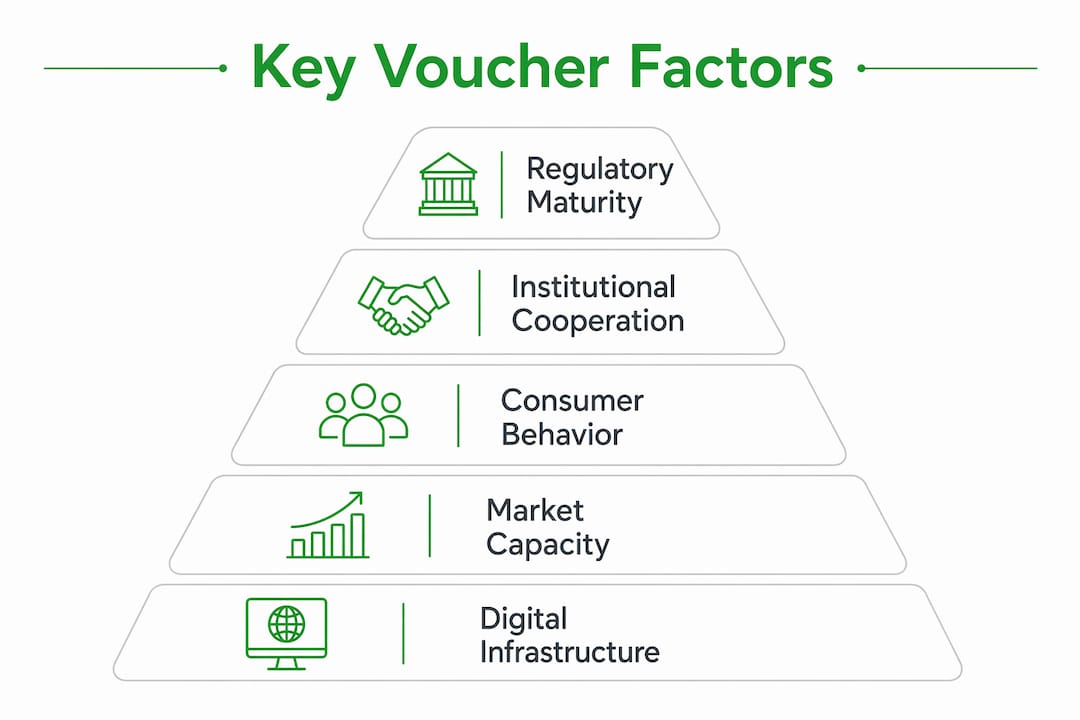
Markets with more vouchers share three traits: mature regulatory frameworks, strong institutional cooperation between governments and businesses, and consumer populations that trust the redemption process. The global gift voucher market is projected to reach $833,828.46 million by 2033, growing at a 6.5% CAGR between 2025 and 2033, and that growth is not evenly distributed. Some markets generate far more voucher activity than others, and the gap comes down to economics, policy design, and behavior, not just population size.
For business marketers and platform strategists, understanding voucher market distribution is not academic. It directly informs where to launch programs, how to structure them, and why a tactic that works in France or South Korea may underperform in a less institutionally developed market.
Why some markets have more vouchers: the core reasons
The short answer: voucher prevalence correlates directly with how much infrastructure a market has built to support them. That infrastructure is economic, regulatory, and social all at once.
- Regulatory maturity: Social vouchers are active in over 40 countries, including 19 EU member states, because those governments have created legal frameworks, fiscal policies, and oversight systems that make voucher programs viable at scale.
- Institutional cooperation: Voucher systems depend on a cooperative relationship among firms, social economy organizations, governments, and voucher issuers. Without that alignment, programs stall at the pilot stage.
- Government fiscal capacity: Local governments’ fiscal capacity influences their preference for competitive tendering models versus partnering with for-profit providers to manage voucher program costs.
- Platform and digital infrastructure: The meal voucher market was valued at $80.30 billion in 2025 and is forecast to reach $162.20 billion by 2036 at a 6.6% CAGR, driven largely by digital card and mobile wallet adoption. Markets without that infrastructure lag.
- Consumer trust and behavior: Where consumers trust the redemption process and understand how vouchers work, adoption rates climb. Where they do not, even free vouchers go unused.
Economic and strategic rationales behind voucher distribution differences
The economic logic behind voucher programs is straightforward: they direct consumption toward specific goods, services, or markets while indirectly increasing the purchasing power of recipients. But the strategic decisions around how to structure a voucher program vary considerably based on local market conditions.
Market capacity shapes the model. Research on Korean elderly care voucher markets found that higher market attractiveness increases the likelihood that local governments choose competitive tendering over fixed price and quality models. In other words, when a market is attractive enough to draw multiple providers, governments can let competition do the work. When it is not, they set the terms themselves.
Fiscal constraints push governments toward private sector partners. A study of Korea's social service voucher program, which examined 1,101 local markets, found that local governments with lower fiscal capacity are more motivated to encourage for-profit provider entry. They need private actors to absorb transaction costs the government cannot afford to manage alone.
Competitive dynamics among retailers amplify voucher activity. In markets where retailers compete aggressively for consumer spending, vouchers become a standard tool for customer acquisition and retention. The US meal voucher market sustains growth specifically through expanding corporate benefit programs and digital platform launches, according to Future Market Insights.
- Demographic factors matter too. Younger, urban, digitally active populations adopt vouchers faster. Markets with older or rural-skewing demographics often require paper-based systems and community distribution networks to achieve comparable penetration.
- Formalizing informal economies. Vouchers serve as a mechanism to pull spending from informal to formal markets. The OECD notes that personal and household service vouchers in France, for example, create jobs and support formalization of labor that would otherwise remain off the books.
Pro Tip: When entering a new market with a voucher program, map fiscal capacity and existing provider density before choosing your model. A competitive tendering approach in a thin market will attract few providers and frustrate consumers.
How regulatory maturity shapes voucher ecosystems
Regulatory frameworks do not just permit vouchers. They define what vouchers can do, who can issue them, where they can be redeemed, and how they are taxed. Markets with mature regulatory regimes have resolved these questions. Markets without them are still working through them.

The OECD's analysis of social voucher programs across Belgium, Brazil, France, Mexico, and Romania shows a consistent pattern: the countries with the deepest voucher penetration are those where vouchers are regulated by law and supported by specific fiscal frameworks. France's food voucher system, for instance, operates under a legal ceiling on daily value, tax-exempt status for employers, and a merchant acceptance network built over decades.
Institutional cooperation is the structural backbone. Voucher programs succeed where governments formalize collaboration with businesses and social organizations, embedding redemption into existing merchant networks. Without that cooperation, a voucher is just a piece of paper with no guaranteed place to spend it.
- Legal and administrative infrastructure: Redemption networks require contracts, verification systems, and dispute resolution mechanisms. Markets that have built these systems attract more issuers and more merchants, which expands the ecosystem.
- Local government fiscal capacity: As noted in the Korean homecare research, fiscal capacity affects voucher model choice. Governments with more resources can run more complex, competitive programs. Those with less tend toward simpler, fixed-term models.
- Regulations define eligible sectors. In Belgium, eco-vouchers target environmentally friendly purchases. In France, culture vouchers target arts spending. The regulatory decision about which sectors qualify shapes the entire market structure around that voucher type.
Digitalization has accelerated regulatory development in many markets. Belgium and Brazil have achieved full digitalization of food and meal vouchers, which reduces administrative burden and enables real-time monitoring. France and Romania are expanding digital systems. The US market advances at a 7.0% CAGR through corporate benefit program expansion and digital platform growth, but lacks the centralized government frameworks that drive European penetration rates.
For real estate investors and platform strategists working in the US, understanding how Section 8 voucher regulations shape market behavior is the direct parallel to these broader regulatory dynamics. The rules governing voucher expiration, portability, and eligible properties determine where voucher holders can spend, which concentrates demand in specific markets.
How consumer behavior drives voucher adoption differences
Behavioral economics explains a lot about why some markets use vouchers heavily and others do not, even when the programs are nominally available to everyone.
Research on Taiwan's triple stimulus voucher program found that behavioral factors outweigh rational ones in voucher choice. Despite active government promotion of digital vouchers, Taiwanese consumers overwhelmingly chose paper. The study, based on survey data from 183 individuals, found that analysis paralysis had the greatest impact on decision comfort, and it pushed people toward paper as a "safe haven" amid uncertainty and information overload. Paper vouchers reduce cognitive load. They feel tangible, trackable, and simple.
Social proof drives adoption in emerging voucher markets. Research on Vietnamese employees' online service voucher purchases found that group consultation was the single strongest factor influencing purchase decisions, outweighing price, convenience, and prior online shopping experience. When people see their peers using vouchers and hear positive reports, they follow. Where that social proof is absent, adoption lags regardless of the voucher's face value.
- Mental accounting comfort: Consumers use paper vouchers as a budgeting tool. Knowing exactly how much is on a voucher and tracking it physically gives people a sense of control that digital balances do not always replicate.
- Referral networks in less mature markets: Where formal advertising is less effective, word-of-mouth referral networks become the primary distribution channel for voucher awareness. Programs that build community-based distribution see higher uptake than those relying on mass media.
- Unofficial costs inhibit uptake: Research from Cambodia's reproductive health voucher program found that unofficial payments to providers, known locally as "tea money," deterred women from redeeming vouchers even when the vouchers were free. The nominal cost of a voucher is not the only cost consumers weigh.
Pro Tip: Tailor voucher design to the behavioral tendencies of your target market. In high-uncertainty environments, paper or card-based formats with clear face values outperform app-based digital wallets, even among smartphone users.
Complexity kills adoption. Voucher systems that require multiple steps, unfamiliar apps, or unclear redemption rules see lower uptake. The research on stimulus voucher adoption is direct on this point: simplifying financial management for users and reducing analysis paralysis are prerequisites for broad adoption, not nice extras.
Types of vouchers and how they differ from coupons
Vouchers and coupons are often used interchangeably, but they function differently, and that distinction matters for market analysis.
A coupon typically offers a discount on a specific product or service at the point of purchase. It reduces the price but does not hold independent monetary value. A voucher, by contrast, holds redeemable value equivalent to a credit. You can spend it like cash within a defined network, and it often covers the full cost of a transaction rather than just reducing it.
The three core voucher types in most market frameworks are:
- Receipt vouchers: Issued as proof of payment or entitlement, often used in government benefit programs. Section 8 housing vouchers in the US operate on this model: the voucher certifies eligibility and defines the subsidy amount.
- Payment vouchers: Used to transfer value between parties, common in corporate benefit programs. Meal vouchers and gift cards fall here.
- Transfer vouchers: Move purchasing power from one party to another, often from government to consumer, as in food assistance programs or COVID-19 stimulus vouchers.
Who bears the cost shapes the market. In corporate meal voucher programs, the employer funds the voucher and often receives a tax benefit for doing so. In government social programs, the public treasury funds the voucher. In promotional programs, the retailer absorbs the cost as a customer acquisition expense. Each cost-bearing structure creates different incentives for issuers, merchants, and consumers, which is why voucher markets look so different across sectors.
Vouchers serve multiple strategic functions simultaneously. A childcare voucher in Belgium supports social inclusion, creates formal employment, and channels spending to licensed providers. An innovation voucher for SMEs in Belgium funds consultancy services toward Industry 4.0 adoption. The same instrument serves social, economic, and regulatory goals at once. That versatility is precisely why governments and businesses in mature markets use them so extensively.
Understanding these distinctions helps platform strategists identify which voucher type fits their market context. For real estate investors analyzing Section 8 market dynamics, the receipt voucher model creates predictable, government-backed demand in specific geographic markets, which is a fundamentally different opportunity than a retail coupon strategy.
How voucher systems evolved differently across markets
The historical path each market took explains much of the variation in voucher prevalence today. Voucher systems did not emerge uniformly. They developed in response to specific economic pressures, policy experiments, and institutional capacities that varied widely by country and region.
The US followed a welfare-to-work logic. The Section 8 Housing Choice Voucher Program, established under the Housing and Community Development Act of 1974, was designed to give low-income households portable housing subsidies rather than placing them in government-owned housing. The program embedded vouchers into a private rental market, creating a demand-side subsidy model that has shaped US housing policy for over five decades. The logic was market-based from the start: let recipients choose their housing, and let landlords compete for their business.
Europe built voucher systems through labor and social policy. France introduced meal vouchers in 1967 as a tax-advantaged employee benefit, creating a system that now covers millions of workers. Belgium expanded the model to include eco-vouchers, culture vouchers, and childcare vouchers over subsequent decades. The European approach embedded vouchers into formal employment relationships and collective bargaining frameworks, which is why European voucher penetration in the workforce is structurally higher than in the US.
Developing markets used vouchers as health and social delivery tools. Cambodia's reproductive health voucher program, supported by the German Development Bank (Kreditanstalt für Wiederaufbau) and the Cambodian Ministry of Health, used vouchers to overcome access barriers for poor women. The program gave vouchers to poor households for specific health services, with pre-approved providers reimbursed for serving voucher clients. This demand-side subsidy model mirrors the US Section 8 structure but applied to healthcare in a low-income country context.
COVID-19 accelerated voucher adoption globally. Governments across Europe, Asia, and Latin America turned to vouchers as a rapid-response tool during the pandemic. Taiwan's triple stimulus voucher program, Belgium's consumption vouchers, and Brazil's informal worker vouchers all launched or expanded between 2020 and 2022. The crisis demonstrated that voucher infrastructure built over years could be repurposed quickly for emergency stimulus, which reinforced government confidence in the model. South Korea and Japan are now the fastest-growing meal voucher markets, driven by corporate welfare reform and digital payment ecosystem integration.
Digital infrastructure created new divergence. Markets that invested early in digital payment infrastructure, like South Korea is growing at a 9.0% CAGR, and Japan also shows strong growth driven by corporate welfare reform and expanding meal benefit adoption. Both countries are pulling ahead in voucher adoption because digital delivery reduces distribution costs and increases redemption convenience. Markets still relying on paper booklets face structural limits on scale. The transition from paper to digital is not just a technology upgrade. It is a market expansion mechanism, and markets that complete it first gain a compounding advantage in voucher program depth and reach.
For platform strategists evaluating where to build or expand voucher programs, the historical trajectory of a market predicts its current infrastructure. A market with decades of formal voucher policy has merchant networks, consumer familiarity, and regulatory clarity already in place. A market without that history requires building all three from scratch, which is a fundamentally different investment.
Deal-zilla's Section 8 Investment Analyzer gives real estate investors direct access to HUD rates, real Section 8 data, and market comparison tools that translate these voucher dynamics into actionable investment decisions. Understanding why some markets have deeper voucher penetration is the first step. Knowing which specific markets offer the best risk-adjusted returns for Section 8 investors is where the analysis pays off.

Key Takeaways
Voucher prevalence is determined by regulatory maturity, institutional cooperation, and behavioral infrastructure, not market size alone.
| Point | Details |
|---|---|
| Regulatory frameworks drive prevalence | Social vouchers are active in many countries worldwide, including numerous EU member states, where legal and fiscal frameworks support them. |
| Fiscal capacity shapes the model | Local governments with lower fiscal capacity promote for-profit entry; higher capacity correlates with competitive tendering models. |
| Behavioral factors determine adoption | Analysis paralysis and mental accounting comfort push consumers toward paper vouchers even when digital options are available. |
| Social proof accelerates uptake | Group consultation is the strongest factor influencing online service voucher purchases, outweighing price and convenience. |
| Digital infrastructure expands markets | The meal voucher market has seen substantial growth in recent years and is forecast to continue expanding significantly through 2036, driven by digital card adoption. |