
A voucher expiration is the deadline by which a housing assistance voucher must be used to find and lease an eligible rental unit. Miss that date, and the voucher becomes void. For Section 8 participants, this is not a technicality. It is the difference between securing subsidized housing and restarting a waiting list that can stretch years. Under 24 CFR 982.303, federal law sets a minimum search term of 60 calendar days, but the real risk lies in what happens when that clock runs out without a signed lease.
What is a voucher expiration and how does the validity period work?
A voucher expiration marks the last day a voucher holder can submit a Request for Tenancy Approval to their Public Housing Authority (PHA). After that date, the voucher is administratively void. The PHA countdown begins on the issue date printed directly on the voucher document.
Federal law under 24 CFR 982.303 sets the minimum voucher validity period at 60 calendar days. That is the legal floor, not the standard. Most PHAs in competitive rental markets issue initial terms of 90–120 days to reflect real housing conditions.

The gap between the federal minimum and local practice matters. The average voucher holder needs about 78 days to find an eligible unit, according to 2026 data. A PHA that issues only a 60-day term is setting many families up to need an extension before they even start.
Voucher validity periods also vary by jurisdiction. A PHA in a tight urban market like Los Angeles or New York City may issue 120-day terms as standard practice. A rural PHA with more available inventory may stick closer to the federal minimum. The initial term must be stated on the voucher itself, so voucher holders should read that document the day they receive it.
Pro Tip: Read your voucher document on day one. The issue date and expiration date are printed on it. Mark the expiration date on your calendar immediately and count backward to set your own internal deadlines.
How do voucher extensions work, and when should you request one?
Extensions are not guaranteed, but they are available. PHAs have discretion to grant extensions in most cases, and the PHA Administrative Plan defines the exact limits and procedures for your jurisdiction. Reading that document is the single most important step a voucher holder can take after receiving a voucher.
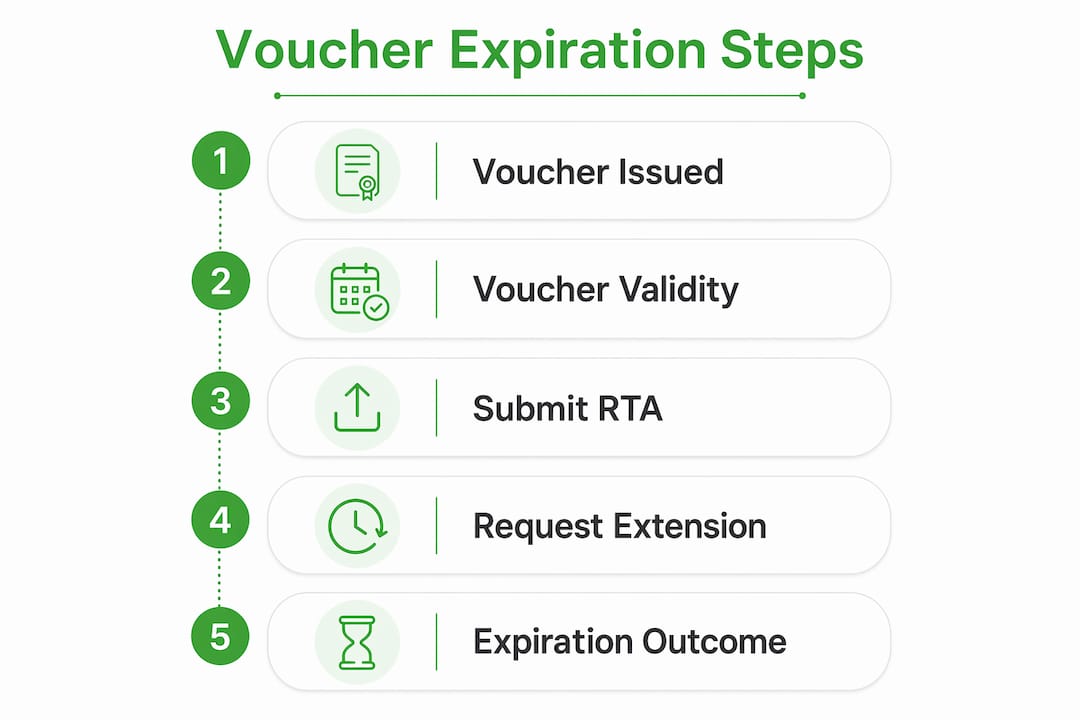
Standard extensions are typically granted in 30–60 day increments. The process requires a written request submitted to the PHA before the voucher expires. A request submitted after the expiration date will almost always be denied.
There is one category where extensions are not discretionary at all. Voucher holders with disabilities can request a reasonable accommodation extension under federal fair housing law. PHAs cannot deny these requests. This creates a legally distinct category separate from standard discretionary extensions, and it carries real weight.
The quality of your extension request determines whether it gets approved. PHAs respond to evidence, not explanations. A documented search log showing every unit contacted, every rejection received, and every reason for that rejection gives the PHA a factual basis to approve the extension.
Here is a practical approach to building an effective extension request:
- Start your search log on day one of the voucher term. Record every unit you contact, the address, the landlord's name, the date of contact, and the outcome.
- Note specific rejection reasons. "Landlord does not accept vouchers" or "unit failed HQS inspection" are concrete, documentable facts.
- Request the PHA Administrative Plan in writing within the first week. Know the extension limits before you need them.
- Submit your extension request at least two weeks before the expiration date. Early requests signal good faith.
- Include supporting documents with the request: search logs, rejection letters, and any correspondence with landlords.
Pro Tip: Never wait for the PHA to contact you about an approaching expiration. PHAs treat expiration as an administrative outcome, not a problem they will solve for you. Proactive communication is the only reliable strategy.
What happens if a voucher expires?
Voucher expiration results in the immediate loss of housing assistance. The voucher becomes void, and the family loses its place in the program. Losing a voucher to expiration typically means reapplying and rejoining the waiting list at the bottom.
That consequence is severe. Many Section 8 waiting lists are closed or carry wait times measured in years. A family that loses a voucher to expiration may not receive another one for a decade in some jurisdictions. The stakes are not abstract.
Roughly 4 in 10 newly issued vouchers expire unused each year, according to HUD administrative data. That figure represents thousands of families who received assistance and then lost it before securing a unit. The most common cause is not lack of effort. It is lack of strategy, documentation, and timely communication with the PHA.
The scale of unused voucher expiration also affects housing markets. When vouchers expire unused, the federal funding attached to them goes unspent. PHAs face administrative pressure to reduce expiration rates, which is why documented extension requests carry weight.
Key steps to avoid forfeiture:
- Track the expiration date from day one and set calendar reminders at the 30-day and 14-day marks.
- Begin your housing search immediately after receiving the voucher. Do not wait for the "right" unit.
- Contact the PHA in writing if you encounter systemic barriers such as landlord refusal to accept vouchers.
- Request an extension before the deadline, not on the deadline.
- If you have a disability, request a reasonable accommodation extension in writing and cite fair housing law explicitly.
How landlords and tenants can navigate voucher expiration in rental agreements
Voucher expiration directly affects lease timing decisions. A landlord who holds a unit off the market for a voucher holder takes on real risk if that voucher expires before a lease is signed. Understanding voucher timelines helps landlords make informed decisions about how long to wait and when to move on.
Landlords benefit from asking voucher holders directly about their expiration date at the start of any tenancy discussion. This is not invasive. It is practical. A voucher with 10 days remaining is a different situation than one with 60 days remaining, and the lease offer timeline should reflect that.
One distinction that both landlords and tenants frequently misunderstand is the difference between voucher expiration and lease termination. Ending a lease does not mean the voucher expires. A Housing Assistance Payment (HAP) contract can end when a tenancy ends, but the voucher itself remains valid if the tenant is in good standing with the PHA. That tenant then enters a new search period with a new voucher term.
Best practices for landlords working with voucher holders:
- Ask for the voucher issue date and expiration date before scheduling an HQS inspection.
- Factor the HQS inspection timeline into your lease offer. Inspections can take one to two weeks, which eats into the voucher validity period.
- Maintain open communication with the PHA during the leasing process. Delays on the landlord side can contribute to voucher expiration.
- Review property cash flow strategies that account for the administrative timelines specific to Section 8 tenancies.
Tenants should keep landlords informed about their voucher status throughout the search. A landlord who understands the deadline is more likely to prioritize the HQS inspection and paperwork.
Key Takeaways
A voucher expiration is a hard administrative deadline. Missing it means losing the voucher entirely and restarting a waiting list process that can take years.
| Point | Details |
|---|---|
| Federal minimum is 60 days | Under 24 CFR 982.303, PHAs must grant at least 60 calendar days; many issue 90–120 days. |
| Average search takes 78 days | Most voucher holders need more than the federal minimum, making extensions a common necessity. |
| Extensions require written requests | Submit your request before expiration with documented search logs to improve approval odds. |
| Disability accommodations are mandatory | PHAs cannot deny reasonable accommodation extensions under federal fair housing law. |
| Expiration is not the same as lease termination | A HAP contract ending does not void the voucher if the tenant remains in good standing with the PHA. |
What I've learned about voucher expiration after years of watching it go wrong
The single most common mistake I see is passive waiting. A voucher holder receives the document, feels relieved, and then treats the search period as open-ended. It is not. The PHA does not send reminders. The clock runs regardless of whether you are actively searching or not.
Reading the PHA Administrative Plan on day one is not optional. That document tells you exactly how many extensions you can request, what evidence the PHA requires, and what the maximum extension period is. Voucher holders who skip this step often discover the rules only when they are denied an extension they assumed they could get.
The distinction between voucher expiration and HAP contract termination also trips people up constantly. I have seen tenants panic when a lease ends, believing their voucher is gone. It is not, provided they stayed in good standing. Clarity on this point prevents bad decisions, including accepting poor housing conditions out of fear of losing assistance that was never actually at risk.
My honest advice: treat the voucher search term like a project with a fixed deadline. Document everything. Communicate early. And if you have a disability, invoke your reasonable accommodation rights in writing from the start. The law is on your side, but only if you use it.
— ARX
Deal-zilla tools for landlords managing Section 8 timelines
Section 8 investing requires tracking more than rent. Voucher validity periods, HQS inspection windows, and HAP contract timelines all affect when a unit generates income.

Deal-zilla builds tools specifically for investors working with Section 8 data. The Section 8 Investment Analyzer, Rent Analyzer, and real HUD rate data give landlords a factual basis for lease timing decisions and rental offer calculations. When a voucher holder's expiration date affects your leasing window, Deal-zilla helps you run the numbers before committing. Visit Deal-zilla to see how the platform supports Section 8 investment decisions with real data.
FAQ
What is a voucher expiration in Section 8?
A voucher expiration is the deadline by which a Section 8 voucher holder must find an eligible unit and submit a Request for Tenancy Approval to the PHA. After that date, the voucher becomes void and housing assistance is lost.
How long does a Section 8 voucher last before it expires?
Federal law under 24 CFR 982.303 requires a minimum of 60 calendar days. Most PHAs issue 90–120 day terms, and 2026 data shows the average search takes about 78 days.
Can you extend a Section 8 voucher before it expires?
PHAs can grant extensions in 30–60 day increments at their discretion. Requests must be submitted in writing before the expiration date and should include documented evidence of an active housing search.
What happens if your voucher expires before you find housing?
The voucher becomes void and you lose housing assistance. In most jurisdictions, you must reapply and rejoin the waiting list from the bottom, which can mean years without assistance.
Is voucher expiration the same as a HAP contract ending?
No. A HAP contract termination ends the lease agreement, but the voucher itself remains valid if the tenant is in good standing with the PHA. The tenant then receives a new search period with a new voucher term.