
Rent reasonableness is the federal standard, defined under 24 CFR 982.507, that prevents landlords from charging more for a Section 8 voucher unit than what comparable unassisted units rent for in the same market. This rule sits at the center of every Housing Choice Voucher transaction. It protects taxpayers from inflated subsidies, protects tenants from unfair pricing, and determines whether your lease gets approved at all. For landlords and property managers, understanding why rent reasonableness matters is not optional. It is the difference between a signed Housing Assistance Payment contract and a failed lease-up.
Why rent reasonableness matters in Section 8 housing
Rent reasonableness functions as a market-based rent ceiling. A Public Housing Agency (PHA) will not approve a contract rent that exceeds what a comparable unassisted unit rents for in the same area. This requirement applies before the initial lease, before any rent increase, and whenever Fair Market Rent drops by 10% or more. That last trigger catches many landlords off guard.
The rule exists to protect the integrity of the voucher program. Rent reasonableness determinations prevent inflated rents and keep subsidy spending equitable across the housing market. Without this check, landlords could price voucher units above market, effectively extracting excess public funds.

Failing the test has real consequences. A lease cannot be approved without passing rent reasonableness. Rent increases during a tenancy require a new determination. If your unit fails, the PHA will not execute or renew the HAP contract until the rent is adjusted downward. That means lost rental income and a delayed or canceled tenancy.
How do PHAs determine rent reasonableness?
PHAs compare your proposed contract rent against at least three comparable unassisted units in the same market. The comparison criteria include:
- Unit size: bedroom and bathroom count
- Building type: single-family, duplex, garden apartment, high-rise
- Location: proximity to the subject property, neighborhood quality
- Physical condition: age, maintenance level, structural quality
- Amenities: parking, laundry, appliances, outdoor space
- Utilities: which utilities are included in the rent
PHAs pull comparable data from internal databases built over time, public rental listings, and periodic market surveys. The quality of that database directly affects how accurate the comparison is. A PHA with outdated data may undervalue your unit. One with current listings may approve a higher rent.
Subsidized units are excluded from comparisons by design. Low-Income Housing Tax Credit (LIHTC) properties, HOME-funded units, and other assisted housing do not count as market comparables. This exclusion ensures the government bases its subsidy on true private market conditions, not artificially suppressed rents from other programs.
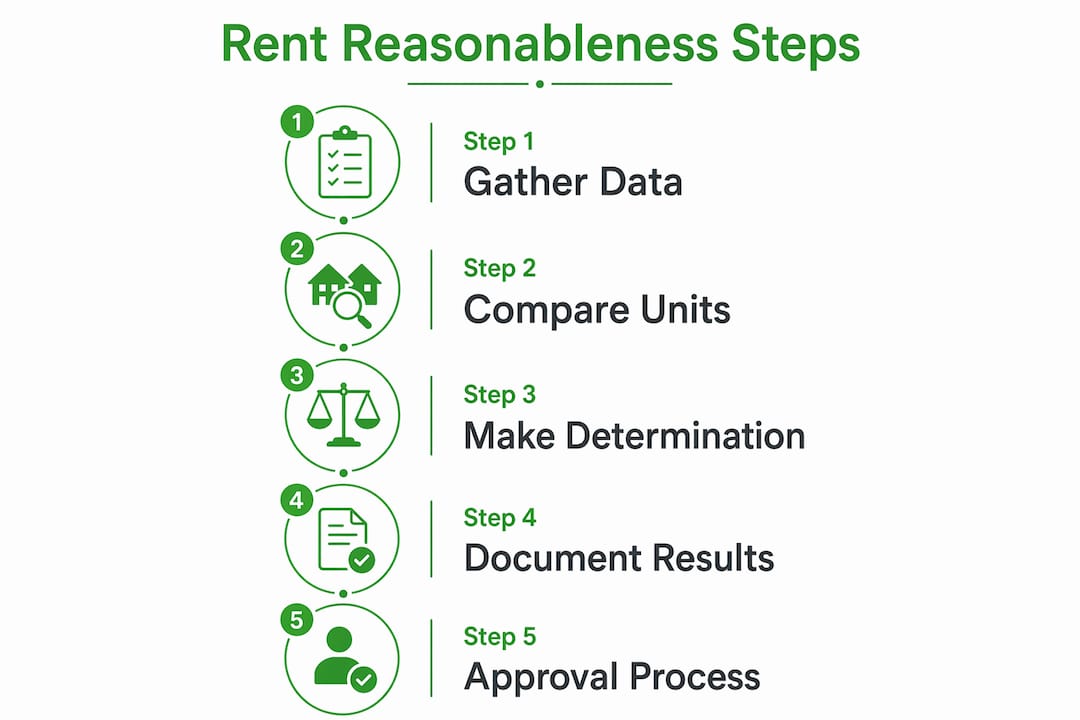
Documentation matters. PHAs must record the comparable units used, the data source, and the determination outcome. Landlords who understand this process can analyze comparable rental properties before submitting a rent request, which puts them in a stronger position from the start.
Pro Tip: Before submitting your rent to the PHA, pull your own comparables from local listings. If your unit has above-average amenities or recently renovated finishes, document them with photos and a written description. PHAs can only approve what they can justify.
What is the difference between rent reasonableness, payment standards, and FMR?
These three concepts are related but distinct. Confusing them costs landlords money and causes failed approvals.
| Concept | What it is | Who sets it |
|---|---|---|
| Rent reasonableness | Market-based cap on contract rent | Determined by PHA using local comparables |
| Payment standard | Subsidy cap for a given unit size | Set locally by each PHA, based on FMR |
| Fair Market Rent (FMR) | HUD's estimate of gross rent at the 40th percentile | Set annually by HUD for metro areas |
Rent reasonableness and the payment standard operate independently. Your rent can pass the reasonableness test and still exceed the payment standard. In that case, the tenant pays the difference. The tenant's share cannot exceed 40% of adjusted income at move-in when the rent is above the payment standard. That cap limits how much a tenant can absorb, which effectively limits how high you can price the unit even if the market supports it.
Utilities create another layer of complexity. PHAs evaluate gross rent, which is the contract rent plus any tenant-paid utilities. A unit with a lower contract rent but high tenant-paid utilities may fail the test against a comparable unit where utilities are included. Utilities treatment directly affects gross rent comparisons, and this catches landlords off guard more often than any other factor.
Small Area Fair Market Rents (SAFMRs) add another variable. HUD sets SAFMRs by ZIP code rather than metro area. SAFMR implementation by ZIP code can produce rent reasonableness outcomes that differ significantly from metro-wide FMR expectations. A property in a high-rent ZIP code may qualify for a higher approved rent than the metro average suggests. Knowing your ZIP code's SAFMR is a concrete advantage.
Pro Tip: Always calculate gross rent, not just contract rent, when pricing a Section 8 unit. If your tenant pays electricity and gas separately, add the PHA's utility allowance to your contract rent before comparing it to market rates. That is the number the PHA will actually evaluate.
What are the practical consequences for landlords and property managers?
The impact of rent reasonableness on daily operations is direct and significant. Here is how it plays out across the landlord lifecycle:
-
Lease approval: No lease can be executed without a passed rent reasonableness determination. The PHA will not issue a HAP contract until the test clears. Pricing your unit too high from the start delays the entire process.
-
Rent increases: Every rent increase request triggers a new determination. If the market has softened since your last approval, your increase may be denied. Landlords who track local market trends avoid this surprise.
-
HAP contract maintenance: The HAP contract is the financial backbone of your Section 8 tenancy. Unauthorized charges above the approved contract rent must be refunded, and repeated violations risk removal from the program entirely.
-
Market distortion prevention: Rent reasonableness keeps Section 8 rents aligned with private market rents. This prevents a two-tier market where voucher units are systematically overpriced relative to unassisted units, which would harm both tenants and the broader rental market.
-
Community stability: When rents stay aligned with market rates, voucher holders can access a wider range of neighborhoods. That benefits tenants and supports stable, long-term tenancies, which reduces turnover costs for landlords.
Understanding HUD rate charts gives landlords a clearer picture of where their rents stand relative to FMR benchmarks before they ever submit a request. That preparation reduces back-and-forth with the PHA and speeds up approvals.
How is rent reasonableness evolving in 2026?
PHAs are modernizing how they conduct rent reasonableness determinations. The shift is toward automated, data-driven tools that reduce delays and increase consistency.
- RentWatch Quick Certify is one example of a platform PHAs are adopting to apply algorithmic analysis to rental market data, replacing manual comparisons that relied on staff judgment and outdated spreadsheets.
- Earlier owner involvement is a key feature of modernized processes. Landlords receive rent assessments earlier in the certification cycle, reducing negotiation delays and failed lease-ups.
- Automated market data pulls from live rental listings rather than periodic surveys, making determinations more accurate and more current.
- Transparency improvements give landlords clearer explanations of why a rent was approved or denied, which makes it easier to adjust pricing or submit supporting documentation.
These changes align with broader HUD goals of fiscal responsibility and efficient tenant services. The pressure to modernize comes from both federal oversight and the practical need to reduce the backlog of pending voucher approvals. For landlords, the practical benefit is faster approvals and fewer surprises. The challenge is that automated systems may not capture the full value of a recently renovated unit or a unique amenity package. Landlords who submit strong documentation alongside their rent requests will continue to have an advantage over those who rely on the PHA to discover value on its own.
Key Takeaways
Rent reasonableness is the mandatory federal standard that caps Section 8 contract rents at comparable unassisted market rates, and passing it is required before any lease, rent increase, or HAP contract can be executed.
| Point | Details |
|---|---|
| Federal requirement | Rent reasonableness under 24 CFR 982.507 applies at lease start, rent increases, and FMR drops of 10% or more. |
| Comparability factors | PHAs evaluate size, type, location, condition, amenities, and utilities against unassisted private market units only. |
| Gross rent calculation | Utilities paid by the tenant are added to contract rent; this total is what the PHA compares to market rates. |
| Payment standard is separate | Rent reasonableness and payment standards are independent caps; both must be satisfied for a lease to proceed. |
| Modernization is underway | Automated tools like RentWatch Quick Certify are speeding up determinations and involving owners earlier in 2026. |
The landlord advantage most people miss
Most landlords treat rent reasonableness as a bureaucratic hurdle. I see it differently. It is one of the few places in the Section 8 process where a well-prepared landlord has a genuine edge over a passive one.
PHAs are not appraisers. They work from databases and listings, and those sources are imperfect. A unit with new appliances, a private yard, or an in-unit washer and dryer is worth more than the database entry for a comparable address from two years ago. The PHA will not automatically credit you for those features. You have to show them.
The landlords I have seen succeed consistently in Section 8 do three things differently. They know their local comparables better than the PHA does. They submit documentation proactively, not reactively. And they price their units to pass the test on the first submission, not after two rounds of negotiation.
The utilities trap is real. A landlord who prices a unit at $1,400 with tenant-paid utilities may fail against a comparable at $1,350 with utilities included, because the gross rent comparison puts them over market. Running the gross rent math before you submit is not optional. It is the single most common avoidable failure I see.
The SAFMR shift is also worth watching. If your property sits in a ZIP code with a higher SAFMR than the metro average, you may be leaving money on the table by anchoring to metro-wide FMR figures. Check your specific ZIP code before you set your rent.
— ARX
Deal-zilla tools for Section 8 rent analysis
Section 8 compliance does not have to be a guessing game. Deal-zilla gives landlords and property managers the data and analysis tools to price units correctly, understand HUD benchmarks, and evaluate deals before committing.
The Section 8 Investment Analyzer on Deal-zilla pulls real HUD rate data so you can see exactly where your proposed rent stands relative to FMR and local payment standards. The Rent Analyzer helps you build a defensible comparable set before you ever submit to the PHA. For landlords managing multiple units or evaluating new acquisitions, Deal-zilla's cash flow improvement tools connect rent reasonableness compliance directly to investment performance. Pricing right the first time is not just about compliance. It is about protecting your income.
FAQ
What is the rent reasonableness test?
The rent reasonableness test is a mandatory PHA evaluation that compares a proposed Section 8 contract rent to at least three comparable unassisted units in the same market. A lease cannot be approved if the proposed rent exceeds comparable market rents.
How does rent reasonableness differ from the payment standard?
Rent reasonableness caps the contract rent based on market comparables, while the payment standard caps the subsidy amount the PHA will pay. Both limits apply independently, and a rent can pass one while failing the other.
Do utilities affect the rent reasonableness determination?
PHAs evaluate gross rent, which is the contract rent plus tenant-paid utilities. A lower contract rent with high tenant-paid utilities can still fail the test if the gross rent exceeds comparable units where utilities are included.
When must rent reasonableness be re-evaluated?
Re-evaluation is required before the initial lease, before any rent increase, and when Fair Market Rent decreases by 10% or more. Landlords should plan for this timing when requesting rent adjustments.
Can a landlord dispute a rent reasonableness finding?
A landlord can submit supporting documentation, such as photos, renovation records, and current market listings, to challenge a determination. PHAs are required to consider this evidence before issuing a final decision.