
You can reliably evaluate a Section 8 deal remotely when three conditions hold: a trustworthy local proxy handles the physical inspection, you have the full document package from the seller, and you've confirmed the local PHA's payment standard and inspection policy before running numbers. Miss any one of those, and you're underwriting on assumptions.
Quick remote due-diligence checklist:
- Confirm the tenant's voucher is active and the PHA is accepting new landlords
- Verify the PHA allows Remote Video Inspections (RVI) or has a proxy inspection option
- Request the full document package: rent roll, HAP contract, leases, inspection reports, repair invoices
- Identify and contract a local property manager or inspector before making an offer
- Run a basic underwriting pass/fail using the PHA's actual payment standard, not a statewide average
The single biggest gating factor is the PHA's inspection policy and payment standard. Get those two numbers wrong and every other calculation is fiction.
Table of Contents
- What every remote investor must know about Section 8
- How do you confirm voucher status and PHA rules remotely?
- Can you pass an HQS inspection without being on-site?
- How to underwrite a Section 8 deal remotely
- What documents should you request from the seller?
- How do you screen tenants and manage lease risk remotely?
- How do you hire and manage local partners for remote Section 8 deals
- What timelines and costs should you budget for?
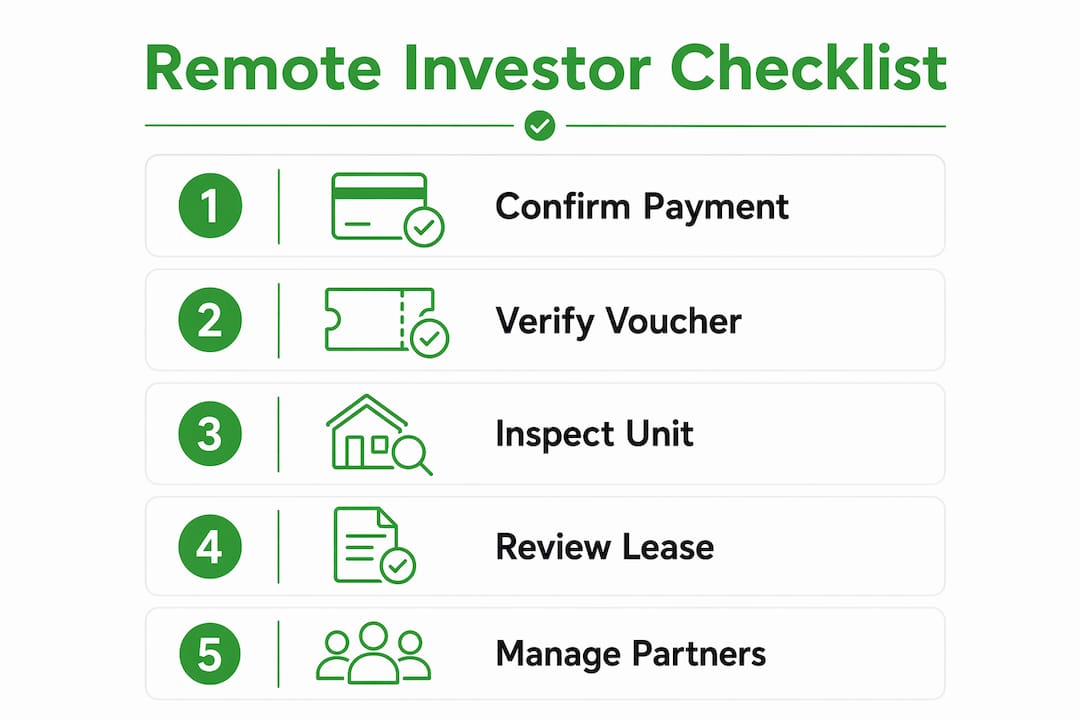
- Step-by-step remote due-diligence checklist
- Key Takeaways
- Why remote Section 8 investing rewards the prepared, not the optimistic
- Deal-zilla makes remote Section 8 underwriting faster
- Useful sources and next steps
What every remote investor must know about Section 8
The Housing Choice Voucher program serves a large number of households and distributes significant annual rental assistance. That scale matters because it signals program durability, but the details that affect your deal are all local.
Key terms, investor-focused:
- PHA (Public Housing Authority): The local agency that administers vouchers, sets payment standards, and schedules inspections. Every PHA operates differently.
- HAP contract: The Housing Assistance Payments contract between you and the PHA. This is what guarantees the government's portion of rent.
- HQS / NSPIRE: Housing Quality Standards is the legacy inspection framework; NSPIRE (National Standards for the Physical Inspection of Real Estate) is the current standard, phased in since 2023. Your property must pass to receive HAP.
- Payment standard: The PHA's maximum subsidy for a given unit size. PHAs set payment standards between 90% and 110% of HUD's published Fair Market Rent (FMR), unless HUD grants an exception.
- Rent reasonableness: The PHA must confirm your contract rent is reasonable compared to unassisted units in the area. Even if you're below the payment standard, you can still fail this test.
- Portability: Vouchers can transfer across PHAs. A tenant's voucher may be administered by a different PHA than the one in your market.
Pro Tip: Check the PHA's budget utilization rate before you underwrite. PHAs are expected to maintain utilization near 95% of their budget authority. A PHA running well below this utilization rate may have administrative friction or payment delays that affect your cash flow.
For a deeper primer on program mechanics and voucher variability, the Deal-zilla housing guide covers PHA-level differences in detail.
How do you confirm voucher status and PHA rules remotely?
Voucher availability and wait times vary at the local PHA level. There is no statewide number you can rely on. Here's the exact remote verification sequence:
- Request tenant documentation: Ask the seller or tenant for the current voucher, the most recent HAP contract, and the PHA contact listed on the contract.
- Call the PHA directly: Ask for the inspections department and the payment standards department separately. They often have different staff and different information.
- Confirm the payment standard: Ask for the current payment standard by bedroom size for the specific zip code or census tract.
- Ask about RVI availability: Not every PHA has adopted Remote Video Inspections. Confirm before you budget for it.
- Check portability rules: If the voucher originated elsewhere, confirm whether the local PHA has absorbed it or is billing the issuing PHA.
- Pull PHA performance data: HUD publishes budget utilization rates for every PHA. Low utilization is a yellow flag.
Sample PHA email questions: "What is the current payment standard for a 3-bedroom unit at [address]? Does your PHA conduct Remote Video Inspections? What is the typical scheduling window for an initial HQS/NSPIRE inspection? Is this voucher currently active and in good standing?"
Check voucher timing and deadlines before you lock in a lease start date. Expired or expiring vouchers can kill a deal at closing.
Can you pass an HQS inspection without being on-site?
Yes. HUD authorizes RVI as an approved inspection method when the PHA has adopted RVI procedures. The inspector conducts the inspection via live video stream; a proxy at the unit follows the inspector's directions in real time. Photos alone are not sufficient.
RVI four-phase workflow:
- Administrative prep: Confirm the PHA uses RVI, select an approved streaming platform (Cisco Webex, Zoom, or Microsoft Teams are commonly accepted), and schedule the inspection window.
- Pre-inspection planning: Advise your proxy of the date, time, required tools, and platform. The LACDA RVI guide recommends the proxy be ready within a 60-minute window around the scheduled call to avoid a "no entry" outcome.
- Inspection performance: The proxy walks every room on camera, following the inspector's directions. The inspector verifies the unit address from outside before starting.
- Post-inspection: The PHA notifies the proxy and tenant of results. Archive the streaming record, any screenshots, and the written report.
Required equipment at the unit: smartphone or tablet with a high-resolution camera and reliable internet, tape measure, flashlight, circuit analyzer, and smoke/CO test devices. HUD recommends all of these as standard RVI tools.
Proxy vetting checklist: government-issued ID, ability to follow inspector directions without improvising, no conflict of interest with the tenant, and familiarity with the unit layout. If the PHA requires a licensed inspector as proxy, budget for that.
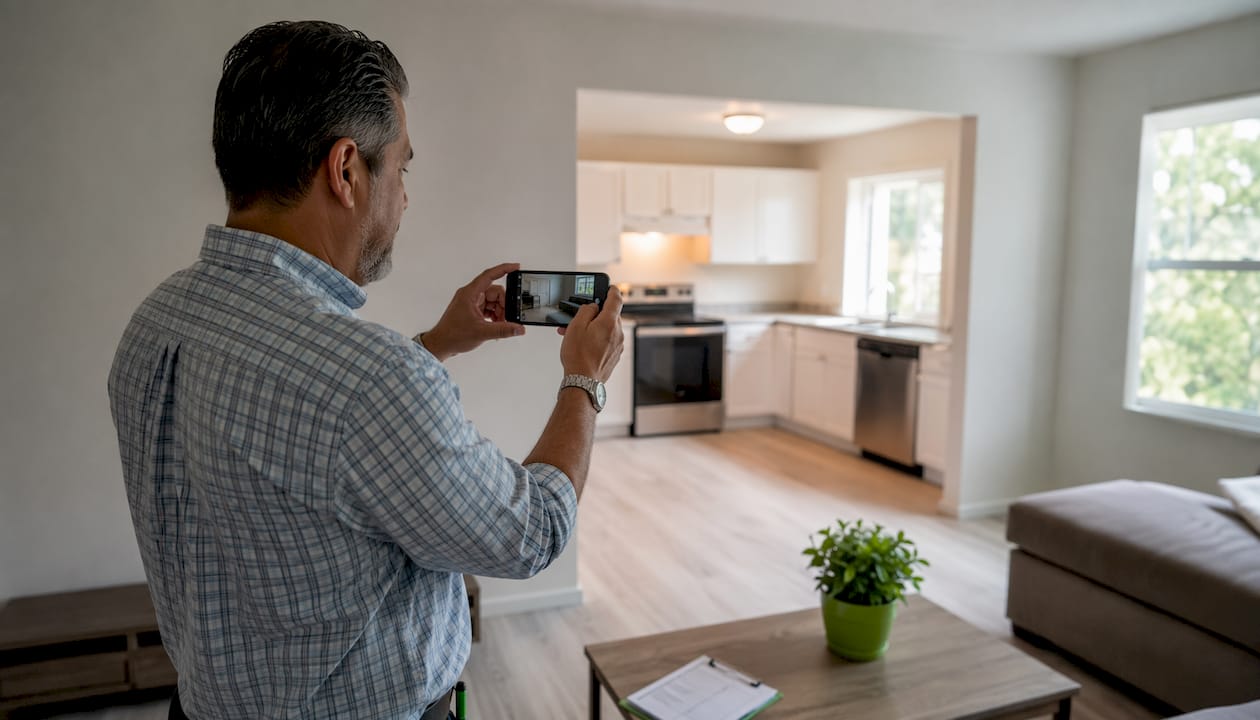
Pro Tip: Require your proxy to capture timestamped still photos alongside the live stream. RVI shifts risk to documentation quality. Timestamped photos paired with the video record give you a defensible defect log for lender due diligence and future re-inspections.
HUD notes that PHAs retain discretion to require an on-site inspection when the video evidence is insufficient. Build that contingency into your timeline.
How to underwrite a Section 8 deal remotely
Remote underwriting hinges on three accurate inputs: the HAP payment estimate, a confirmed rent reasonableness determination, and conservative expense assumptions. Get the payment standard from the PHA directly, not from a listing.
Required inputs:
- Contract rent (what you'll charge)
- Payment standard (PHA maximum subsidy for the unit size)
- Tenant contribution (roughly 30% of adjusted income; the PHA calculates this)
- Vacancy assumption (use 5–8% for stabilized Section 8; higher for a new lease-up)
- Maintenance and CapEx reserve, property taxes, insurance, management fee, and financing costs
Core formulas:
- HAP payment = Payment standard minus tenant contribution
- Gross potential income (GPI) = Contract rent × 12
- Effective gross income (EGI) = GPI × (1 minus vacancy rate)
- NOI = EGI minus operating expenses
- Cap rate = NOI ÷ purchase price
- Cash-on-cash return = Annual cash flow ÷ total cash invested
For cash-on-cash return examples specific to Section 8 deals, Deal-zilla's worked examples show how payment standard variance moves the numbers.
Sample calculation:
A 5% drop in the payment standard shaves roughly $34 off annual NOI here. Run the same sensitivity on CapEx and vacancy to find your floor. Understanding why rent reasonableness matters is the other half of this calculation.
For deals using DSCR financing, confirm your NOI supports a DSCR of at least 1.20 before proceeding.
What documents should you request from the seller?
Request these before making an offer, not after:
- Current rent roll with tenant names, unit numbers, and monthly rents
- Active HAP contract (all pages, including the rent schedule)
- Tenant voucher copies and PHA contact information
- Most recent NSPIRE/HQS inspection report and any correction notices
- Repair invoices for the past 24 months
- Dated interior and exterior photos or video walkthroughs
- Utility history (12 months minimum)
- Property tax records and current insurance declarations
- Lease agreements (all active tenants)
Verification steps: Check photo metadata for timestamps and GPS data. Cross-reference repair invoice dates against inspection reports. Call the PHA to confirm the HAP contract number is active. Look up the property in county tax records to verify ownership and tax status. If HAP deposit records are available, confirm the payment pattern matches the HAP contract amounts.
Red flags that require an on-site check: mismatched unit descriptions between the lease and the HAP contract, inconsistent signatures across documents, unverifiable HAP payment history, or inspection reports with no correction follow-up on cited deficiencies.
How do you screen tenants and manage lease risk remotely?
Standard screening applies, but add voucher-specific items. Confirm the HAP start date, portability conditions, and any PHA-specific lease addenda before signing.
Screening checklist:
- Government-issued ID verification
- Criminal and background check (follow Fair Housing Act and local ordinances on permissible criteria)
- Rental history with prior landlord contacts
- Confirm voucher eligibility and the effective HAP date with the PHA
Suggested lease clauses: HAP payment clause specifying what happens if HAP is abated; rent adjustment process tied to annual PHA recertification; access terms for RVI or repairs with reasonable notice; and remedies for nonpayment of the tenant's share.
Remote risk controls: Keep the security deposit in a compliant escrow account. Designate a local emergency contact with authority to authorize repairs up to a set dollar threshold. Document every PHA communication in writing for HAP audit purposes.
How do you hire and manage local partners for remote Section 8 deals
Qualified local partners are what make remote Section 8 investing work. A good property manager who knows the local PHA is worth more than any tool.
Vendor vetting checklist:
- Three references from current Section 8 landlords
- Proof of licensure, insurance, and bonding
- Sample inspection photos and repair documentation from prior jobs
- Background check for property managers with financial authority
- Google Maps or time-stamped evidence of prior work in the target market
Contract clauses that matter: Define inspection photo deliverables (timestamped, geotagged), response time for maintenance calls (24 hours for urgent, 72 hours for routine), holdback provisions for warranty work, and monthly KPI reporting.
Monthly KPIs to require: occupancy rate, unit turn time, NSPIRE inspection pass rate, HAP payment receipt date, and maintenance spend versus budget. If a manager can't produce these monthly, find one who can.
What timelines and costs should you budget for?
Expect longer lead times than a standard rental. PHA interactions add weeks, not days.
| Phase | Typical timeline |
|---|---|
| PHA voucher verification | 3–7 business days |
| RVI scheduling and inspection | 1–3 weeks |
| Repair completion (if needed) | 1–6 weeks depending on scope |
| Lease execution and HAP contract | 1–2 weeks post-inspection pass |
| First HAP payment received | 30–45 days after lease start |
Primary cost buckets: inspection and proxy fees, travel costs if an on-site visit becomes necessary, repair contingency (budget at least one month's rent), property management setup fee, security deposit float, and working capital to cover the gap before the first HAP payment arrives. For properties needing significant rehab before passing NSPIRE, an FHA 203(k) loan may be worth evaluating as a financing option.
Step-by-step remote due-diligence checklist
- Initial inquiry (Day 1–3): Request the full document package; confirm the property address and PHA jurisdiction.
- PHA confirmation (Day 3–7): Call the PHA to verify voucher status, payment standard, and RVI availability.
- Document review (Day 5–10): Review rent roll, HAP contract, leases, inspection reports, and repair invoices. Flag red flags.
- Underwriting pass/fail (Day 7–10): Run NOI, cap rate, and cash-on-cash using the confirmed payment standard. Set a minimum cash flow threshold.
- Local partner onboarding (Day 10–14): Contract a property manager and inspector. Brief them on RVI requirements.
- Schedule RVI (Day 14–21): Coordinate proxy, equipment, and streaming platform. Confirm the 60-minute availability window.
- Inspection and repair assessment (Day 21–35): Complete RVI; get repair bids if deficiencies are found. Revise underwriting if repair costs change the return.
- Closing conditions (Day 35–45): Require inspection pass, verified HAP contract, and signed lease as closing conditions.
- Post-close inspection schedule: Set quarterly self-inspections and annual NSPIRE prep reviews with your local manager.
Decision gates: Walk away if the PHA won't confirm the payment standard in writing, if repair costs exceed your contingency budget, or if document authenticity can't be verified. Require an on-site inspection if the RVI reveals conditions the video can't fully document.
Key Takeaways
Evaluating a Section 8 deal remotely is practical when you confirm the PHA's payment standard and inspection policy first, use a vetted proxy for RVI, and underwrite conservatively with real local data.
| Point | Details |
|---|---|
| PHA policy is the gating factor | Confirm payment standard and RVI availability before running any numbers. |
| RVI is HUD-authorized | HUD approves Remote Video Inspections when the PHA has adopted the procedure and a qualified proxy is used. |
| Budget utilization signals reliability | PHAs maintaining utilization near 95% of their budget authority are a stronger bet for consistent, timely HAP payments. |
| Conservative underwriting protects returns | Model a 5–10% payment standard drop and a 6–8% vacancy rate to stress-test cash flow before committing. |
| Deal-zilla tools map to each step | The Section 8 Investment Analyzer and Rent Analyzer cover the exact inputs and sensitivity analysis this process requires. |
Why remote Section 8 investing rewards the prepared, not the optimistic
The conventional wisdom is that Section 8 is either a passive income machine or a compliance nightmare. Neither framing is accurate. What it actually is: a program with reliable payment mechanics and real administrative complexity, where the investor's edge comes from knowing the local PHA better than the next buyer does.
The RVI workflow is a genuine advantage for remote investors. It removes the biggest logistical barrier to out-of-state deals. But the investors who get burned aren't the ones who skipped the site visit. They're the ones who treated "remote-friendly" as "hands-off." Annual NSPIRE inspections, re-inspection cycles, and HAP audits all require an accountable local representative and documented follow-up. The proxy for the RVI is not a substitute for a property manager who knows the PHA's inspectors by name.
The other underrated risk is document fraud. Sellers who know a remote buyer can't walk the property sometimes present inspection reports that don't match current conditions. Timestamped photo metadata, cross-referenced repair invoices, and a direct PHA call to verify the HAP contract number are not optional steps. They're the difference between a deal and a disaster.
Deal-zilla makes remote Section 8 underwriting faster
Running the numbers on a remote Section 8 deal means juggling payment standards, rent reasonableness, HAP calculations, vacancy assumptions, and CapEx reserves simultaneously. Deal-zilla's Section 8 Investment Analyzer, Deal Analyzer, BRRR calculator, and Rent Analyzer are built specifically for this workflow, with PHA data placeholders, sensitivity analysis, and RVI checklist templates already mapped to the inputs this guide covers.
You get the underwriting structure without building it from scratch. The Rent Analyzer pulls real Section 8 data so your payment standard inputs reflect actual local rates, not guesses. The sensitivity tables show exactly how a payment standard shift or a higher vacancy rate moves your cash-on-cash return before you commit capital.
Run your next deal through the Deal-zilla investment tools and see where the numbers actually land.
Useful sources and next steps
- HUD Housing Choice Voucher Fact Sheet: Confirms program scale, PHA-level variability, and voucher portability rules.
- HUD PIH Notice on Remote Video Inspections: The primary HUD guidance on RVI authorization, proxy requirements, and equipment standards.
- HUD RVI Webinar Materials: Covers PHA discretion on when RVI may not replace an on-site inspection.
- LACDA Remote Video Inspection Guide: A practical local PHA example of RVI proxy requirements, scheduling, and the 60-minute readiness window.
- Deal-zilla Section 8 Market Comparison Guide: Use this to assess PHA budget utilization rates and regional deal viability before selecting a market.