
A Section 8 deal is a rental arrangement under the federal Housing Choice Voucher program, where the U.S. government subsidizes rent payments directly to private landlords on behalf of eligible low-income tenants. The program is funded by the U.S. Department of Housing and Urban Development (HUD) and administered locally by Public Housing Agencies (PHAs) across the country. Tenants typically pay about 30% of their adjusted income toward rent and utilities, and the PHA pays the remainder directly to the landlord through a Housing Assistance Payment (HAP) contract.
- PHA payment: The local PHA pays the difference between the tenant's share and the approved rent, up to the local Payment Standard.
- Landlord payment: The HAP is sent directly to the landlord, separate from the tenant's portion.
- Voucher type: Section 8 vouchers are tenant-based, meaning the tenant holds the voucher and can use it at any qualifying private-market unit, not just public housing.
- Inspection requirement: Every unit must pass a Housing Quality Standards (HQS) inspection before a lease begins and at regular intervals afterward.
For investors, a Section 8 deal often means acquiring a rental property already occupied by a voucher holder, or marketing a unit specifically to attract voucher tenants—a strategy enhanced by understanding DSCR Loans: The Real Estate Investment Game Changer. The appeal is straightforward: part of the rent comes from a government agency, not from a tenant's paycheck.
Who qualifies for Section 8 and how do you apply?
Eligibility for the Housing Choice Voucher program is primarily income-based, though several other factors also determine who gets approved. PHAs manage their own waitlists and set local preferences, so the process varies by location.
Eligibility criteria
To qualify for Section 8 assistance, applicants must generally meet the following requirements:
- Income limits: Gross annual household income must fall at or below 50% of the Area Median Income (AMI) for the local area. HUD requires PHAs to prioritize at least 75% of new vouchers to households at or below 30% of AMI.
- Citizenship or eligible immigration status: At least one household member must be a U.S. citizen or have eligible immigration status.
- Family composition: Eligibility extends to families, elderly individuals (62 or older), and people with disabilities. Single adults without dependents can qualify in many jurisdictions.
- Criminal background: Most PHAs screen for criminal history. Certain convictions, particularly drug-related offenses or sex offender registration, can disqualify an applicant.
- Rental history: A pattern of evictions or lease violations may result in denial.
The application process
- Find your local PHA. The HUD website maintains a directory of all PHAs by state. Each PHA administers its own waitlist and has its own application portal or paper form.
- Submit an application when the waitlist opens. Many PHAs have closed waitlists due to high demand. You need to monitor your local PHA's announcements, since waitlists often open for only a short window.
- Wait for your name to be called. Waitlist times vary widely. In high-demand cities, waits can stretch for years. Some PHAs use a lottery system rather than a first-come, first-served queue.
- Attend an eligibility interview. Once your name reaches the top of the list, the PHA will schedule an interview to verify income, family size, and other eligibility factors.
- Provide documentation. You will typically need birth certificates, Social Security cards, proof of income (pay stubs, tax returns, benefit letters), and photo ID for all adult household members.
- Receive your voucher. If approved, the PHA issues a voucher with a deadline, usually 60–120 days, to find a qualifying unit and submit a Request for Tenancy Approval (RFTA).
Pro Tip: If you are on multiple waitlists across different PHAs, keep your contact information updated with each one. Missing a notification because of an outdated address or phone number is one of the most common reasons applicants lose their spot.
How Section 8 vouchers work: rent calculations and landlord steps
The mechanics of a Section 8 rental agreement are more structured than a standard lease, and understanding them upfront saves both tenants and landlords from surprises.
How rent is calculated
The tenant's share of rent is based on their adjusted monthly income, not the market rate of the unit. The PHA calculates the tenant's portion at roughly 30% of adjusted income, then pays the landlord the difference up to the local Payment Standard. The Payment Standard is set by each PHA, typically within a range of 90%–110% of HUD's published Fair Market Rent (FMR) for that area.
If a landlord charges more than the Payment Standard, the tenant must cover the gap out of pocket. That extra amount cannot push the tenant's total housing cost above 40% of their monthly adjusted income during the initial lease term (including rent and utilities). Landlords must also pass a rent reasonableness assessment, meaning the PHA confirms the requested rent is in line with comparable unassisted units in the same area.
HQS inspections
Before any HAP contract is signed, the unit must pass a Housing Quality Standards inspection conducted by the PHA. Inspectors check for working smoke detectors, adequate heating, no lead paint hazards, functional plumbing, and structural safety, among other items. If the unit fails, the landlord has a set window to make repairs before the voucher expires. Annual or biennial reinspections follow throughout the tenancy.
Landlord participation steps
- List the unit and accept the RFTA. When a voucher holder wants to rent your unit, they submit an RFTA to their PHA. The PHA then contacts you to begin the approval process.
- Pass the HQS inspection. Schedule and pass the inspection before the lease start date.
- Sign the HAP contract. This is a separate agreement between you and the PHA, distinct from the lease with the tenant. It governs the subsidy payment terms.
- Sign the lease with the tenant. The lease must meet HUD's required tenancy addendum terms.
- Receive split payments. The tenant pays their portion directly to you; the PHA sends the HAP separately, usually on the first of the month.
Pro Tip: The guaranteed subsidy payment does not guarantee a trouble-free tenancy. just as carefully as any other applicant: check rental history, references, and prior eviction records. The voucher covers part of the rent; it does not cover property damage or lease violations.
Can you move with a Section 8 voucher? How portability works
One of the most misunderstood aspects of the Housing Choice Voucher program is portability. Vouchers are not locked to the city or state where they were issued. Tenants can move to a new jurisdiction and bring their voucher with them, including across state lines, as long as they follow the correct process.
The portability process
Section 8 vouchers are portable across jurisdictions, but the subsidy amount can change based on the receiving area's Payment Standard. Here is how the transfer works:
- Request portability from your initial PHA. The tenant must have fulfilled any residency requirement (typically one year in the jurisdiction that issued the voucher) before requesting a port.
- Initial PHA sends paperwork to the receiving PHA. This includes HUD Form 52665 and the tenant's eligibility documentation.
- Receiving PHA issues a new voucher. The receiving agency may absorb the voucher into its own program or bill the initial PHA for the subsidy costs. Either way, the tenant's benefits continue.
- Tenant finds a unit in the new area. The same RFTA and HQS inspection process applies in the new jurisdiction.
- Subsidy adjusts to local Payment Standards. If the new area has a higher cost of living, the PHA payment may increase. If it is lower, the tenant may need to cover a larger share of rent.
Practical considerations for tenants moving out of state
Buying a Section 8 rental out of state, or moving as a tenant to a new state, involves timing that catches many people off guard. Vouchers have expiration deadlines, typically 60–120 days from issuance, and the portability process adds administrative steps that eat into that window. Tenants should request the port as early as possible and confirm the receiving PHA is actively accepting portability transfers before making any housing commitments.
Some areas have no PHA or operate under a regional authority with limited capacity. If the receiving PHA has a closed waitlist, it may not be required to absorb the voucher immediately, which can delay the move significantly. For investors evaluating what a Section 8 out-of-state deal looks like from the landlord side, the key point is that the tenant's voucher follows them, but the payment amount recalibrates to local conditions.
Pro Tip: Check the voucher expiration timeline before initiating a port. If the deadline passes before the receiving PHA issues a new voucher, the tenant may lose assistance entirely.
What landlords and investors need to know about Section 8 deals
Section 8 participation offers real financial advantages, but it also comes with obligations that casual landlords often underestimate. The program is not passive income with no strings attached.
Benefits of renting to Section 8 tenants
- Guaranteed partial payment. The PHA's portion of rent arrives reliably each month, regardless of the tenant's financial situation. For landlords in markets with high eviction rates, this predictability has real value.
- Reduced vacancy risk. Voucher holders are motivated to keep their housing, since losing a unit means returning to a waitlist that may have taken years to clear. Turnover tends to be lower than in comparable market-rate rentals.
- Consistent demand. In most U.S. markets, demand for Section 8 units exceeds supply. A well-maintained property that passes HQS inspection rarely sits vacant for long.
- Potential for above-market rents in certain zip codes. In areas where HUD Fair Market Rents are set above actual market rates, landlords can sometimes collect more through the voucher program than they would from an unassisted tenant.
Challenges and obligations
- HQS inspections. Every unit must pass before the lease begins, and reinspections happen annually or biennially. Failing an inspection freezes HAP payments until repairs are made.
- Rent increase approvals. Landlords cannot raise rent unilaterally. Any increase requires PHA approval and must still pass the rent reasonableness standard.
- Tenant screening still matters. The subsidy covers part of the rent, not property damage or lease violations. Thorough screening remains the landlord's responsibility.
- Administrative pace. The approval process, from RFTA submission to first HAP payment, can take four to eight weeks. Landlords need to account for that gap in their cash flow planning.
- Neighborhood quality affects ROI. A high Payment Standard in a distressed zip code does not automatically translate to a good investment. Property values, maintenance costs, and tenant pool quality all factor into long-term returns.
Investors evaluating low-risk rental strategies often find Section 8 properties attractive precisely because of the government-backed payment component. The real work is in the property selection and tenant screening, not in chasing rent each month.
Investor insights for Section 8 deals in 2026
For investors, a Section 8 deal is not just a housing arrangement. It is a cash flow strategy built around government-backed rent subsidies, and the location analysis is what separates profitable deals from mediocre ones.

Using HUD data to find the right zip codes
HUD publishes Fair Market Rent data at the metropolitan and zip code level through its Small Area FMR (SAFMR) program. Investors use this data to identify zip codes where the PHA's Payment Standard meets or exceeds what the open market would support. When that alignment exists, a Section 8 tenant can pay rent at or above the going rate, funded largely by the government, which creates a more stable income stream than relying entirely on tenant wages.
The SAFMR approach is particularly useful for investors looking to buy Section 8 rental properties out of state. Rather than relying on local market knowledge, you can pull the zip-code-level FMR data, compare it against actual rental comps, and identify markets where the subsidy creates a pricing advantage. Deal-zilla's HUD rate chart tools walk through exactly how to read those charts and translate them into investment decisions.
The recession-proofing argument
The core appeal of Section 8 as an investment strategy is that the subsidy payment does not shrink during recessions. When private-sector tenants lose jobs and struggle to pay rent, voucher holders' PHA payments continue uninterrupted. That insulation from economic cycles is why many experienced investors deliberately build Section 8 properties into their portfolios as a stabilizing position, not as a fallback.
That said, the program is not immune to federal budget changes. HUD funding levels are set through congressional appropriations, and in periods of fiscal pressure, voucher availability can tighten. Existing HAP contracts are generally honored, but new voucher issuance may slow.
Sample yield comparison: Section 8 vs. market-rate rentals
The table below reflects general patterns investors observe when comparing Section 8 and market-rate properties in similar neighborhoods. Actual figures vary by market, property condition, and local Payment Standards.
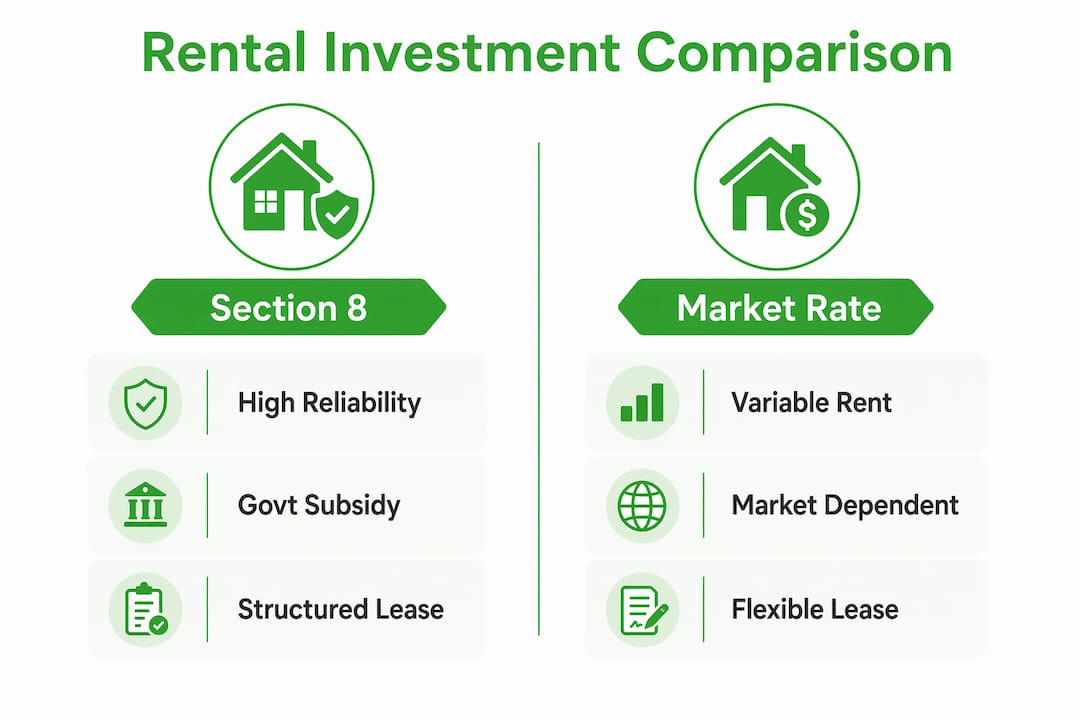
| Factor | Section 8 rental | Market-rate rental |
|---|---|---|
| Rent payment reliability | High (partial govt. payment) | Variable (tenant-dependent) |
| Vacancy risk | Lower (motivated tenants) | Higher in soft markets |
| Rent growth flexibility | Limited (PHA approval required) | Flexible at lease renewal |
| Inspection burden | Annual or biennial HQS required | No mandatory inspections |
| Tenant screening control | Full control retained by landlord | Full control retained by landlord |
| Cash flow predictability | Strong in well-selected zip codes | Depends on local market conditions |
Pro Tip: A high Payment Standard in a low-income zip code can look attractive on paper, but neighborhood quality strongly affects long-term property values and maintenance costs. Always analyze the rental market comparables alongside the FMR data before committing to a purchase.
Investors who treat Section 8 as a pure cash flow play without accounting for property condition and tenant quality tend to run into the same problems: deferred maintenance, difficult turnovers, and properties that lose value faster than the subsidy income compensates. The investors who do well in this space combine the subsidy's payment stability with disciplined property selection and active management. Deal-zilla's Section 8 Investment Analyzer is built specifically to help investors run those numbers before they make an offer, pulling real HUD rate data into a deal analysis framework that accounts for local Payment Standards, rent reasonableness thresholds, and projected cash-on-cash returns.

Key Takeaways
The Housing Choice Voucher program gives investors a government-backed rent stream, but location selection, HQS compliance, and tenant screening determine whether a Section 8 deal actually performs.
| Point | Details |
|---|---|
| Tenant pays roughly 30% of income (including utilities) | The PHA covers the remainder up to the local Payment Standard via a direct HAP payment to the landlord. |
| HQS inspections are mandatory | Units must pass before the lease starts and at regular intervals; failed inspections pause HAP payments. |
| Vouchers are portable across states | Tenants can transfer their voucher to a new jurisdiction, but the subsidy adjusts to the receiving area's Payment Standard. |
| FMR data guides investor location decisions | HUD's zip-code-level Fair Market Rent data helps identify markets where Section 8 payments meet or exceed open-market rents. |
| Tenant screening remains the landlord's job | The guaranteed subsidy covers part of the rent; it does not protect against property damage or lease violations. |