
A low risk rental investment is defined as a real estate position that generates dependable income while minimizing exposure to vacancies, tenant default, and unexpected maintenance costs. The most reliable options in this category include Real Estate Investment Trusts (REITs), Section 8 housing under the HUD Housing Choice Voucher program, turnkey rental properties, and diversified approaches like real estate crowdfunding. Each strategy controls risk through a different mechanism, whether that is government subsidy backing, professional management at scale, or geographic diversification. Understanding which approach fits your capital, time, and income goals is the first decision every investor must make.
What is a low risk rental investment and why does it matter?
A low risk rental investment reduces the three main threats to rental income: vacancy, tenant default, and maintenance surprises. Standard rental properties carry all three risks simultaneously. Low risk strategies isolate or offset at least one of those threats through structure, subsidy, or scale.
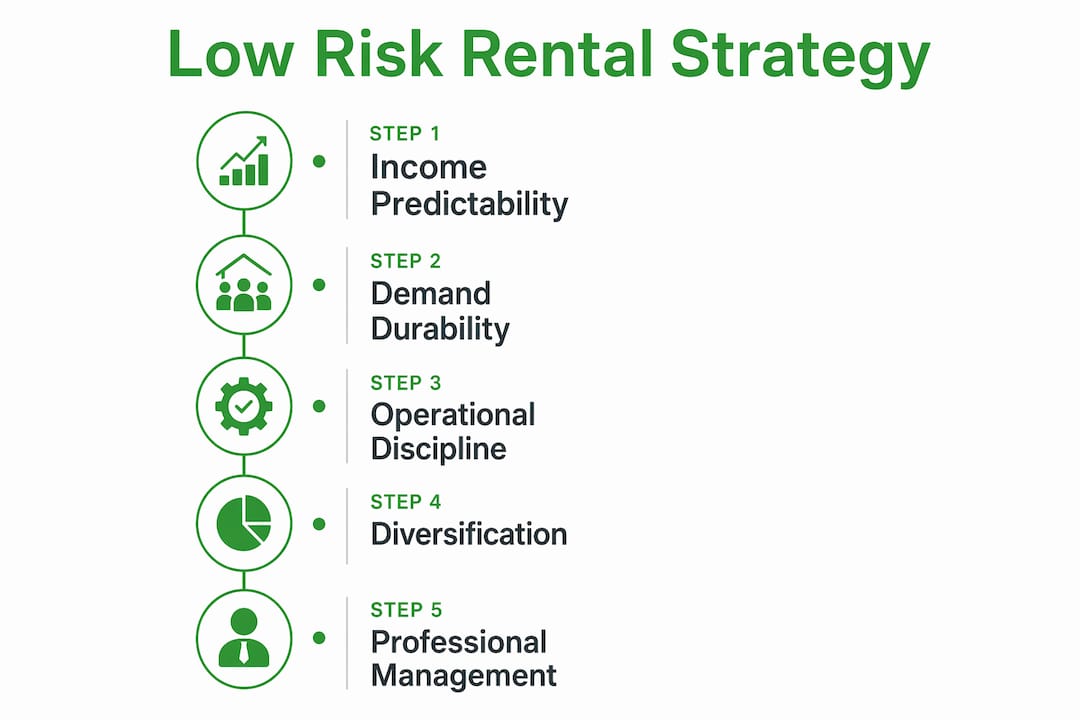
The core insight is that "low risk" is not a property type. It is a combination of income predictability, demand durability, and operational control. A single-family home in a high-demand market with a Section 8 tenant and a funded capital reserve is a low risk position. The same home with no reserves, a month-to-month tenant, and deferred maintenance is not. Risk lives in the details of how you own and operate, not just in what you buy.

Investors new to real estate often conflate "affordable" with "low risk." The two are unrelated. A $90,000 duplex in a declining market carries far more risk than a $300,000 turnkey rental in a stable metro. The right framework for evaluating comparable rental properties starts with demand, not price.
How do REITs and real estate ETFs deliver low risk rental income?
REITs and real estate ETFs provide low risk rental income without the operational burden of direct ownership. You own shares in a portfolio of income-producing properties rather than a single building. That structure eliminates the 2 AM maintenance call and the month-long vacancy that wipes out a quarter's profit.
REIT dividend yields range from 3.5% to 5%, with single-family rental REITs yielding around 3.69% as of july 2026. That consistency reflects the scale and occupancy advantages that institutional landlords hold over individual investors. Dividends arrive monthly or quarterly regardless of whether any single property in the portfolio sits vacant.
The trade-off is real. REITs trade on public markets, so their share price moves with investor sentiment, not just property fundamentals. A rising interest rate environment can compress REIT valuations even when the underlying rental income stays flat. That market valuation risk does not exist with direct ownership.
Key advantages of REITs for beginners
- Instant diversification: One share gives you exposure to dozens or hundreds of properties across multiple markets.
- No management responsibility: Professional teams handle leasing, maintenance, and compliance.
- Liquidity: You can sell REIT shares in seconds. Selling a physical property takes months.
- Dividend consistency: REITs are legally required to distribute at least 90% of taxable income to shareholders.
- Low entry capital: You can start with the price of a single share rather than a $60,000 down payment.
Pro Tip: If you want rental income without landlord duties, pair a single-family rental REIT with a diversified real estate ETF. The REIT gives you yield; the ETF spreads your sector risk across property types.
What makes Section 8 housing a low risk rental strategy?
Section 8 housing, administered through HUD's Housing Choice Voucher program, reduces income risk by guaranteeing that a government agency pays a portion of the rent directly to the landlord. HUD administers vouchers serving 2.3 million families through 2,100 Public Housing Authorities (PHAs). That scale creates durable, consistent tenant demand that private market rentals cannot match.
The subsidy payment does not bounce. It does not disappear when a tenant loses a job. That single feature eliminates the most common source of rental income disruption for individual landlords. Tenant demand for vouchers also far exceeds supply in most markets, which means vacancy periods between qualified tenants are typically short.
Compliance is the operational requirement that investors underestimate. Noncompliance with inspection standards can lead to suspended payments despite the subsidy backing. The PHA inspects the property before a tenant moves in and conducts annual inspections thereafter. A failed inspection freezes your income until repairs pass reinspection.
How to maintain low risk with Section 8 rentals
- Pass the initial HUD inspection before listing. Walk through the HUD inspection checklist yourself before the PHA inspector arrives. Common failures include missing smoke detectors, peeling paint, and broken window locks.
- Set rent at or below the Payment Standard. Each PHA publishes a Payment Standard by bedroom count. Pricing above it shifts the burden to the tenant and increases your vacancy risk.
- Screen tenants beyond the voucher. The voucher covers rent. It does not cover property damage. Run criminal background and reference checks as you would for any tenant.
- Budget for maintenance. Section 8 properties must meet Housing Quality Standards year-round. Deferred maintenance fails inspections and suspends payments.
- Understand rent reasonableness rules. PHAs compare your rent to similar unassisted units in the area. Overpricing disqualifies your property from the program.
Pro Tip: Use Deal-zilla's Section 8 Investment Analyzer to pull real HUD Payment Standard data for your target market before you make an offer. Knowing the subsidy ceiling before you buy prevents the most common Section 8 pricing mistake.
How does direct rental ownership minimize risk through budgeting and property selection?
Direct ownership of rental property carries the highest potential return and the highest operational responsibility. Risk reduction in this category comes from capital discipline, property selection, and professional management, not from the property type alone.
Capital reserve requirements
Safe direct ownership requires a 20–25% down payment plus capital expenditure (CapEx) reserves equal to 5–10% of gross annual income. For a $300,000 property, that means at least $70,000 in liquidity before you close. That figure covers the down payment, closing costs, and a funded reserve for roof, HVAC, and appliance replacements. Investors who skip the reserve fund convert a stable asset into a financial emergency waiting to happen.
Property selection criteria
| Criterion | Low Risk Indicator | Higher Risk Signal |
|---|---|---|
| Property condition | Turnkey or recently renovated | Deferred maintenance, aging systems |
| Market demand | Low vacancy rate, job growth | Single-employer town, population decline |
| Tenant profile | Stable employment, strong references | Frequent moves, income instability |
| Location | Near schools, transit, employers | Isolated or economically distressed area |
| Cash flow | Positive after all expenses | Breakeven or negative before reserves |
Turnkey rental properties reduce risk by providing immediate rental income with minimal upfront renovation needs. They cost more per unit than distressed properties, but that premium buys you time. You collect rent from day one instead of funding a six-month renovation while carrying a mortgage.
The role of professional property management
Professional property managers typically charge 8–12% of monthly rent. That fee buys you tenant screening, lease enforcement, maintenance coordination, and legal compliance. For investors who own one or two properties, self-management is tempting. The math often favors management, though, because a single bad tenant or missed lease violation can cost more than a year of management fees. Tracking cash flow metrics like cash-on-cash return helps you measure whether management costs are justified by income stability.
How does diversification reduce risk in a rental investment portfolio?
Relying on a single property exposes investors to localized downturns and vacancy spikes that a diversified portfolio absorbs without crisis. A factory closure in a single-employer town can push vacancy rates above 20% in months. An investor with properties in three different metros barely notices.
Real estate crowdfunding platforms let investors enter multiple markets with far less capital than direct ownership requires. Instead of concentrating $70,000 in one property, you can spread that capital across several projects in different cities and property types. The income from each position is smaller, but no single vacancy or market event threatens your entire portfolio.
Combining strategies produces the most durable income profile:
- REITs provide liquid, diversified exposure with no management burden.
- Section 8 rentals deliver government-backed income with strong tenant demand.
- Turnkey direct ownership builds equity and offers higher long-term returns.
- Crowdfunding spreads remaining capital across additional markets and asset types.
Investors who use real estate investing strategies that combine two or more of these approaches consistently outperform single-strategy portfolios on risk-adjusted income. The goal is not to eliminate all risk. The goal is to make sure no single failure event can eliminate your income.
Key Takeaways
Low risk rental investing requires combining income predictability, demand durability, and operational discipline across at least two complementary strategies.
| Point | Details |
|---|---|
| REITs offer passive income | Single-family rental REITs yield around 3.69%, with no management responsibility required. |
| Section 8 reduces vacancy risk | HUD vouchers serve 2.3 million families, creating durable demand and guaranteed partial rent payments. |
| Capital reserves are non-negotiable | Direct ownership requires at least $70,000 in liquidity for a $300,000 property to cover down payment and CapEx. |
| Turnkey properties cut renovation risk | Fully operational properties generate income from day one and avoid costly renovation delays. |
| Diversification protects income | Spreading capital across REITs, Section 8, and crowdfunding prevents any single event from eliminating cash flow. |
The uncomfortable truth about "low risk" rentals
The phrase "passive income" does the most damage in rental investing. Investors hear it and assume the asset manages itself. It does not. The "passive" label for rental properties can be misleading because operational effort is still required regardless of the strategy you choose.
I have watched investors buy turnkey properties, hire a property manager, and then disengage completely. Within 18 months, deferred maintenance piles up, the manager stops enforcing lease terms, and a "low risk" property becomes a problem asset. The manager works for you. You still have to hold them accountable.
Section 8 is the closest thing to genuinely passive rental income I have seen for individual investors. The subsidy removes the biggest income risk. But the inspection requirements mean you cannot ignore the property. A landlord who skips annual maintenance to save money will fail a HUD inspection and lose months of income trying to get reinstated.
The investors who build truly stable rental portfolios treat every property as a small business. They review financials monthly, inspect properties quarterly, and screen tenants as carefully as they analyze deals. Risk reduction is a practice, not a product you buy.
— ARX
How Deal-zilla helps you find and evaluate safe rental investments
Choosing the right rental investment starts with accurate data. Deal-zilla gives investors the tools to run the numbers before they commit capital.

Deal-zilla's platform includes a Section 8 Investment Analyzer with real HUD Payment Standard data, a Deal Analyzer for evaluating purchase price against projected income, a BRRR Calculator for renovation-to-rental strategies, and a Rent Analyzer that benchmarks your target rent against comparable units. Whether you are evaluating your first Section 8 property or building a multi-market portfolio, Deal-zilla's investment tools give you the financial clarity to make decisions with confidence. Accurate analysis before you buy is the single most effective way to reduce risk in any rental strategy.
FAQ
What is a low risk rental investment?
A low risk rental investment is a real estate position that generates stable income while minimizing exposure to vacancies, tenant default, and maintenance surprises. Common examples include REITs, Section 8 rentals, and turnkey properties.
Are REITs safer than owning a rental property directly?
REITs carry lower operational risk than direct ownership because professional teams manage the properties at scale, and REIT yields of 3.5–5% reflect consistent occupancy. However, REITs carry market valuation risk that direct property ownership does not.
How much cash reserve do I need for a safe rental property?
Safe direct ownership requires a 20–25% down payment plus CapEx reserves of 5–10% of gross annual income. For a $300,000 property, that means at least $70,000 in available liquidity before closing.
Does Section 8 guarantee full rent payment?
Section 8 guarantees the subsidy portion of the rent, which varies by market and bedroom count. The tenant pays any amount above the PHA's Payment Standard, so pricing your unit correctly is critical to minimizing income risk.
What is the biggest mistake new rental investors make?
The most common mistake is underestimating capital reserve requirements and treating rental income as passive without maintaining active oversight of property condition, tenant compliance, and cash flow performance.