
Investing in foreclosures is the process of purchasing properties tied to mortgage default at a discount, with the goal of profiting through resale, rental, or renovation. The foreclosure property market has grown sharply in 2026, with 118,727 U.S. foreclosure filings recorded in Q1 alone, a 20% year-over-year increase. Bank repossessions surged 45% in that same period. That volume creates real opportunity, but it also creates competition. Successful foreclosure investing demands disciplined underwriting, stage-specific strategy, and a clear exit plan before you ever make an offer.
What is investing in foreclosures, and why does it matter in 2026?
Foreclosure investing covers three distinct stages: pre-foreclosure, auction, and REO (real estate owned). Each stage carries a different risk profile, discount potential, and buyer requirement. Understanding the difference is the foundation of any working foreclosure investment strategy.
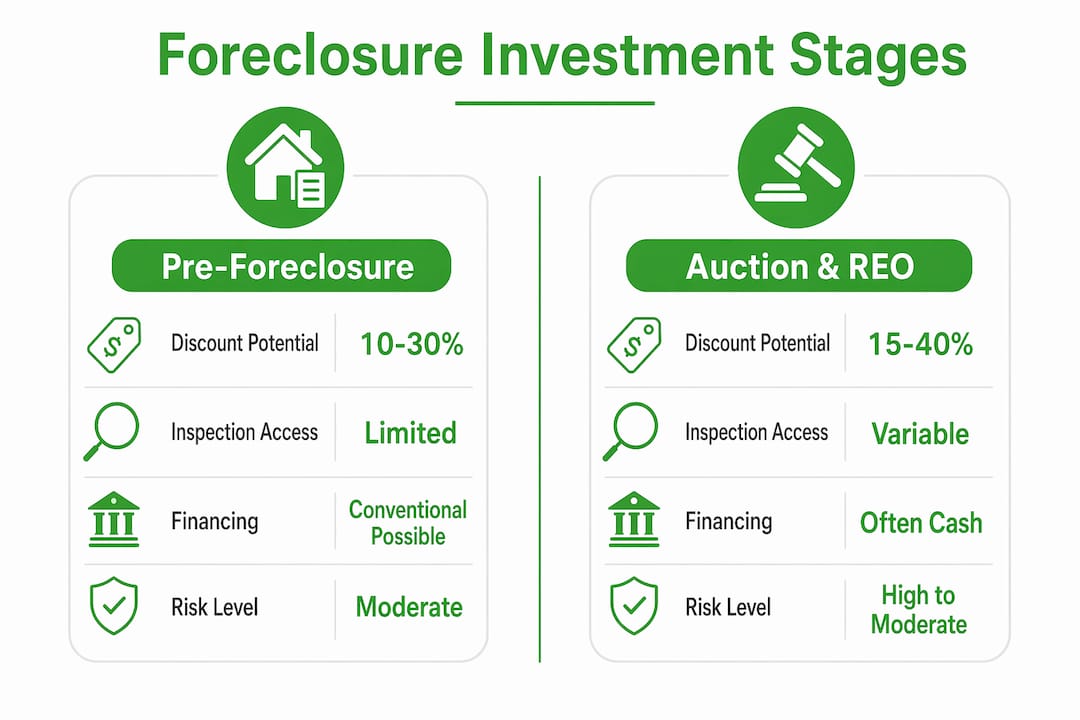
Discounts vary sharply by stage. Pre-foreclosure properties sell 10–30% below market value. Auction properties can go 15–40% below after-repair value (ARV), but with significantly higher risk. REO properties, sold directly by banks after a failed auction, typically trade 5–15% below market with cleaner conditions. Those ranges compress in competitive markets, where some foreclosures clear at or above market value.

The core appeal is real but often overstated. Buying bank-owned properties or pre-foreclosure deals does not guarantee a windfall. The discount is the starting point, not the profit. Actual returns depend on repair costs, holding time, financing terms, and your exit strategy.
What are the stages of foreclosure investing and how do strategies differ?
Pre-foreclosure
Pre-foreclosure begins when a homeowner receives a notice of default and ends when the property goes to auction. Buyers negotiate directly with distressed sellers, which creates the highest discount potential. The tradeoff is complexity. Moving within 48 hours of a new filing improves your lead-to-deal ratio significantly. This stage rewards investors with strong negotiation skills, local networks, and access to daily-updated filing data.
Foreclosure auction
At auction, properties sell to the highest bidder, often on the courthouse steps or through online platforms. Cash is typically required. Inspections are rarely possible. Title issues may follow the property. The discount potential is highest here, but so is the risk of inheriting unknown liens, back taxes, or severe structural damage.
REO (bank-owned) properties
REO purchases are the recommended entry point for investors new to foreclosure investing. Banks have already cleared the auction process, so titles are generally cleaner. Buyers can conduct inspections, use conventional financing, and negotiate with the bank's asset manager. Deals typically close in 30–45 days with 1–3% earnest money deposits.
| Stage | Discount potential | Inspection access | Financing options | Risk level |
|---|---|---|---|---|
| Pre-foreclosure | 10–30% below market | Yes | Conventional, hard money | Moderate |
| Auction | 15–40% below ARV | Rarely | Cash only | High |
| REO | 5–15% below market | Yes | Conventional, FHA 203(k) | Lower |
Pro Tip: If you are new to foreclosure investing, start with REO properties. The inspection access and conventional financing options reduce your exposure while you build experience and local market knowledge.
How do you find and evaluate foreclosure properties?
Finding deals
The best foreclosure deals rarely sit on the MLS waiting for you. Experienced investors build relationships with bank asset managers and wholesalers to access properties before they become public listings. Public notice databases, county courthouse records, and HUD's official listings are all legitimate sourcing channels. Real estate agents who specialize in distressed properties add another layer of access.
Online platforms aggregate foreclosure listings, but the best deals on those platforms move fast. Speed and preparation matter more than the platform itself.
Evaluating a deal
A reliable deal analysis follows a clear sequence:
- Establish ARV. Pull recent comparable sales within a half-mile radius. Use rental comps if you plan to hold the property.
- Estimate repair costs. Walk the property with a licensed contractor. Never self-estimate structural, electrical, or plumbing work.
- Calculate your maximum allowable offer (MAO). Subtract renovation costs, holding costs, closing costs, and your required profit margin from the ARV. Deal-zilla's Deal Analyzer automates this calculation so you bid with confidence, not guesswork.
- Run a title search. Identify any liens, unpaid taxes, or HOA dues before you commit.
- Confirm occupancy. An occupied property adds eviction timelines and legal costs to your budget.
Pro Tip: Use conservative repair estimates. Add a 15–20% contingency buffer on top of your contractor's number. Foreclosures hide deferred maintenance that only surfaces after walls open.
Understanding how to determine your maximum allowable offer is the single most important underwriting skill in foreclosure investing. Overpaying at acquisition is the most common and most costly mistake investors make.
What financing options work for foreclosure investments?
Financing in foreclosure investing is stage-dependent. The wrong financing choice at the wrong stage kills deals or creates losses.
- Cash. Required at most auctions. Fastest close, strongest negotiating position, no lender approval risk.
- Conventional loans. Work well for REO purchases in livable condition. Lenders require the property to meet minimum habitability standards.
- FHA 203(k) loans. Cover both purchase and renovation costs in a single loan. Best for owner-occupant investors or those buying REOs needing moderate repairs.
- Hard money loans. Short-term, asset-based lending at higher interest rates. Used when speed matters and the property does not qualify for conventional financing.
- Bridge financing. Covers the gap between acquisition and permanent financing. Common in BRRRR strategy deals.
Pre-approval and proof of funds are non-negotiable before you make any offer. Sellers, especially banks, will not entertain unverified buyers. HUD rate charts provide a useful benchmark for understanding financing cost assumptions during acquisition planning.
Auction financing deserves a direct warning. Most auctions require full payment within 24–48 hours of winning a bid. Arriving without confirmed cash or a pre-arranged hard money commitment means forfeiting your deposit.
What are the biggest risks of investing in foreclosures?
Novice investors most often fail by treating foreclosure investing as a shortcut to wealth rather than a discipline. The risks are real and specific.
- Unknown property condition. Foreclosed homes are sold as-is. Previous owners sometimes strip fixtures, appliances, and copper wiring before vacating.
- Title defects. Even REO properties carry risk. Banks use contract addenda that shift responsibility for municipal liens, unpaid HOA fees, and other encumbrances back to the buyer.
- Occupancy complications. Tenants or former owners still in the property require formal eviction proceedings, which add weeks or months and legal fees to your timeline.
- Competitive overbidding. Auction environments create emotional pressure. Investors who exceed their MAO to "win" a bid routinely destroy their margin.
- Underestimated rehab costs. Structural damage, mold, and code violations rarely appear in listing photos.
Pro Tip: Title insurance is not optional. Purchase it on every foreclosure deal, including REOs. The cost is minimal compared to the exposure of inheriting a lien you did not know existed.
Disciplined underwriting separates profitable foreclosure investors from cautionary tales. The ability to walk away from a bad deal is a skill, not a failure.
What exit strategies work best for foreclosure investments?
Exit clarity before acquisition is the rule that separates profitable investors from those who improvise their way into losses. Your exit path determines your purchase price ceiling, your renovation budget, and your financing structure.
- Fix and flip. Buy, renovate, and sell for a profit. Requires accurate ARV estimation and tight cost control. Best suited to properties with strong comparable sales in active markets. Read the full fix-and-flip strategy breakdown to understand timeline and margin expectations.
- Buy-and-hold rental. Purchase a foreclosure, renovate to rental standard, and collect monthly cash flow. Works best in markets with strong rental demand. Deal-zilla's Rent Analyzer helps you validate rental income assumptions before you commit.
- BRRRR (Buy, Rehab, Rent, Refinance, Repeat). Acquire a distressed property, renovate it, rent it, refinance to pull out equity, and repeat the cycle. This strategy maximizes capital efficiency but requires precise underwriting at every step. Deal-zilla's BRRRR calculator models each phase so you know your numbers before you close.
Each exit path has a different tolerance for acquisition price and renovation scope. A fix-and-flip investor needs a faster, cheaper renovation than a BRRRR investor who plans to hold. Aligning your property cash flow strategy with your exit before you bid is the clearest competitive advantage available to any foreclosure investor.
Key Takeaways
Successful foreclosure investing requires stage-specific strategy, disciplined underwriting, and a defined exit plan before acquisition, not after.
| Point | Details |
|---|---|
| Stage selection matters | REO properties suit beginners; auctions reward experienced, cash-ready investors. |
| Discount is the starting point | Real profit comes from cost control and due diligence, not the foreclosure label alone. |
| MAO discipline prevents losses | Calculate your maximum allowable offer from ARV minus all costs before bidding. |
| Title insurance is non-negotiable | Even bank-owned properties can carry hidden liens that transfer to the buyer. |
| Exit strategy drives acquisition | Choose your exit path first, then set your price ceiling and renovation budget. |
The discipline most foreclosure investors skip
Most investors enter the foreclosure market chasing the discount. That is the wrong frame. The discount is table stakes. What actually determines whether you profit is how well you underwrite the deal before you commit.
I have watched investors win auctions at prices that made no mathematical sense, simply because the word "foreclosure" made them feel like they were getting a deal. They were not. They were buying a problem at a slight discount to market value, with no inspection, no financing flexibility, and no clear exit.
The investors who consistently profit from foreclosure deals share one habit: they calculate their maximum allowable bid before they ever set foot at an auction or submit an offer. They know their walk-away number. They stick to it. That discipline, more than any market condition or sourcing advantage, is what separates a real foreclosure investor from someone who got lucky once.
Speed matters too, but not at the cost of accuracy. Moving fast on a bad deal is worse than moving slow on a good one. Build your local network, use data tools that update daily, and treat every deal as if the market could turn the week after you close. That mindset keeps your underwriting honest.
— ARX
Deal-zilla: built for foreclosure investors who run the numbers
Foreclosure investing rewards preparation. Deal-zilla gives you the tools to prepare faster and more accurately than investors working off spreadsheets and gut instinct.

Deal-zilla's Deal Analyzer calculates your maximum allowable offer in minutes, factoring in ARV, repair costs, holding costs, and your target return. The BRRRR calculator models every phase of a refinance-and-repeat strategy so you know your equity position before you close. The Rent Analyzer pulls real market data to validate your rental income assumptions. Whether you are buying your first REO or scaling a fix-and-flip operation, start analyzing deals with Deal-zilla before your next offer goes in.
FAQ
What is foreclosure investing?
Foreclosure investing is the practice of purchasing properties in default or bank-owned status at a discount to market value, with the goal of profiting through resale, rental, or renovation.
Which foreclosure stage is best for beginners?
REO properties are the best entry point for new investors. They offer inspection access, conventional financing options, and cleaner titles compared to auction purchases.
How much below market value can foreclosures sell for?
Discounts range from 5–15% below market for REO properties to 15–40% below ARV at auction, though competitive markets often push prices to 94–98% of market value.
Do I need cash to buy a foreclosure at auction?
Most foreclosure auctions require full cash payment within 24–48 hours of winning a bid. Hard money financing arranged in advance is an alternative, but conventional loans do not work at auction.
What is the biggest mistake foreclosure investors make?
Overbidding and underestimating rehab costs are the two most common errors. Both stem from skipping disciplined underwriting and treating the foreclosure label as a guaranteed discount.