
Raising private money for Section 8 deals means securing capital based on a property's government-backed rental income rather than the borrower's credit score. The Housing Assistance Payment (HAP) contract, the formal industry term for the subsidy agreement between a landlord and a Public Housing Authority (PHA), transforms a standard rental into a near-guaranteed income stream. That shift changes everything about how private lenders evaluate risk. This guide covers the full process: what makes these deals attractive, what documentation you need, how to pitch lenders, and how to build a capital stack that scales.
What makes Section 8 deals attractive to raise private money?
Private lenders evaluate deals on one core question: will the income cover the debt? Section 8 answers that question with a government signature. The HAP contract guarantees 70–100% of rent through direct PHA payments, removing the single biggest risk in conventional rental lending: tenant nonpayment.
That income predictability directly improves Debt Service Coverage Ratio (DSCR) calculations. DSCR lenders divide net operating income by total debt payments. When a government agency covers most of the rent, the ratio holds up even when a unit sits vacant briefly. A stabilized Section 8 property with an active HAP contract reads as lower risk than a conventional rental in the same neighborhood.

PHA payment standards also give investors a pricing floor before they even make an offer. Payment standards typically run at 90–110% of HUD Fair Market Rent (FMR). That means you can evaluate income predictability using publicly available data before the deal closes. Private lenders respond well to that level of pre-verified income certainty.
Key lender benefits at a glance:
- Government-backed rent reduces vacancy risk and payment uncertainty
- HAP contracts provide documented, verifiable income history
- PHA payment standards set a predictable income ceiling by bedroom count
- Lower borrower credit dependency since asset income drives underwriting
- Faster loan decisions when income documentation is already in place
Pro Tip: Pull the PHA payment standard for your target zip code before approaching any lender. Showing a lender the exact dollar amount the government will pay, by bedroom count, closes objections before they open.
What documentation do you need before seeking private funding?
Private funding for Section 8 properties requires a documentation package that treats the HAP contract as a financial asset, not just a lease addendum. Lenders need proof that the government income is real, current, and compliant.
The five documents every investor should prepare:
- Signed, current HAP contract. This is the centerpiece. A HAP contract converts a risky deal into a low-risk investment in a lender's eyes. Expired or unsigned contracts disqualify the income.
- HQS inspection report. Housing Quality Standards (HQS) compliance is required for PHA payments to continue. A passed inspection proves the income stream is not at risk of suspension.
- PHA payment history. A 12-month ledger of actual government payments demonstrates consistency. This is the equivalent of a bank statement for your rental income.
- Rent reasonableness study. PHAs require that Section 8 rents not exceed comparable market rents. A current rent reasonableness study confirms your rent is PHA-approved and sustainable.
- Voucher verification letter from PHA. This confirms the tenant's voucher is active and the subsidy will continue. Lenders treat this as income verification.
The table below shows how each document maps to lender concerns:
| Document | Lender concern addressed |
|---|---|
| Signed HAP contract | Confirms government income obligation |
| HQS inspection report | Confirms income stream is not at suspension risk |
| PHA payment history | Proves 12-month income consistency |
| Rent reasonableness study | Confirms rent is PHA-compliant and sustainable |
| Voucher verification letter | Confirms tenant subsidy is active |
Presenting this package as a single, organized deck signals professionalism. Smart investors use PHA payment standards to predict income and reduce uncertainty for private lenders. That preparation shortens the lender's due diligence timeline and improves your terms.
How to pitch and secure private money for Section 8 deals
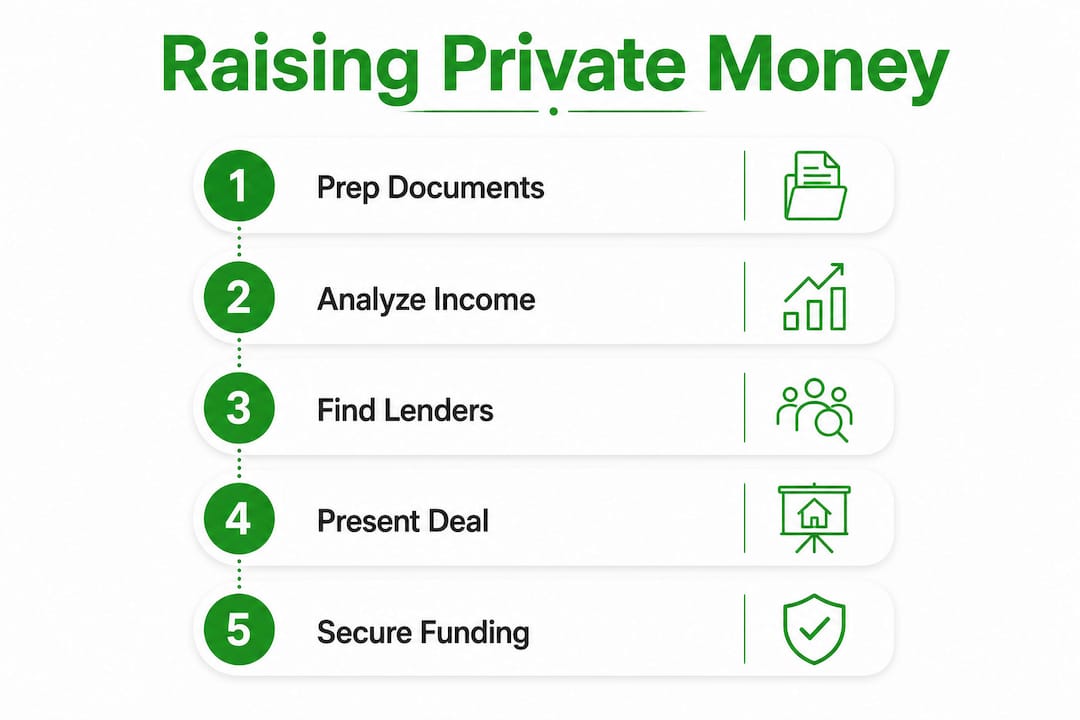
Securing private capital for Section 8 investments follows a specific sequence. Skipping steps costs time and credibility.
-
Identify lenders who understand Section 8 financing. Not every private lender knows what a HAP contract is. Target lenders who have financed affordable housing or DSCR loans before. Real estate investment clubs, local REIA groups, and hard money networks are the fastest places to find them.
-
Lead with the HAP contract, not the property. Open your pitch by showing the government payment obligation. Private lenders assess Section 8 deals differently because the HAP contract reduces borrower credit risk in their loan calculations. Let the contract do the selling.
-
Present a DSCR calculation using verified subsidy income. A concrete example: a $96,000 loan at 80% LTV requires a $24,000 down payment and roughly $3,000 in closing costs. Show the lender how the DSCR calculation holds when government rent covers 80% or more of the monthly payment.
-
Build cash flow projections that separate subsidy and tenant portions. Show the PHA payment as a fixed line item. Show the tenant's portion as a secondary figure. Lenders want to see that the deal survives even if the tenant portion is delayed.
-
Negotiate terms around the asset, not your credit. Private money lending evaluates asset value over borrower credit profile. Use that to negotiate lower down payments or better rates. The HAP contract is your collateral argument.
-
Address objections before they arise. Prepare a one-page FAQ covering HQS compliance, PHA inspection timelines, and what happens if a tenant vacates. Lenders who have never financed Section 8 will ask these questions. Having written answers ready signals that you have managed these deals before.
Pro Tip: Bring a HUD rate chart analysis to every lender meeting. Showing that the local FMR has trended upward over three years tells a lender that the income floor is rising, not shrinking.
What challenges come up when raising private money for Section 8?
The most common obstacle is the DSCR seasoning requirement. Some DSCR lenders require 12 months of Section 8 tenancy before counting the government subsidy fully in income calculations. That gap requires a bridge financing plan to cover the interim period.
Other challenges investors face regularly:
- Government bureaucracy delays. PHA inspections and voucher processing take time. Build a 30–60 day buffer into your closing timeline and communicate it to lenders upfront.
- Rent reasonableness disputes. If your rent exceeds comparable market rents, the PHA can reduce or deny the subsidy. Run a rent reasonableness check before signing any lease. Deal-zilla's Rent Analyzer gives investors a fast read on where their rent stands relative to local comps.
- Tenant quality concerns from lenders. Some private lenders worry about property condition under Section 8 tenants. Counter this with a current HQS inspection report and a documented maintenance history.
- Constrained private money markets. When private capital is tight, consider layering in DSCR loans, seller financing, or self-directed IRA funds from individual investors.
Treating Section 8 as a professional investment means presenting the HAP contract as a financial instrument, not a social program. Lenders who see a government-backed income stream documented with the same rigor as a commercial lease respond with commercial-grade terms.
The investors who close private money fastest are the ones who have already solved these objections on paper before the first lender meeting.
How to maximize returns by combining private money with other funding sources
The most experienced investors in Section 8 do not rely on a single capital source. They build a capital stack that uses each funding type for what it does best.
DSCR loans with high loan-to-value ratios work well when the HAP contract is seasoned and income is verified. The government-backed rent stream supports the debt service, and the investor preserves cash for the next acquisition. A mixed capital stack reduces risk at the deal level and improves overall portfolio cash flow.
Private equity fills the gaps that institutional loans leave open. Down payments, renovation costs, and closing fees are natural targets for private equity partners. The Housing Impact Fund model demonstrates this at scale: $225 million in equity generates $750 million in purchasing power when combined with government-backed loans. Individual investors can apply the same logic at a smaller scale by pairing private equity partners with DSCR debt.
Municipal bond financing represents the large-portfolio version of this strategy. A Los Angeles portfolio secured $104 million in municipal bond financing backed by Section 8 voucher-stabilized income across 14 properties. That deal shows what is possible when government-backed income is treated as a bond-grade asset.
Pro Tip: Use cash flow improvement strategies to tighten your operating expenses before approaching any lender. A deal with a 1.3 DSCR is fundable. A deal with a 1.1 DSCR is a negotiation.
Key Takeaways
Raising private money for Section 8 deals succeeds when investors treat the HAP contract as a financial asset, document government income rigorously, and present lenders with a complete, pre-verified deal package.
| Point | Details |
|---|---|
| HAP contract is your core asset | Present it as a government income obligation, not just a lease document. |
| Documentation wins deals | A complete package including HQS reports and PHA payment history shortens lender due diligence. |
| DSCR seasoning requires planning | Budget for bridge financing if your lender requires 12 months of Section 8 income history. |
| Mixed capital stacks scale faster | Combine private equity, DSCR loans, and government programs to maximize purchasing power. |
| Rent reasonableness protects income | Verify PHA compliance before signing leases to prevent subsidy reductions. |
What I have learned from financing Section 8 deals the hard way
The biggest mistake I see investors make is treating Section 8 as a passive income shortcut. They buy a property, get a tenant placed, and then try to refinance without any documentation of the government income. Lenders turn them down flat, and they cannot figure out why.
The shift that changes everything is treating the HAP contract the way a commercial real estate investor treats a triple-net lease. It is a contractual income obligation from a government entity. When you present it that way, with a full documentation package and a DSCR model that shows the math, lenders stop seeing a subsidized rental and start seeing a government-backed note.
I have also seen investors get burned by the seasoning requirement. They close a deal, place a Section 8 tenant, and assume they can refinance in 90 days. Some DSCR lenders want 12 months of payment history before they count that income. Plan for that gap from day one, or you will be scrambling for bridge capital at the worst possible time.
The investors who consistently close private money on Section 8 deals are the ones who have done the education work. They know their local PHA payment standards. They know what HQS compliance requires. They know their DSCR before they walk into a lender meeting. That preparation is not optional. It is the difference between a funded deal and a rejected application.
— ARX
Deal-zilla tools for funding your Section 8 portfolio
Pulling together the documentation and analysis needed to raise capital for rental properties takes time. Deal-zilla is built specifically for investors working Section 8 deals.

The Section 8 Investment Analyzer gives you real HUD payment data, rent reasonableness checks, and deal underwriting in one place. You can model DSCR scenarios using actual PHA payment standards for your target market, then export a clean deal package ready for lender review. For investors building a portfolio of Section 8 properties, Deal-zilla also provides a BRRR calculator and Rent Analyzer to stress-test cash flow before you commit capital. The platform is designed for investors who treat Section 8 as a professional asset class, not a side project.
FAQ
What is a HAP contract and why do lenders care about it?
A HAP contract is the Housing Assistance Payment agreement between a landlord and a Public Housing Authority that obligates the government to pay a portion of the rent directly. Private lenders treat it as a government-backed income guarantee, which reduces borrower credit risk in their underwriting.
How does DSCR work for Section 8 rental properties?
DSCR lenders divide net operating income by total debt payments. When a HAP contract covers 70–100% of rent, the income side of that ratio is backed by a government agency, making the loan easier to qualify for than a conventional rental.
What is the seasoning requirement for Section 8 DSCR loans?
Some DSCR lenders require up to 12 months of Section 8 payment history before counting the government subsidy as qualifying income. Investors should plan bridge financing to cover that gap.
Can I combine private money with government financing for Section 8 deals?
Yes. Private equity typically covers down payments and renovations, while DSCR loans or municipal bond financing cover the acquisition. This capital stack approach increases purchasing power and reduces single-source risk.
What is rent reasonableness and how does it affect private funding?
Rent reasonableness is the PHA requirement that Section 8 rents not exceed comparable market rents in the area. If your rent fails this test, the PHA can reduce or deny the subsidy, which directly threatens the income stream lenders are counting on.