
What does a deal analyzer do for real estate investors?
A deal analyzer is a financial evaluation tool that calculates whether an investment property is worth buying. You enter the property's numbers, and it spits back the metrics that actually matter: cash flow, return on investment, cap rate, and internal rate of return. No spreadsheet formulas to build from scratch, no guesswork about whether the numbers pencil out.
The core value is speed and objectivity. Instead of spending hours modeling a deal manually, you get a clear financial picture in minutes. Key metrics generated by standard deal analyzers include:
- Cash flow: Monthly income after all expenses
- ROI: Total return relative to your invested capital
- Cap rate: Net operating income divided by purchase price, independent of financing
- IRR: Internal rate of return, accounting for the time value of money
- Cash-on-cash return: Annual pre-tax cash flow divided by total cash invested
These outputs turn a raw property listing into a yes, no, or "needs more digging" decision.
Table of Contents
- Key features that separate good deal analysis tools from basic calculators
- How to use a deal analyzer to evaluate real estate deals
- Common use cases and benefits for real estate investors
- Expert insights on getting the most from deal analysis
- How popular deal analyzer tools compare
- Real-world examples of deal analyzer usage
- Deal-zilla gives you the analysis tools built for real estate investors
- Key Takeaways
Key features that separate good deal analysis tools from basic calculators
The gap between a basic calculator and a full deal analyzer is wider than most investors expect. A real deal analysis tool does more than arithmetic.
Essential features to look for:
- Automated data input: Pulls figures from rent rolls, leases, and PDFs rather than requiring manual entry
- Customizable parameters: Lets you adjust vacancy rates, expense ratios, financing terms, and holding periods
- Scenario analysis: Models best-case, base-case, and worst-case outcomes side by side
- Multiple investment types: Supports long-term rentals, fix and flips, BRRR strategies, and multi-unit properties
- Risk flagging: Highlights anomalies in the data before you commit to a deal
- Reporting: Exports clean summaries for lenders, partners, or your own records
AI-powered analyzers go further by ingesting unstructured files and automatically flagging inconsistencies for risk mitigation. That matters on complex deals where a missed lease clause or misread rent roll can cost you tens of thousands of dollars.
How to use a deal analyzer to evaluate real estate deals
The process is straightforward, but the quality of your inputs determines everything.
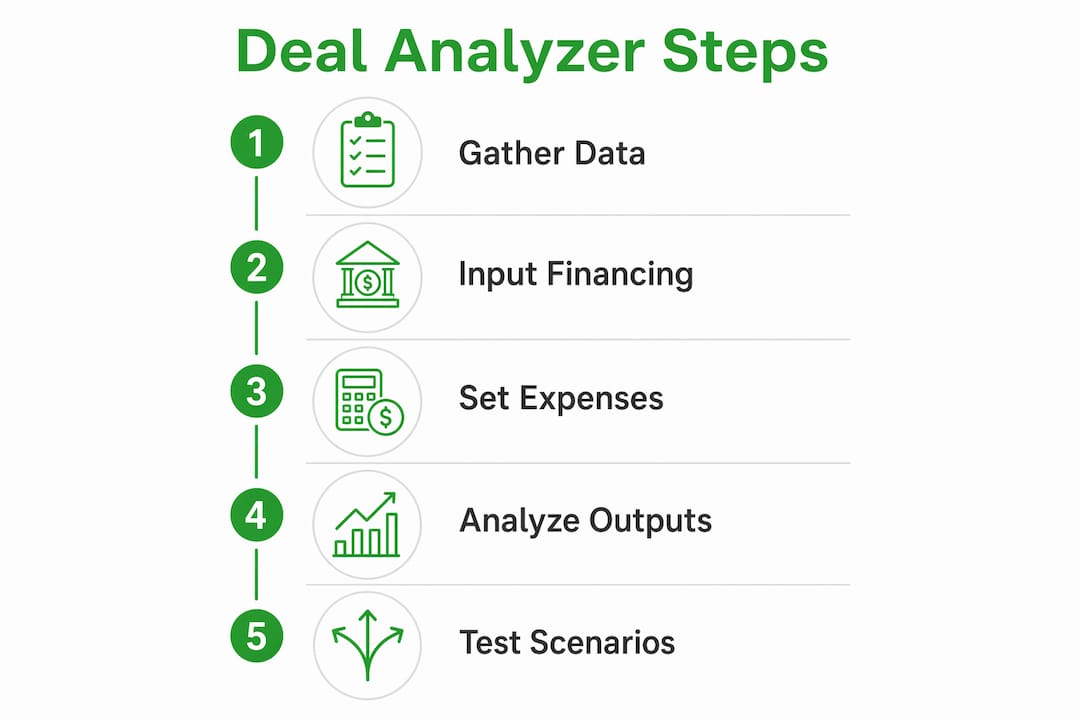
Step 1: Gather property data. Pull the asking price, current rents, tax records, insurance estimates, and any known repair costs. For rental properties, get the actual rent roll, not the seller's projected numbers.
Step 2: Enter your financing terms. Input your down payment, loan amount, interest rate, and loan term. The analyzer uses these to calculate your actual cash-on-cash return, which changes dramatically with different financing structures.

Step 3: Set your expense assumptions. Vacancy rate, property management fees, maintenance reserves, and capital expenditure allowances all belong here. Most investors underestimate these.
Step 4: Run the analysis and read the outputs. Look at cash flow first. If the property loses money every month under realistic assumptions, the other metrics rarely save it.
Step 5: Test scenarios. What happens if vacancy hits 10% instead of 5%? What if rents drop $150 per month? Scenario testing is where deal analyzers earn their keep.
Pro Tip: Experienced investors add a 15% contingency to every rehab budget as standard practice. Build that buffer into your analyzer inputs before you run the numbers, not after.
When your After Repair Value deviates significantly from comparable sales in the area, treat it as a red flag and re-verify your comps before moving forward using how to assess land purchase for development. Learning how to analyze comparable rental properties is a skill that makes every deal analysis sharper.
Common use cases and benefits for real estate investors
Deal analyzers fit nearly every investing strategy, but they shine brightest in three scenarios.
Rental property evaluation is the most common use. You need to know whether a property generates positive cash flow after debt service, taxes, insurance, and management. A deal analyzer answers that in under five minutes.

Fix and flip projects require a different set of inputs: purchase price, rehab budget, ARV, holding costs, and selling costs. The analyzer calculates your projected profit and tells you whether the margin justifies the risk. Speed matters here because good flip deals move fast.
BRRR strategy analysis (Buy, Rehab, Rent, Refinance, Repeat) is where deal analyzers get genuinely complex. You need to model the initial purchase, the rehab, the stabilized rental income, the refinance proceeds, and the long-term cash flow all in one view. Doing that manually is error-prone. A purpose-built analyzer handles it cleanly.
The broader benefits:
- Faster deal assessment means you can evaluate more opportunities without burning out
- Objective outputs reduce emotional bias, which is one of the most expensive mistakes in real estate investing
- Early risk identification lets you walk away before you're committed
- Clean reports improve conversations with lenders and real estate investing partners
Expert insights on getting the most from deal analysis
Experienced investors treat deal analyzers as a discipline, not just a tool. A few practices separate the investors who use these tools well from those who get burned despite using them.
- Never trust the seller's numbers. Always re-enter expenses from your own research. Sellers routinely understate vacancy and maintenance costs.
- Verify your ARV against at least three recent comparable sales. When your estimated value diverges significantly from the comps, the deal needs a second look before you proceed.
- Add your rehab buffer before you run the analysis, not as an afterthought. That 15% contingency exists because renovation projects almost always surface surprises.
- Use scenario testing every time. A deal that only works under perfect conditions is not a deal worth taking.
- Move fast, but move accurately. Experienced investors warn that slow or unclear deal analysis leads to poor decisions, either missing good deals or chasing bad ones.
Advanced AI analyzers perform continuous data validation and automated risk detection, reducing the manual errors that creep into complex underwriting. For investors scaling a portfolio, that kind of workflow automation is worth paying for.
How popular deal analyzer tools compare
The market for deal analysis tools ranges from free calculators to enterprise-grade platforms. Here is how the main categories stack up.
Entry-level calculators handle basic ROI and cash flow math. They work for simple single-family rentals but fall short on complex strategies like BRRR or multi-unit analysis. Free fix-and-flip analyzers in this category can complete a basic evaluation in roughly 90 seconds, which is useful for quick screening.
Mid-tier deal analysis platforms support multiple investment types, scenario modeling, and basic reporting. They cover the needs of most active investors and typically offer customizable parameters for financing, expenses, and holding periods.
Enterprise and AI-powered platforms add automated document ingestion, continuous data validation, and risk flagging. Document intelligence tools model deal economics deterministically, benchmarking terms against market data to surface negotiation leverage. These are built for investors managing large portfolios or complex capital structures.
Deal-zilla sits in the purpose-built category for real estate investors, covering rental analysis, fix and flip, BRRR, Section 8 investing, and HUD rate data in one place. It is designed for investors who need property-specific data, not generic financial modeling.
For investors evaluating software options, a comparison of real estate analysis alternatives is worth reviewing before committing to a platform.
Real-world examples of deal analyzer usage
Rental property scenario: An investor finds a duplex listed at a certain price. She enters the purchase price, a down payment with defined interest, current rents per unit, and her estimated expenses. The analyzer returns a monthly cash flow that initially is negative under realistic vacancy assumptions. She passes. Two weeks later, the seller lowers the price. She reruns the analysis, cash flow turns positive, and she makes an offer.
Fix and flip scenario: An investor identifies a distressed property with set asking and estimated ARV values. He enters rehab costs, adds the 15% contingency buffer, and includes several months of holding costs. The analyzer shows a projected profit margin below his criteria. That margin is too thin for his criteria, so he either negotiates the purchase price down or moves on.
BRRR scenario: An investor models a property she plans to buy at a given price, rehab for an estimated amount, rent at a specified monthly rate, and refinance at a portion of the estimated ARV. The analyzer shows she recovers nearly her full investment at refinance while retaining a cash-flowing rental. That is the kind of clarity that makes the BRRR strategy work at scale.
Deal-zilla gives you the analysis tools built for real estate investors
If you are evaluating rental properties, running fix and flip numbers, or modeling a BRRR strategy, Deal-zilla is built for exactly that work. It combines a deal analyzer, BRRR calculator, rent analyzer, and real Section 8 and HUD rate data in one platform, so you are not stitching together three different tools to get a complete picture.

The Section 8 analyzer is a feature most platforms skip entirely. For investors targeting government-assisted housing, having actual HUD payment standards built into the analysis changes how you evaluate deals in that market. Deal-zilla pulls real data, not estimates, so your cash flow projections reflect what the program actually pays in your target area.
Start your next deal analysis at Deal-zilla and see how fast a well-built tool moves you from listing to decision.
Key Takeaways
A deal analyzer is the fastest way to turn a property listing into a clear financial verdict, and the quality of your inputs determines whether that verdict is trustworthy.
| Point | Details |
|---|---|
| Core function | Deal analyzers calculate ROI, cash flow, cap rate, and IRR to evaluate investment properties objectively. |
| Rehab cost buffer | Add a 15% contingency to every rehab estimate before running your analysis to protect against budget overruns. |
| Scenario testing | Always model best-case, base-case, and worst-case outcomes; a deal that only works perfectly is too fragile. |
| AI-powered tools | Advanced analyzers automate document ingestion and flag financial anomalies, reducing manual errors on complex deals. |
| Deal-zilla | Covers rental analysis, fix and flip, BRRR, and real Section 8 and HUD rate data in one purpose-built platform. |