
What is the BRRRR method in real estate investing?
The BRRRR method stands for Buy, Rehab, Rent, Refinance, Repeat. It's a capital recycling strategy where you purchase a distressed property below market value, renovate it, rent it out, then pull your invested capital back out through a cash-out refinance to fund the next deal. The cycle repeats, letting you grow a rental portfolio without saving a fresh down payment for every acquisition.
BRRRR works best on single-family homes and small multifamily properties (typically two to four units) in markets with strong rental demand and room for forced appreciation. Unlike a traditional buy-and-hold approach, where your capital stays locked in each property, BRRRR treats equity as a revolving line of fuel, leveraging top strategies home buyers can learn from real estate investors to maximize growth.
Key characteristics at a glance:
- Targets distressed or undervalued properties priced below market value
- Relies on strategic renovation to increase both rental income and appraised value
- Uses cash-out refinancing to recover invested capital tax-efficiently
- Scales a portfolio faster than conventional buy-and-hold real estate investing strategies
- Requires active management during rehab and tenant placement phases
How each phase of the BRRRR strategy works, step by step
1. Buy
Your profit margin is set the moment you sign the purchase contract. Successful BRRRR investors typically target properties priced significantly below market value, often distressed homes with deferred maintenance, pre-foreclosures, or bank-owned listings. You'll need cash or short-term financing here. Traditional mortgages can slow you down when competing with other buyers, so hard money loans, private lenders, or bridge financing are common entry tools. A useful rule of thumb: avoid paying more than 70% of the after-repair value (ARV) at purchase.
2. Rehab
Renovation turns a cheap, rough property into a rentable, appraisable asset. The goal is not a luxury flip. Targeted cosmetic improvements like updated kitchens, bathrooms, flooring, and fresh paint increase tenant appeal and appraisal value without overcapitalizing. Budget carefully and build in a 10–20% contingency for hidden surprises. Contractor selection matters enormously here. Delays cost you carrying costs, and a bad contractor can turn a profitable deal into a money pit.
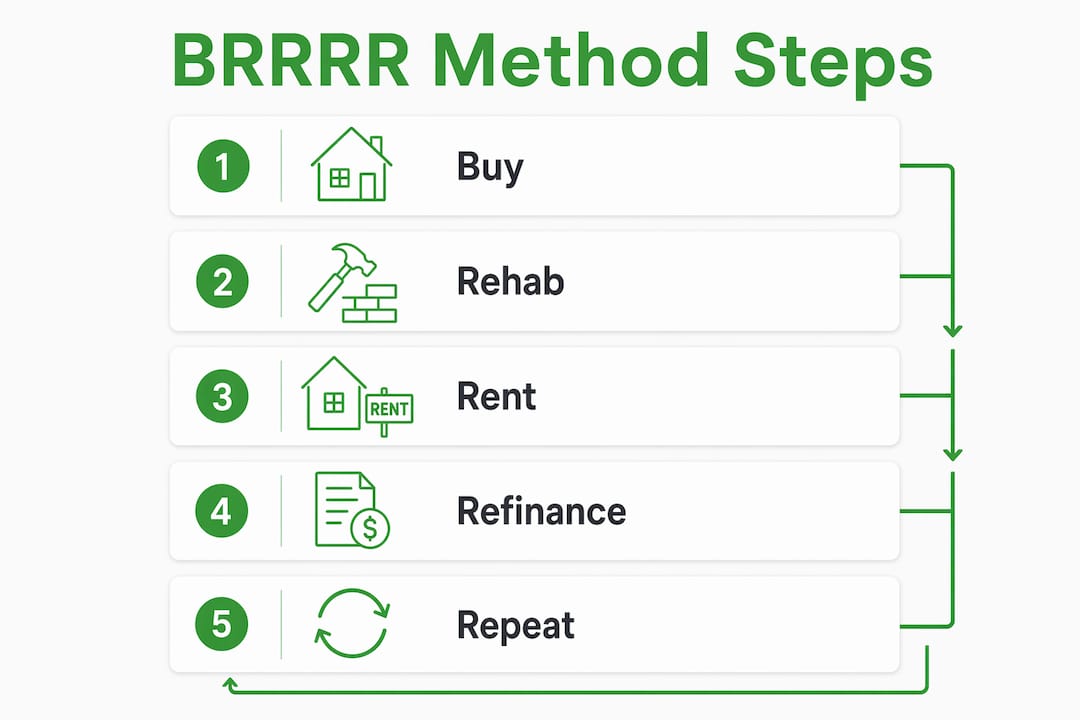
3. Rent
Once renovations are complete, place a qualified tenant as quickly as possible. Every vacant day is lost income. Screen applicants thoroughly: verify employment, pull credit reports, and check rental history. Set rents based on comparable properties in the area, factoring in your improvements. A well-renovated property can command premium rents that cover your mortgage, taxes, and insurance while generating positive cash flow. Many lenders also require a signed lease before approving a cash-out refinance.
4. Refinance
This is where the strategy's financial power shows up. With the property rented and appraised at its improved value, you apply for a cash-out refinance. Banks typically lend 70–75% LTV on investment properties in a cash-out refi, allowing you to pull out most of your original capital. The loan proceeds are generally not taxable income, making this one of the most tax-efficient ways to access equity. The new long-term mortgage replaces your short-term bridge loan, and you walk away with cash to deploy.

5. Repeat
The capital you recovered goes straight into the next deal. Each completed cycle adds a cash-flowing property to your portfolio while freeing up funds for the next acquisition. The key discipline here is maintaining adequate reserves. Don't drain every dollar into the next purchase. Unexpected vacancies, repairs, and refinance delays happen, and thin reserves can stall the whole machine.
A full BRRRR cycle typically runs several months, varying by rehab scope, tenant placement speed, and lender timelines.
Financial and tax benefits of the BRRRR method
The financial case for BRRRR goes well beyond property appreciation. Cash-out refinance proceeds are generally not taxable income under 2026 IRS guidance, which means you're accessing equity without a tax bill the way a property sale would trigger. That distinction separates BRRRR from flipping in a meaningful way.
Depreciation adds another layer. Rental property owners can deduct depreciation against rental income, reducing their taxable income each year. Combined with deductions for mortgage interest, property taxes, and operating expenses, the tax profile of a BRRRR property is considerably more favorable than a standard investment account.
Forced appreciation is the third pillar. You're not waiting for the market to lift your property's value. Strategic rehab creates equity on a timeline you control.
Key financial benefits:
- Tax-free equity extraction through cash-out refinancing, with no capital gains event
- Depreciation deductions offset rental income, lowering your annual tax liability
- Forced appreciation through rehab creates equity independent of market conditions
- Capital recycling lets you acquire multiple properties using the same initial investment
- Faster portfolio cash flow growth compared to traditional buy-and-hold methods
Cornerstone CPA notes: "Because loan proceeds are generally not taxable income, refinancing can be an extremely powerful wealth-building tool — and one of the biggest mistakes BRRRR investors make is focusing only on acquisition and financing while overlooking tax planning."
Risks and challenges you need to understand before starting
BRRRR carries real risks, and glossing over them is how investors lose money. Appraisal shortfalls and rehab complexity are the two most common deal-killers. If the property doesn't appraise at the value you projected, you can't pull out as much capital as planned, and your next deal stalls.
Common risks to plan for:
- Appraisal risk: The post-rehab value may fall short of projections, leaving capital trapped in the property
- Rehab overruns: Unexpected structural issues, contractor delays, or scope creep erode margins fast
- Carrying costs: Mortgage payments, insurance, and taxes accumulate during rehab and vacancy periods before refinancing
- Market risk: Economic downturns reduce both rental demand and property values, compressing your refinance proceeds
- Vacancy risk: Extended vacancy after rehab delays refinancing and drains reserves
Pro Tip: Experienced investors sometimes use a "slow BRRRR" approach with interest-only bridge loans extending up to five years. This removes the pressure to refinance immediately if market or appraisal conditions are unfavorable. Pair that with loan clauses requiring no prepayment penalties and built-in term extensions for maximum flexibility.
Conservative budgeting is non-negotiable. Underestimating rehab costs is the single most common reason a BRRRR deal fails to pencil out at refinance.
How BRRRR compares to flipping and traditional buy-and-hold investing
BRRRR occupies a distinct position between flipping and passive buy-and-hold investing, and understanding where it sits helps you decide if it fits your goals.
Flipping requires selling the property after renovation, which exposes you to market timing risk and triggers a taxable gain. BRRRR avoids that market sale risk entirely by transitioning from rehab to renting to refinancing without listing the property. You keep the asset, collect rent, and access equity without a taxable event.
Compared to traditional buy-and-hold, BRRRR builds a portfolio faster by recycling capital rather than saving fresh down payments. The tradeoff is higher short-term complexity and risk. A buy-and-hold investor buys, places a tenant, and largely steps back. A BRRRR investor manages a renovation project, coordinates contractors, and navigates a refinance process on every single deal.
SoFi advises: "BRRRR accelerates wealth building but is riskier and more labor-intensive than buy-and-hold investing. Newer investors may want to wait until they have more experience with traditional real estate investing before they jump into this strategy."
For investors comparing BRRRR to a fix and flip strategy, the key difference is the exit. Flipping monetizes through a sale. BRRRR monetizes through refinancing and ongoing rental income, which creates a more durable, tax-efficient wealth-building path.
How to get started with BRRRR as a new investor
Starting well means doing the groundwork before you make an offer. Here's what that looks like in practice:
- Find the right property first. Target homes needing cosmetic updates rather than major structural work. Structural rehabs carry more risk and are harder to budget accurately.
- Secure flexible financing before you shop. Hard money lenders and private lenders close faster than traditional banks, which matters when competing for distressed deals.
- Build your team early. Reliable contractors, a real estate agent who understands investment properties, and a property manager are not optional. They determine whether your timeline holds.
- Run conservative projections. Calculate rental income, rehab costs, and expected refinance proceeds using conservative assumptions. Build in safety margins.
- Negotiate loan terms carefully. Include no-prepayment-penalty clauses and term extension options to protect against appraisal delays or refinancing setbacks.
- Keep reserves. Never deploy every available dollar into a deal. Reserves cover unexpected repairs, vacancy periods, and carrying costs between rehab and refinance.
- Engage a CPA early. Tax planning around depreciation and cash-out refinancing has a real impact on returns. Don't treat it as an afterthought.
Understanding cash-on-cash return before you close your first deal gives you a clear benchmark for evaluating whether a property actually performs after refinancing.
Legal considerations and compliance during rehab and rental phases
Rehab and rental both carry legal obligations that can create liability if ignored. During renovation, any work affecting structural elements, electrical systems, plumbing, or HVAC typically requires permits from the local building department. Unpermitted work can surface during appraisal, delay refinancing, or create problems when you eventually sell.
Fair housing laws apply from the moment you market the property. Advertising language, tenant screening criteria, and lease terms must comply with the Fair Housing Act, which prohibits discrimination based on race, color, national origin, religion, sex, familial status, and disability. State and local laws often add protected categories beyond the federal baseline.
Landlord-tenant law governs security deposits, lease disclosures, habitability standards, and eviction procedures. These rules vary significantly by state. A property that's legal to rent in Texas may require additional disclosures or inspections in California or New York. Working with a local real estate attorney before placing your first tenant is a practical safeguard, not an optional expense.
Cash flow analysis and how to evaluate deal profitability
A BRRRR deal lives or dies on the numbers before you close. The after-repair value (ARV) is your starting point. ARV equals the current property value plus the value added by planned renovations, benchmarked against comparable recent sales in the area.
From ARV, work backward. If lenders will refinance at 75% LTV, multiply ARV by 0.75 to get your maximum refinance proceeds. Your total acquisition and rehab costs should stay below that number to ensure you recover most of your capital. The gap between your total investment and your refinance proceeds is the equity you leave in the deal.
For cash flow, subtract all monthly expenses (mortgage payment, property taxes, insurance, property management fees, and a vacancy reserve) from gross monthly rent. Positive cash flow after all expenses confirms the property earns its keep as a rental asset. Deal-zilla's BRRR calculator lets you model these figures before committing to a purchase, so you can stress-test assumptions on ARV, rehab costs, and rent before you're under contract.
Strategies to reduce vacancy risk and weather market downturns
Vacancy is the most controllable risk in a rental portfolio. Pricing rent competitively from day one fills units faster than holding out for top dollar. Offering slightly longer initial lease terms (18 months instead of 12) reduces turnover frequency and the carrying costs that come with it.
Property condition drives tenant retention. Tenants who feel their maintenance requests are handled promptly stay longer. A well-maintained property also commands better rents at renewal, which protects your cash flow against market softening.
For market downturns, the best protection is buying with enough margin that your cash flow stays positive even if rents soften. Investors who buy at or near market value with thin cash flow are the most vulnerable when vacancy rates rise or rents flatten. Diversifying across multiple markets or property types also reduces concentration risk. Reviewing low-risk rental investment strategies alongside BRRRR gives you a clearer picture of where each approach fits in a broader portfolio.
Key Takeaways
The BRRRR method builds rental portfolios faster than traditional buy-and-hold by recycling capital through tax-free cash-out refinancing, but it demands active management, conservative budgeting, and solid legal compliance at every phase.
| Point | Details |
|---|---|
| Capital recycling is the core advantage | Cash-out refinance proceeds are generally not taxable income, letting you redeploy equity without a tax event. |
| Lenders typically refinance at 70–75% LTV | Banks usually lend 70–75% loan-to-value on investment properties in cash-out refinance, allowing investors to recover most or all of their original capital if their acquisition and rehab costs stay below that threshold. |
| Rehab focus determines returns | Targeted cosmetic and functional improvements increase appraisal value and rental income without overcapitalizing. |
| Beginners should build experience first | Experts advise starting with traditional rentals before tackling BRRRR's higher complexity and short-term risk. |
| Loan terms protect your timeline | No-prepayment-penalty clauses and term extensions reduce refinancing pressure if appraisal or market conditions shift. |